-
Title
-
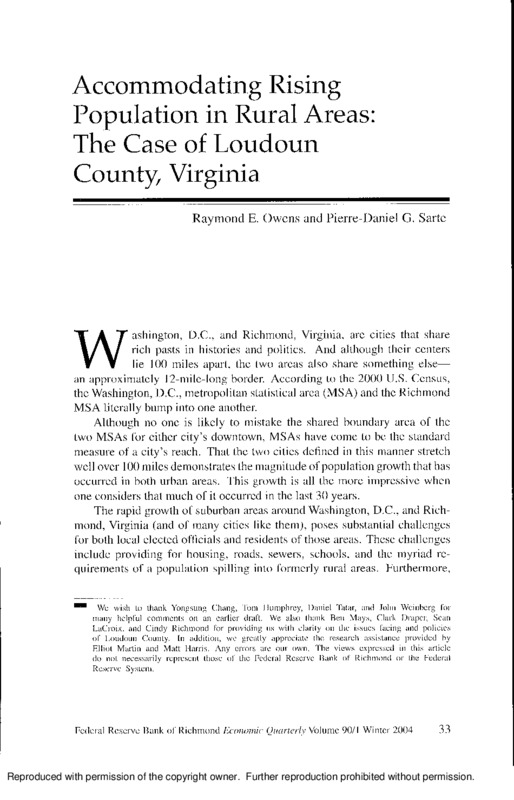
Accommodating Rising Population in Rural Areas: The Case of Loudoun County, Virginia
-
Repository
-
Economic Quarterly - Federal Reserve Bank of Richmond
-
Date Created
-
Winter 2004
-
Creator
-
Raymond E. Owens, and Pierre-Daniel G. Sarte
-
Description
-
Owens and Sarte's article explore the way in which Loudoun has sought to restrict suburban expansion and development. They point to the use of zoning as one way in which the county has restricted development, particularly in zoning two thirds of the county as rural zoning with much larger amounts of acre per dwelling. This tool is essential to the controlled modernity approach of Loudoun County.
-
Index/Partial Transcript
-
Abstract:
Rapidly expanding urban populations have pushed out cities' geographic reach in recent years, leading to rising population densities in previously rural areas. The influx of new residents into these areas have caught many localities unprepared to provide commensurate local infrastructure promptly, leading to congestion. Localities; ability to provide infrastructure is made difficult by infrastructure production often involving large fixed costs as well as legal or political restrictions on their ability to generate revenues through impact fees. As a result, a variety of local policies have emerged to address increases in population, but debate continues over the effects of these policies. An examination of the primary policies employed by Loudoun County, Virginia, suggests their impact on the welfare of the county's residents.
-
Research Themes
-
Loudoun County
Controlled Modernity
Zoning
Suburbanization
Suburban control
-
Type
-
Academic Article
-
Researcher Name
-
Jacob Connelly
-
Bibliographic Citation
-
Owens, Raymond E., and Pierre-Daniel G. Sarte. “Accommodating Rising Population in Rural Areas: The Case of Loudoun County, Virginia.” Economic Quarterly - Federal Reserve Bank of Richmond 90, no. 1 (Winter 2004): 33–50.