History of the Tinner Hill area ranging from its earliest days to the present. Provides clear insight and background into the community's experiences with retrocession, segregation, civil rights organizing, and Lee Highway.
The THHF website with links to their civil rights history, the historic preservation efforts, and the 100 Years of Black Falls Church archival website (https://research.centerformasonslegacies.com/s/bfc/page/about). An invaluable resource and accessible way to study the history of Tinner Hill, and the impacts of the early 20th century civil rights work of Tinner Hill's residents.
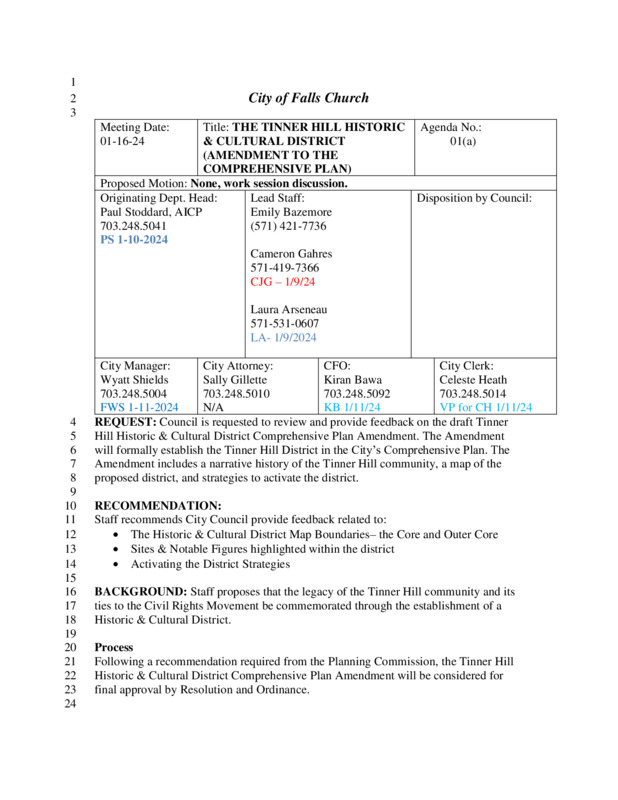
Amendment to the Falls Church City Comprehensive plan to establish the Tinner Hill area as a historic and cultural district. This historic district would be comprised of primarily the area that was designated as Segregation District 1 in the 1917 maps that marked the zones of the 1915 Town Council ordinance. This amendment to the Comprehensive Plan would be honorific, and according to this amendment would not impact zoning, permitting, or taxation. This would continue to honor the legacy of the early Tinner Hill civil rights workers, the remaining Tinner Hill community, and those in the past who worked to maintain Tinner Hill for generations. This proposed amendment was created in part with the Tinner Hill Heritage Foundation, and if passed opens opportunities to promote heritage tourism, implement historic projects, and explore archaeological significance. Hearings on the amendment will continue throughout Spring 2024 before a final vote in May 2024.
Book containing Black Laws passed in the state of Virginia that restricted and endangered Black lives, from the times of early enslavement to the publication of the first edition of the book in 1936. The photographed pages show the law, "Chapter 157", passed in 1912 by the Virginia State Assembly that allowed for localities to pass segregation ordinances. The Town Council of Falls Church was empowered by this law to pass a segregation ordinance, and in 1915 the acted to do so. They note on the 12/14/1914 Town Council meeting minutes that they have the power to pass a segregation ordinance because of this law passed two years prior. This law passed by the state assembly greatly constrained Black communities and Black residents of Virginia greatly until 1917 when segregation zoning was found as unconstitutional by the Supreme Court with Buchanan vs. Warley - though even after, segregation marks geographies to this day due to its enforcement early in the 20th century.
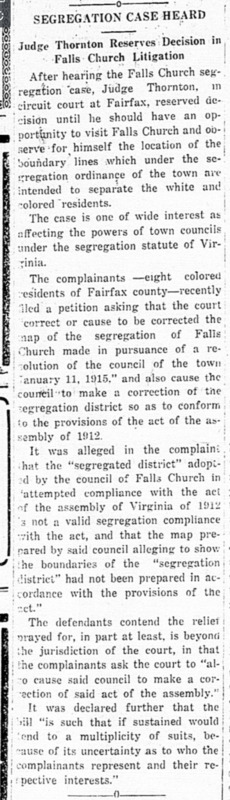
Article written in the Alexandria Gazette covering the process by the CCPL and Falls Church Black community to have the segregation ordinance rejected through the courts, after its passage by the Town Council of Falls Church in early 1915. The Judge decided to hold off on a final decision until they were able to observe the boundary lines which would have segregated white and Black residents of Falls Church. The eight Black plaintiffs who brought the case forward had claimed that the Town of Falls Church's segregation ordinance had "not been prepared in accordance" with the 1912 law passed by the Virginia assembly that allowed for local segregation ordinances. Later that year the Judge would rule in favor of the defendants that the ordinance was in accordance to laws and enforceable.
1969 interview with E.B. Henderson and his wife "Miss Nellie" Henderson. Topics include the creation of the James Lee Elementary school, the work of the NAACP in education in Falls Church and Fairfax County, and general work to improve Black education in Fairfax County by the Henderson's. The table of contents provides a detailed record of when and where the discussions takes place with page numbers.
1966 Radio interview on WMAL with E.B. Henderson, topics included Black education, E.B. Henderson's early work in Black sports programs and educational equality work in Virginia and in Washington D.C. The table of contents provides a detailed record of when and where the discussions takes place with page numbers.
Interview with E.B. Henderson from 1962, the interview covers a wide range of topics surrounding his experiences in Falls Church, the history of Black life in Falls Church, the work by the CCPL to organize and resist segregation, as well as discussions of the changes to Tinner Hill such as the placement of Lee Highway. The table of contents provides a detailed record of when and where the discussions takes place with page numbers.
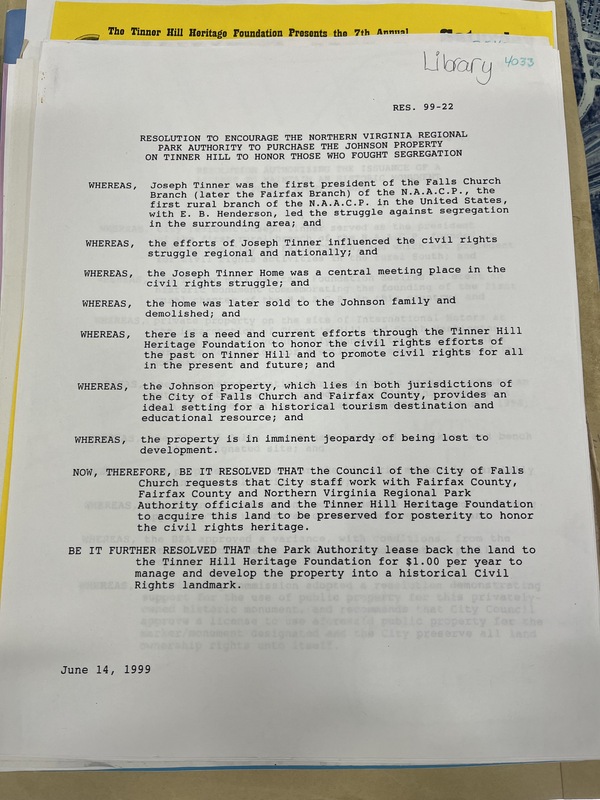
Resolution passed by the City Council for the purchase of land owned by the City of Falls Church and County of Fairfax. Utilizing the NOVA Regional Park Authority to maintain the land. The land would have had the former Tinner home rebuilt and used as a museum after 2000. Today the Tinner land holds the Tinner Hill Historic Park with the Zig Zag monument, and the sunken foundation of the original Joseph Tinner home.
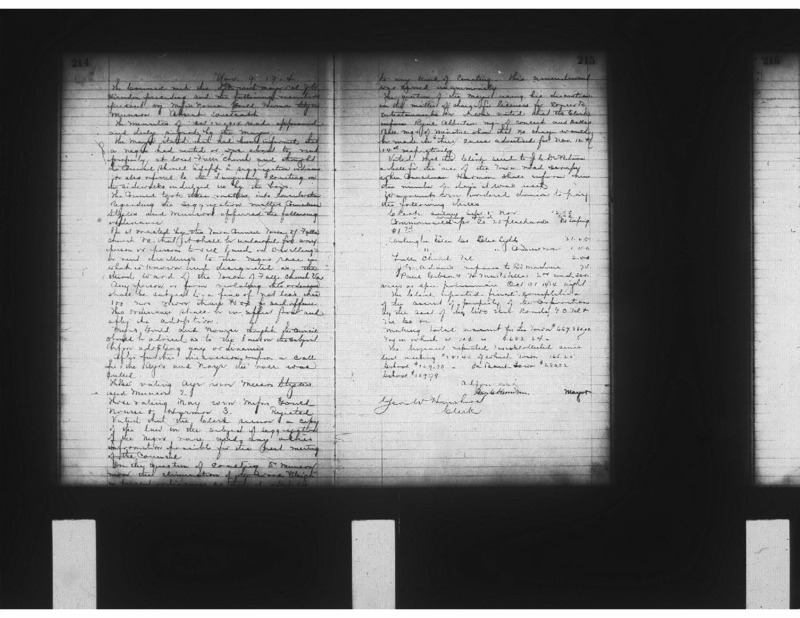
Assorted meeting minutes from the Town Council of Falls Church minutes book Vol. 1. Included minutes are all mentions of the Segregation Ordinance, the CCPL, and the fight to stop the passage of the ordinance from 1914 to 1916.
Meeting minutes for the first CCPL meeting. Here they elected rolls for each of the members present, including naming Joseph Tinner as the president and E.B. Henderson as Secretary. At the first meeting held on January 8th, 1915, the committee decided to write the letter read by E.B. Henderson at the January 11th, 1915. At the second meeting held on January 18th, the committee considered applying to become a branch of the NAACP - the first consideration of such an action by the CCPL. They also proposed a letter to send to town residents to ask for their disapproval of the segregation ordinance.
Speech for the deed signing ceremony for the purchase of the Joseph Tinner land lots 106-108 on Tinner Hill. Edwin Henderson II - grandson of E.B. Henderson - delivered this speech discussing the importance of maintaining this land, the memory of Tinner Hill, and commemorating the Tinner Hill Heritage Foundation and its future.
An undated brochure prepared by the Tinner Hill Heritage foundation sometime between 1999 and 2000. The brochure provides background into the community's civil rights history, the work of the CCPL/NAACP, and prominent community members as well as the formation of the Tinner Hill Heritage Foundation. The back flap outlines the future goals of the Heritage Foundation and the purchasing of the Joseph Tinner home to be used for a museum in Tinner Hill.
Speech delivered by E.B. Henderson II at the unveiling of the Tinner Hill monument arch using stones quarried from Tinner Hill, and local quarries. The first section of the speech discusses the legacy of Joseph Tinner's stonemasonry, and his historic arches. Important to note is the destruction of Tinner's greatest arch (in the words of Henderson II) by the creation of a Koons Ford dealership, highlighting the history of development and the way in which the myth of progress and the goals of expansion, development, and growth oriented mindsets destroy and diminish Black geographies and histories.
Proposal document made by the Tinner Hill Heritage Foundation that outlines their goals and fundraising plans in the coming years. The document has a short history on Tinner Hill providing insight into the history of the Tinner and Henderson family's. The final section of the document outlines the creation and evolution of the Tinner Hill Heritage Foundation and all of the work accomplished in a short span of time. The work of the THHF carries on the legacy of stewardship for Tinner Hill by the original Tinner's and Henderson's, and continues to protect and maintain the small community and foundation to this day.
Thirteenth anniversary celebration booklet for the CCA, a committee created by Tinner family descendants, and local Black Falls Church residents. Their work coincides with that of the CCPL and its later format as the Falls Church Branch of the NAACP while providing other avenues of organizing in the community. This research could not find the reason for its establishment, but presumes it was done so to establish a community organization separate from that of the NAACP. The booklet lists their achievements and goals - demonstrating their successes in the previous 13 years.
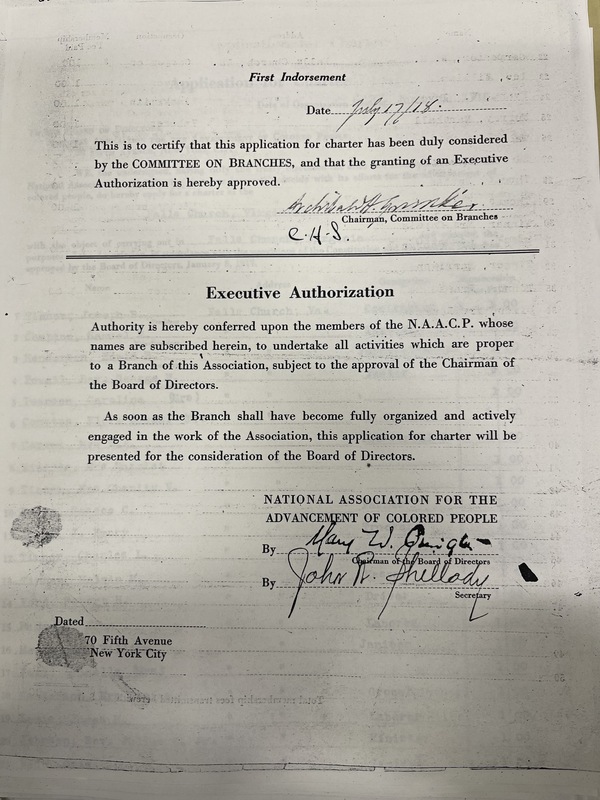
The Executive Authorization signed by the Chairman of the Committee on Branches, Chairman of the Board of Directors and the Secretary of the NAACP on July 17, 1918. This was sent along with a letter by Walter White on July 23, 1918. This document approved the Charter made by the CCPL in June 1918 and therefore established the Falls Church Branch of the NAACP. Their authorization and establishment is a testament to the work of the Black community in Tinner Hill and Falls Church in their efforts to maintain their space and place for generations.
Application submitted by the CCPL in June 1918 to the NAACP for the chartering of the Falls Church Branch of the NAACP. The document includes the list of all members who were attached to the first rural branch of the NAACP, listing their names, locations and occupations. The skilled work of these community members shows the vital and vibrant nature of Black communities in Falls Church and Fairfax County. It reiterates the importance of Black stonemasons like the Tinner family, as they were essential to building early structures in Falls Church. The work of the CCPL in the preceding 3 and a half years, and their ongoing existence in the NAACP also shows the transgressive nature of Black organizing in the face of displacement, slow violence, and racism.
Flier for the 1915 referendum vote regarding segregation within the Town of Falls Church. The Town held a Council meeting inviting all qualified voters to express approval or disapproval of the "segregation of the races within the town." The majority voted for the ordinance and the law was approved. The Town Council would meet one month later (June 28, 1915) and establish the system of two districts, one white and one Black - the latter comprising 32% of the town population confined to 5% of the land. While the law was eventually fought and denied constitutionality by court order and later Supreme Court order, it would stay in the town book of laws until at least the mid-1940s and was finally repealed in 1999.
This letter sent to a woman named Miss Ovington provides insight into the early work of the Falls Church Branch (at the point of sending the letter the Fairfax County Branch) of the NAACP. The letter notes the tribulations of the early years for the branch, squabbling over the name and the need to integrate other community groups led to the name change to the Fairfax County Branch. Yet, Mr. Henderson declares the work of the Branch is strong willed and vital to the County. He also notes their intentions moving forward, including developing a larger voting base and improving sidewalks and roads.
Letter from Walter White to E.B. Henderson, with the executive authorization of the Falls Church Branch. In the letter Mr. White gives suggestions on how to approach their first meeting as a branch of the NAACP, including two to three speakers, and a few short musical numbers, along with providing some literature for their new branch. White also notes that following the vote for creating this branch - comprised of 35 members - the NAACP changed the minimum membership requirement to 50 members going forward.
Letter sent from E.B. Henderson included with the Application for Chartering the Falls Church Branch in June, 1918. Mr. Henderson states that he believed they could quickly double the membership registration from the original 35 listed on the Application. In the letter Mr. Henderson stresses the importance of forming this branch as they declare that Falls Church's "problems are many and interesting and this step helps us to begin to solve some of them." The Falls Church Branch would be important, as Mr. Henderson believed, and would provide an outlet for greater support from a national organization to resist displacement, segregation, slow violence, and structural racism for decades - as the Fairfax Branch of the NAACP remains to this day.
A letter to E.B. Henderson from Assistant Secretary and historic NAACP figure Walter White. The letter outlines the importance of the CCPL and broader fight to dismantle segregation laws that would "herd colored people into ghettos." Mr. White declares his intention to send information to establish a Falls Church branch of the NAACP following Henderson's request in a previous letter, and elaborates on the process of application. This is important to both the history of Black organizing in Virginia and in the NAACP, as Falls Church's branch would be one of, if not the first rural branches of the NAACP.
The response by the NAACP to E.B. Henderson following their letter to W.E.B. Dubois. The unnamed secretary provides insight on who to talk to, and notes that currently a group in Richmond are working to oppose a local ordinance there as well. The author also lists a man who they could contact who may have background in the standing of the ordinance. This letter the running relationship between the NAACP and the CCPL for the next three years.
This letter from E.B. Henderson to W.E.B. Dubois is a call for aid from Henderson to seek assistance from the NAACP in regards to fighting the segregation ordinanced for Falls Church passed in early January 1915. Henderson asks for any records as to whether the law would stand in court or if others are fighting a similar law in other states.
One interesting thing to note is that Henderson states that white people in Falls Church were also "expressing themselves as out of accord with such legislation." This research could not find examples of this, requiring deeper inquiry.