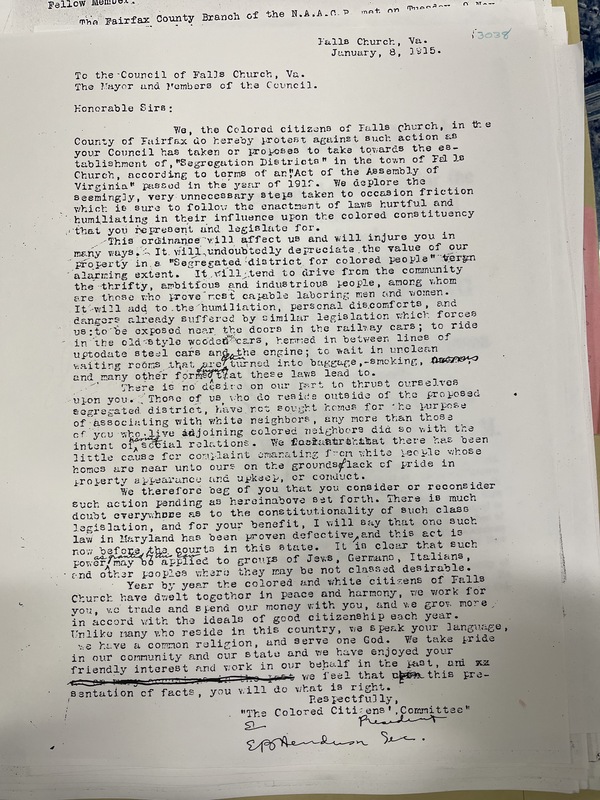
Letter written to the Falls Church Town Council on behalf of the Colored Citizens' Committee (later the CCPL) protesting the establishment of "Segregation Districts." This letter was both a brave and transgressive act and an outcome of the organizing by the Black Falls Church and Tinner Hill community in response to the segregation ordinance.
Read before the Town Council on January 8, the letter marks the Black community's protest against the action to create segregated districts in the town. The letter notes the harmful nature of the law, and states that laws enacted like this would be dangerous for others who may be seen as undesirable (such as Irish, Italians or Jews) in other locations, as well as the white citizens due to the outcomes of what the law would bring.
The letter ends with their plea that they are just as good of residents as those who are white, that they share the same god, and the same goals.
Letter from E.B. Henderson in early January, 1915. Henderson declares their protest against the potential adoption of the segregation, and a study on it in the Town Council in late 1914. Gould, the recipient, was a council member appointed to gather data for the potential ordinance. Henderson notes the dangers of such an ordinance to the Black community in Falls Church, and pleads their case citing reasons which segregation only hurts the Black community and the broader town itself.
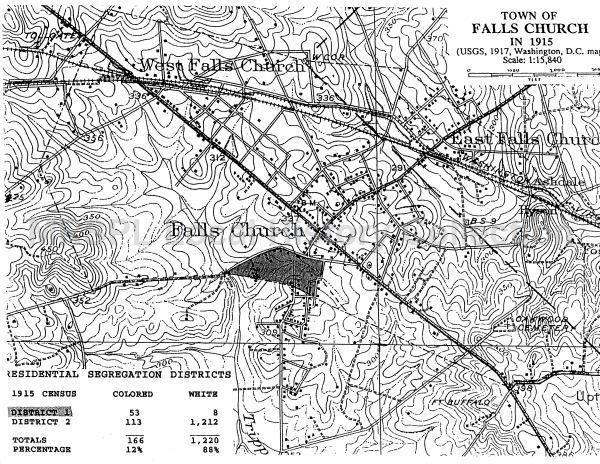
A 1917 USGS map of the town with residential segregation districts data added. District one highlighted in black is the local district within which all sales could be made on property by Black residents. This primarily comprised of the Tinner Hill community and its surrounding residents. If the law for segregation districts were upheld according to the law this very likely would have created a ghettoizing effect on this region of Falls Church. This map also demonstrates the population per district demonstrating that district one was primarily comprised of Black residents.
While the law was made unconstitutional by Buchanan v. Warley in 1917 it stayed on the book, and the segregation district was still "in effect" though nullified. This exemplifies displacement in place, and marked the region, as prior to this law the location was disproportionately Black land/homeowners while the rest were interspersed at much lower concentrations. This furthered their separation from white land/homeowners after the retrocession of 1887 by denoting their segregation plan on a map even if it was not legally enforceable.
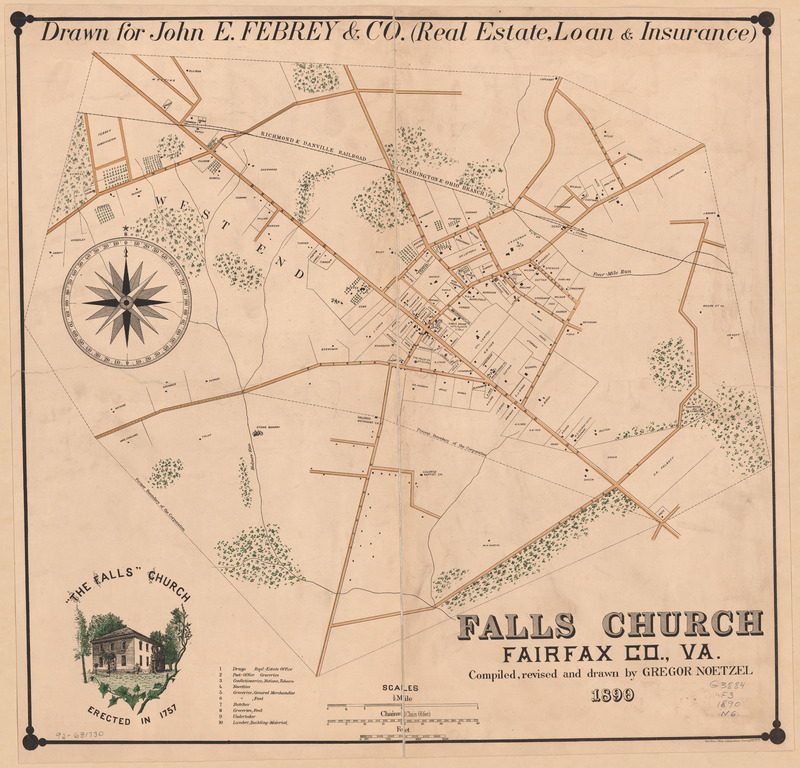
Map drawn by Gregor Noetzel in 1890 for the town of Falls Church. The map includes the retroceded territory in South Falls Church demarcated by a dashed line under the title "Present Boundary of the Corporation." This land that was retroceded in 1887, and voted to return to the County in 1890 contained a large contingent of Black homes, and dropped the voter rolls of the Black community in Falls Church by half. The line splits the land of Tinner Hill in half (the land is bordered by Lincoln St. to the East, Fairfax St. to the North, and the boundary line in its midpoint).
This act to cede land to the county was not slow violence in the way this research describes the concept. However, the action was a direct effort to gerrymander the community, and it removed Black members of the community. It established future actions of slow violence, and enabled displacement in place for these communities in the ceded lands and Tinner Hill as they lost their voice for power in Falls Church.
The 1916 Laws of the Town of Falls Church published in October to include the segregation ordinance passed in the beginning of 1915. While the Colored Citizens Protective League had fought to keep it from passing and staying on the law through court battles local courts upheld the validity of the law allowing the Town Council to keep it on the book. This law represented a clear challenge to the Black Falls Church and Tinner Hill community.
While the segregation of town zoning was later made illegal by the Supreme Court in Warley v. Buchanan, the law stayed on the books until at least the 1940s, though it was not in effect. Though it is an overtly violent law, it paved the way for slow violence in the decades following its nullification by remaining both on the book and acting as a continuation of the 1890 zoning out of Black landowners by Falls Church south of Tinner Hill and the district zoned for segregation in 1915.
Editorial on the eviction situation surrounding the housing hygiene ordinance. After nearly two years since its implementation, newspapers like the Northern Virginia Sun who were proponents of the ordinance, and staunch supporters of the need for eviction start to call for a change in the approach to administering the code. They note the historic inability for urban renewal projects to address the need for building homes that keep residents in their neighborhoods and not be removed/move to new slums.
Notice to advertise upcoming County Board of Supervisors for voting on the proposed housing hygiene ordinance set in motion at the start of 1960. The notice was posted following a Board meeting on May 3rd, 1961 which set the date for June 14th, 1961.
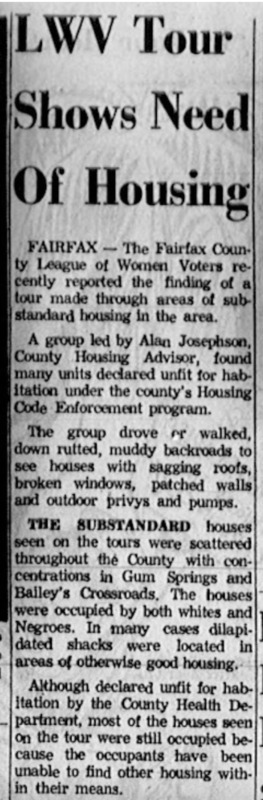
Article on the beginning of the housing hygiene ordinance process. Outlines the goals of the ordinance that would be passed in 1961, and the study that was put in place to recognize the extent and conditions of the problem of substandard housing.
The article lists the sites of interest including Gum Springs and its drainage problems being of key interest. Dr. Harold Kennedy makes the note that the bulk of substandard housing is actually white homeowners, contrary to the belief that the majority were Black homeowners. However this distorts the fact that the vast majority of white homeowners in Fairfax County were not owners of substandard housing while around 40% or more of Black homeowners were - displaying the disproportionate state of affairs and systemic experience of displacement in place for Black homeowners in Fairfax.
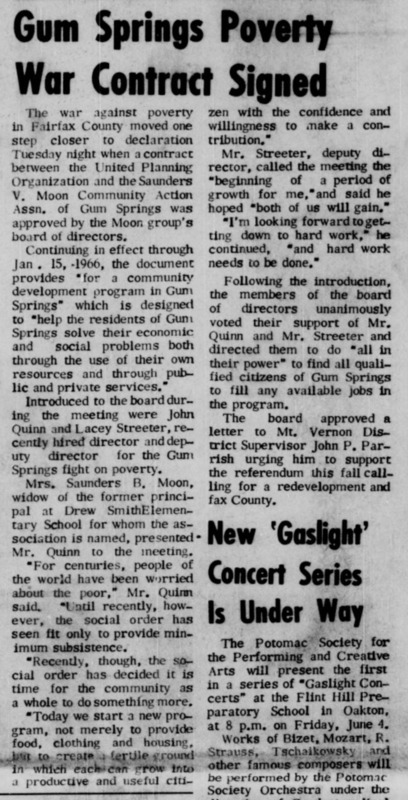
Article on the approval of the contract between the United Planning Organization and the SBMCAA by the Moon group's board of directors. The document provided for the work to improve the economic and social condition of the community (see text below), and find all qualified citizens of the community to fill available jobs in the program.
Article on the selection of the first heads of the Saunders B. Moon Community Action Association. The article provides the start date of the SBMCAA's work as June 1st, after their $70,000 grant by the Office of Economic Opportunity through the United Planning Organization.
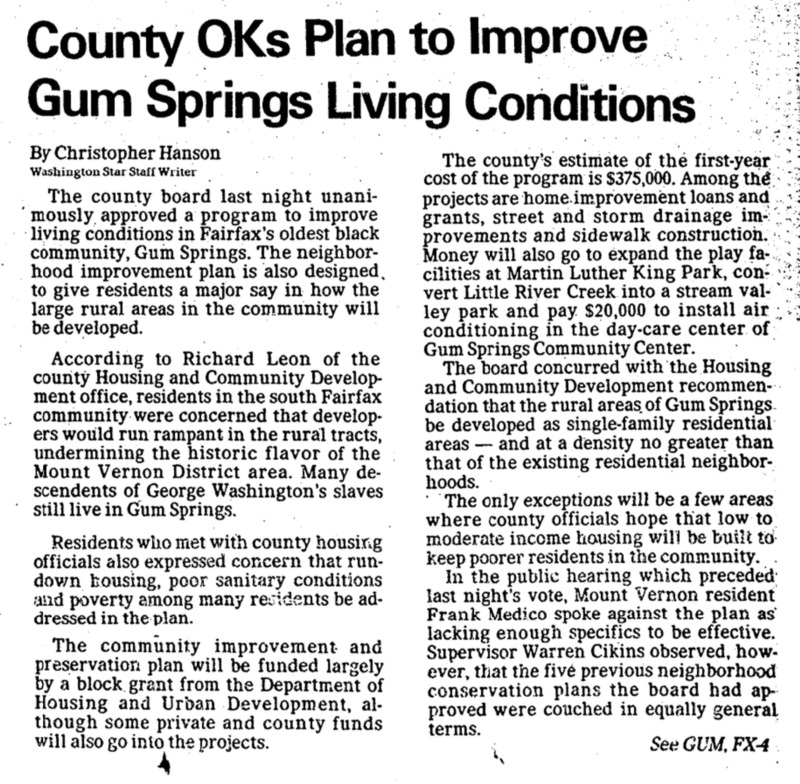
Article on the passage of the Improvement Program and Conservation Plan for Gum Springs. The article notes the specific stakes Gum Springs residents held in bringing this plan forward due to their fears of rampant development "undermining the historic flavor of the Mount Vernon District area." This conservation plan gave residents a major say in how the development of the community would be carried out over the next three decades.
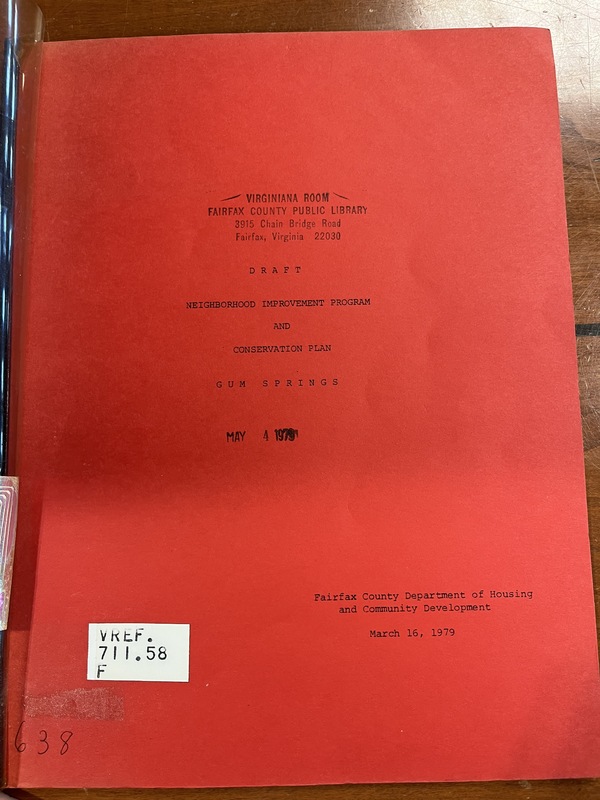
The Neighborhood Improvement Program and Conservation Plan created for Gum Springs in 1979. This plan allowed for the appropriation of funds towards Gum Springs in multiple areas to help update and improve the community in areas that had been continuous problems in the community through block grants, as well as creating a conservation plan that would help to improve and conserve the community. Adopted by the Board of Supervisors after insistence from the community itself and county stakeholders. This conservation plan gave residents a major say in how the development of the community would be carried out over the next three decades.
This book tells the history of Gum Springs from its creation by West Ford until the late 1980s at the time it was written. The book explores the challenges Gum Springs faced throughout the middle of the 20th century, and discusses the work by the community to always improve itself even in the face of these challenges.
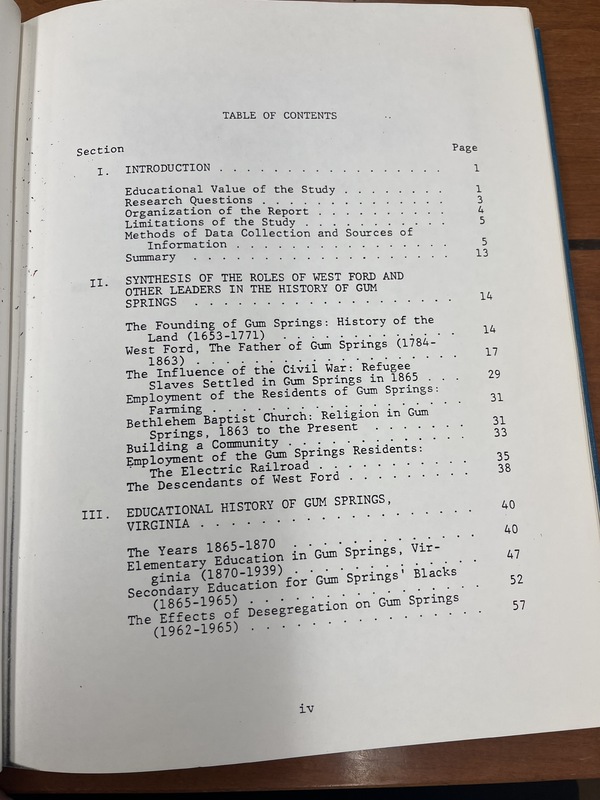
Dissertation prepared by Judith Saunders Burton on Gum Springs' Black leadership structures, its impacts, successes and the community's challenges throughout its existence. Their focus covers both the educational structures and community action groups that helped to fight for housing, drainage, and resist displacement throughout the 20th century. Their focus on Black leadership demonstrates the power of Gum Springs to resist displacement, and the power of Black geographies.
Registration form the Mount Vernon Enterprise Lodge, and the Pride of Fairfax County Lodges. The Lodge is also known as Odd Fellows Hall and is located in the heart of Gum Springs. The registration form provides the history of the Odd Fellows and Odd Fellows Hall's place in Gum Springs as a site of community action, organization and resistance for the growth and maintenance of Gum Springs.
Plan for Route 1's expansion to as wide as 13 lanes that follows along Gum Springs southwest border, and stops at Sherwood Hall Lane which intersects into Gum Springs. Gum Springs' multiple Civic Associations and many Gum Springs residents have been opposed to the continual expansions throughout the previous three decades. This most recent expansion plan was put in place with no discussions occurring between Gum Springs residents and the County/VDOT, and will potentially remove multiple homes in Gum Springs.
Further coverage on Gum Springs' interactions with continued expansions to Route 1 that encroach on their community, and risks destroying Black homes in the community. The proposed expansion to Route 1 would take the road all the way to 13 lanes for a stretch ending at the intersection of Route 1 and Sherwood Hall Lane (running through Gum Springs).
Article on Gum Springs, their then upcoming Juneteenth celebration, the communities thoughts on the recent Holland Court development, and coming expansions to Route 1.
Coverage on the expansion of the Inova Mount Vernon Hospital to the south of Gum Springs that required the expansion of Route 1. Queenie Cox, the New Gum Springs Civic Association, and residents of Gum Springs' concerns about the expansion of Route 1 were left out of the discussion. Expansion of Route 1 has continued to be a problem that the NGSCA, and Gum Springs community have been against. There remains a lack of re-installments to the Gum Springs conservation plan, ending in 2004, that had protected their community from expansion/construction without their input
Coverage on the continuing loss of funds for community programs. The author points out that in the coming year the Saunders B. Moon Community Action Association would lose close to $75,000 - nearly 30% of their funds, while the Housing Development Corporation side of SBM had already lost 50% of their funding. Continual conservative shifts to cut federal funding greatly reenforced the problems of slow violence by seeking to cut funding to public works and public projects particularly for communities like Gum Springs that had used these to greatly build up their community.
Article on the impacts of the Nixon administrations freeze on low-income housing programs, and the Office of Economic Opportunity that had assisted Gum Springs during the late 1960s and the early 1970s. These Community Action Programs had been utilized by Gum Springs for funding to build up their community.
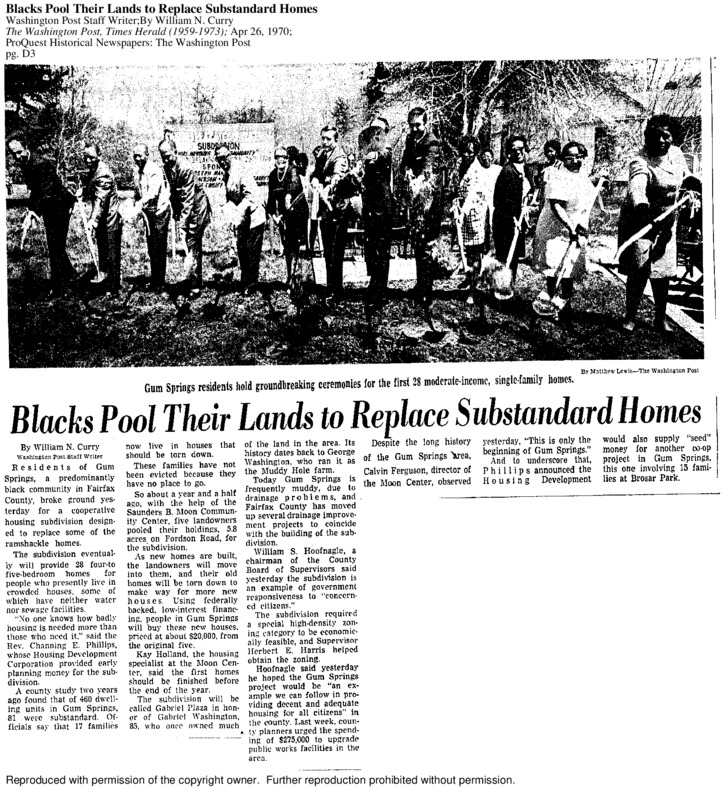
Report on the breaking of ground on a cooperative housing subdivision in Gum Springs. Five landowners, with the help of the Saunders B. Moon association, pooled their land holdings to create a subdivision that would contain 28 four-to-five-bedroom homes for those currently living in Gum Springs including those still living in shacks, or without water or sewage facilities. This action of pooling land resources and breaking it into a subdivision was used in the late 19th century by recently freed Black residents of Gum Springs that moved to the burgeoning community after the Civil War.
A reprisal of this tactic of claiming space and place nearly 100 years later in Gum Springs shows the versatility of means and measures to maintain and build their community even in the face of ongoing crises that had not been addressed in the continual lack of housing, drainage, and sewerage.