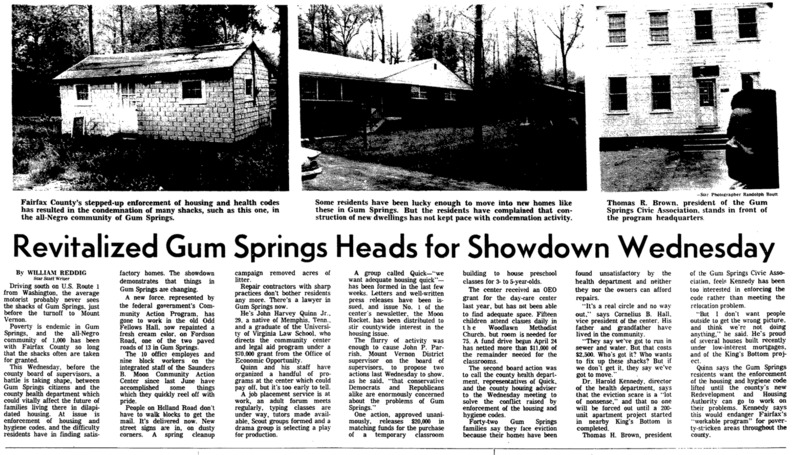
Article on the approval of a United Planning Organization (a Washington D.C. based poverty program) grant for Gum Springs. Later approved for $67,000 through the LBJ administration's Office of Economic Opportunity the UPO and this grant was part of the broader Community Action Program that created the Saunders B. Moon organization. These grants headed off by the community itself demonstrate the power of community organization against displacement in place through self-reliance and resistance.
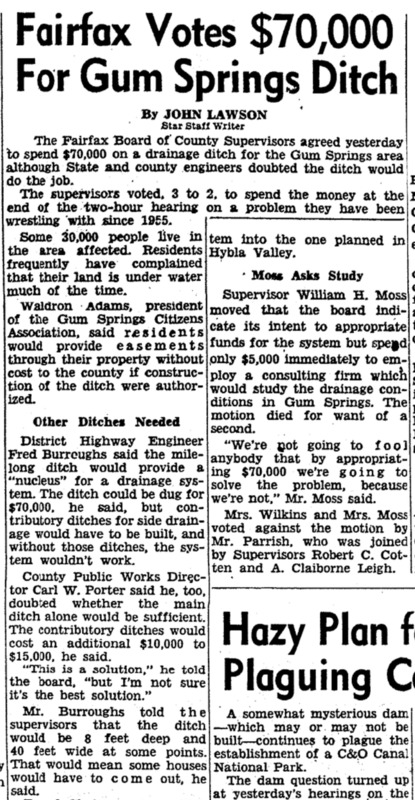
Coverage of the Board of Supervisors vote to create a drainage ditch for the Gum Springs area. While this drainage ditch was much needed for the area, it did little in the long term to create change for the flooding problems.
As pointed out in the article State and County engineers "doubted the ditch would do the job." Lack of effective aid against Gum Springs' problems presents one of the clearest forms of slow violence, by way of failing to fund or plan the correct aid necessary in a Black geography the Board of Supervisors were complicit in the housing problems and eviction crises that followed.
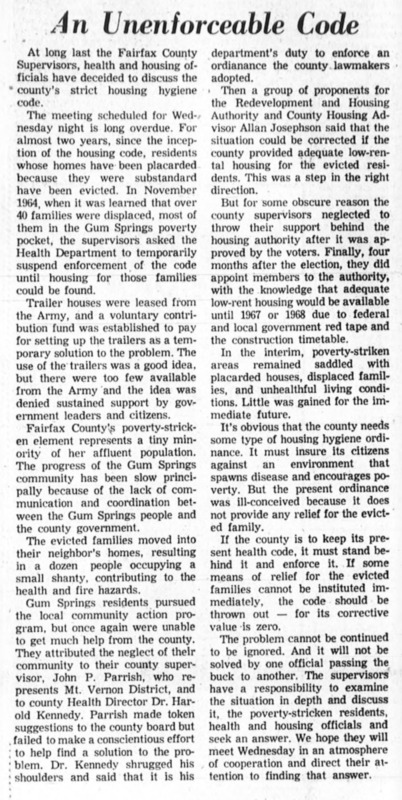
Report from the Northern Virginia Sun on their view of housing hygiene law and its problems regarding evictions which would be discussed at the Board of Supervisors meeting which would take place later that week. In the 6 years of discussing the ordinance their view has changed from ardent support to clear criticisms of its ability to change the problems of substandard homes and improving living conditions for low-income homes in Fairfax.
Follow up article to Reddig's article on 5/16/1966. The Board of Supervisors acted to implement automatic appeals for all eviction cases. This change meant that all potential evictions would be sent to the housing and hygiene appeals board, where previously only cases of extreme hardship wold be sent to the appeals board. While Gum Springs community members and leaders sought for a moratorium or a scrapping of the ordinance all together, their fight for change provided relief in the form of automatic appeals.
Article on the Board of Supervisors meeting that would take place later in the week of publication. The Board would hear the recently empowered Saunbers B. Moon Community Action Association (by the LBJ administration's Community Action Plan) and Gum Springs residents' case for halting the eviction clause of the housing hygiene code and resisting displacement.
Letter to the editor in response to a previous letter on 10/9/1965 by the League of Women Voters of Fairfax who had been champions for low-income housing, and had worked to push for federally funded public housing aid in Gum Springs in the early 1960s. Mrs. Gilreath's letter in disagreement with the LWV's call for public housing shows the lack of recognition of the struggles facing poor Black geographies in Northern Virginia - in this case Gum Springs - and points to the framework of the myth of progress.
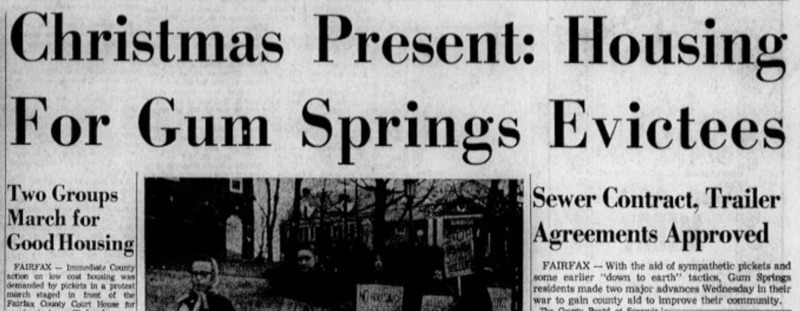
Report on protests outside the Fairfax Courthouse for action in the fight for low-income housing by Fairfax citizens (including Gum Springs residents), the Congress of Racial Equality (CORE) and the Liberal Education Action Project (LE/AP) from George Washington University. The protestors sought to push the Board of Supervisors to heed their call on the need for low-income housing, particularly for those in places like Gum Springs who were facing large amounts of evictions but had nowhere to go.
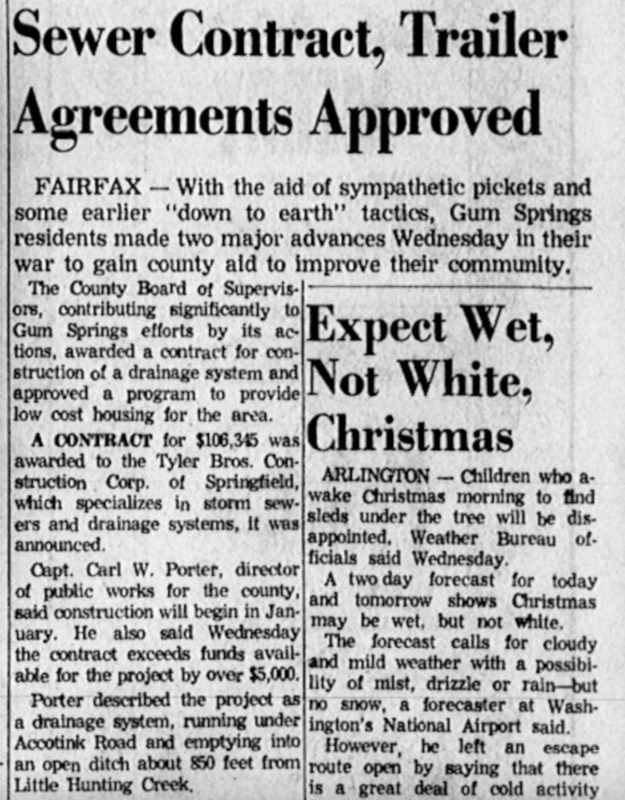
The article follows the successful fight by Gum Springs residents to gain a construction contract for both drainage and low cost trailer housing. The two contracts would provide some much needed relief to Gum Springs residents after facing hardship in the face of the housing hygiene laws eviction clause, and the county's failure to provide proper drainage systems for decades.
This article demonstrates the strength of the communities voice in the fight against displacement in place by protesting and making their voices heard in local government.
A multi-story front page report on protests outside the Fairfax Courthouse for action in the fight for low-income housing by Fairfax citizens (including Gum Springs residents), the Congress of Racial Equality (CORE) and the Liberal Education Action Project (LE/AP) from George Washington University. The second report follows the successful fight by Gum Springs residents to gain a construction contract for both drainage and low cost trailer housing. This shows the strength of the communities voice in the fight against displacement in place by protests and making their voices heard in local government.
Article on the passage of the minimum housing standards (housing hygiene) ordinance. They note the important tag on the eviction clause that evictions would not be enforced for residents "if it would work a hardship on them." This clause was key to Gum Springs residents who faced serious trouble in the years following the passage of the housing hygiene ordinance. Finding affordable housing was one of the greatest challenges for Black residents of Fairfax, and those facing eviction from the ordinance. Often the inability to find replacement housing kept them in Gum Springs and they could resist displacement by eviction.
Editorial following the passage of the housing hygiene ordinance on June 14, 1961. The editorial notes the inclusion of eviction powers in the ordinance as a measure combating substandard housing, and enforcement of the ordinance. They note the inclusion of financing, and assistance in the case of tear downs/rebuilding or drastic repairs.
Editorial on the need for a housing hygiene ordinance as a way to "curb slum breeding," and take action against slumlords and blighted property. By marking sites of Black geographies as slums that are breeding grounds for problems that need to be attacked, they are viewed as dirty, violent and hostile and in this articles case - "lacking human decency." They are framed as in the way of the greater goals of progress in Fairfax, playing into narratives that form the myth of progress.
Editorial on the need for a "anti-slum weapon" in the form of the proposed housing hygiene standards. Morrison and the Northern Virginia Sun's choice of words in these articles such as lacking weapon, breeding slums demonstrate attacks on Black claims to space. By marking sites of Black geographies as slums needing to be attacked, they are viewed as dirty, violent and hostile to the greater goals of progress in Fairfax.
Article on a dilapidated home in Fairfax with 26 people living in it. Article discusses the fervor by some in the county to implement a housing hygiene law as a way to curb slums, tackle poverty, and remove pockets of dilapidated housing in an otherwise affluent county.
Report on the Fairfax County Board of Supervisors hearing of the proposed housing hygiene law. Began the hearing process for implementation of the law. The framing of these sections as slums and as breeding grounds for disease and crime frames these geographies in a way that diminishes their claims to space and place - aiding in displacement in place, and creating a narrative of progress where the land must be improved no matter the cost (such as eviction, displacement).
County ordinance Chapter 15B. The Minimum Housing Hygiene and Standards Code was passed by the Fairfax County Board of Supervisors on Wednesday, June 14, 1961, and took effect Friday, September 1, 1961.
This Hygiene Code was implemented throughout the county and established standards for basic facilities for light, water, heating, and "safe and sanitary maintenance of dwellings". To keep track of this the county created a Board of Housing Hygiene and a court of appeals to the board for homes/owners found in violation of these codes. The housing hygiene codes significantly impacted the small number of citizens in the county who made up those areas marked as blighted, slums, impoverished, and below the standards of the growing and developing county. Thus, primarily impacting small communities, or Black enclaves such as Gum Springs who had long been left without funding for sewers, housing, and roads.
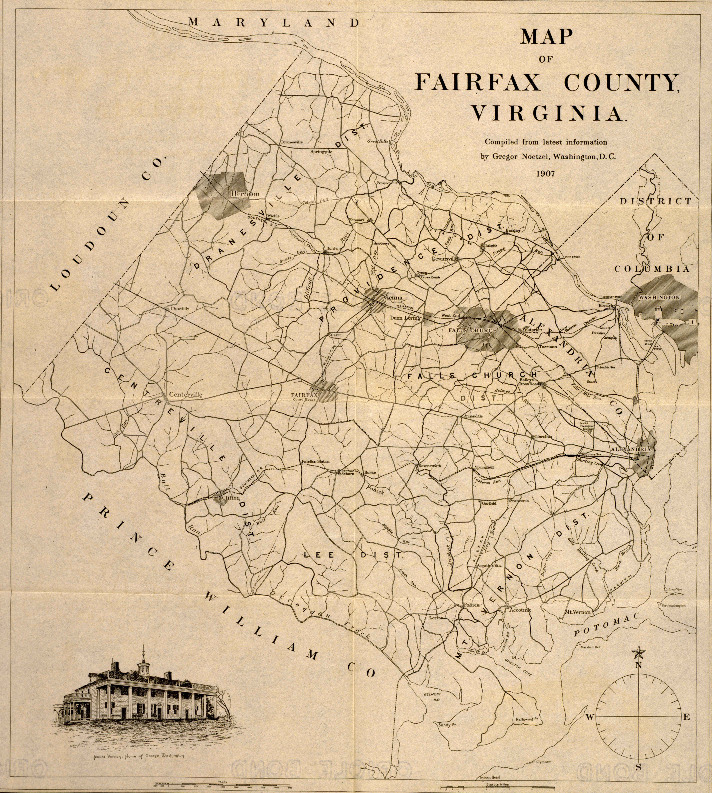
Demonstrates sites marked by the county as fitting their terms of "residential blight" in the shaded regions including a significant number of lots in the southwest corner of Gum Springs.
Neighborhood analysis study for the Department of Housing and Urban Development. Enacted as part of a broader county need to qualify for and re-certify certain public housing grants, the focus of this set of these Neighborhood Analyses was to target the nature, cause, and extent of blight and poverty in Fairfax County. This neighborhood analysis is for the Gum Springs community - which held the highest concentration of blight in the county, in a small district.
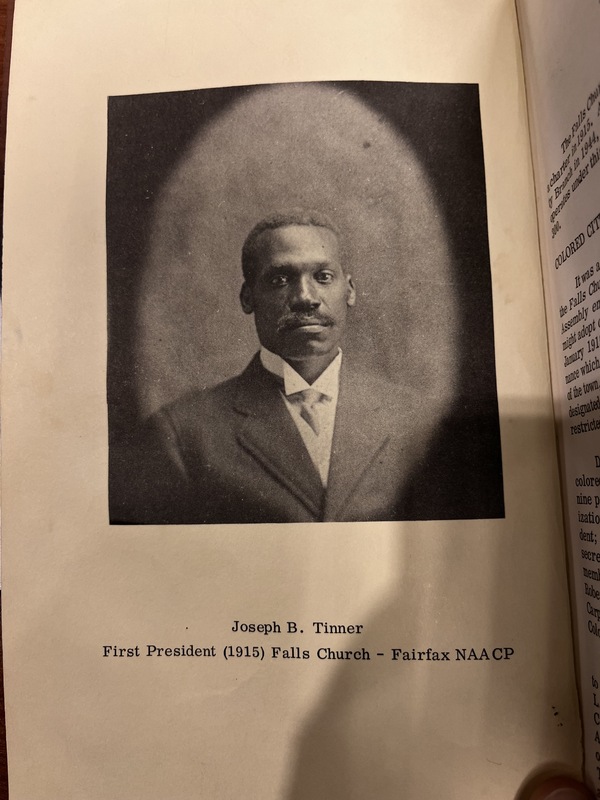
History of the creation and work of the Fairfax Branch of the NAACP starting with Falls Church organizing in Tinner Hill as the CCPL up to the 1960s as told by E. B. Henderson - former Secretary of the CCPL and later NAACP Branch.
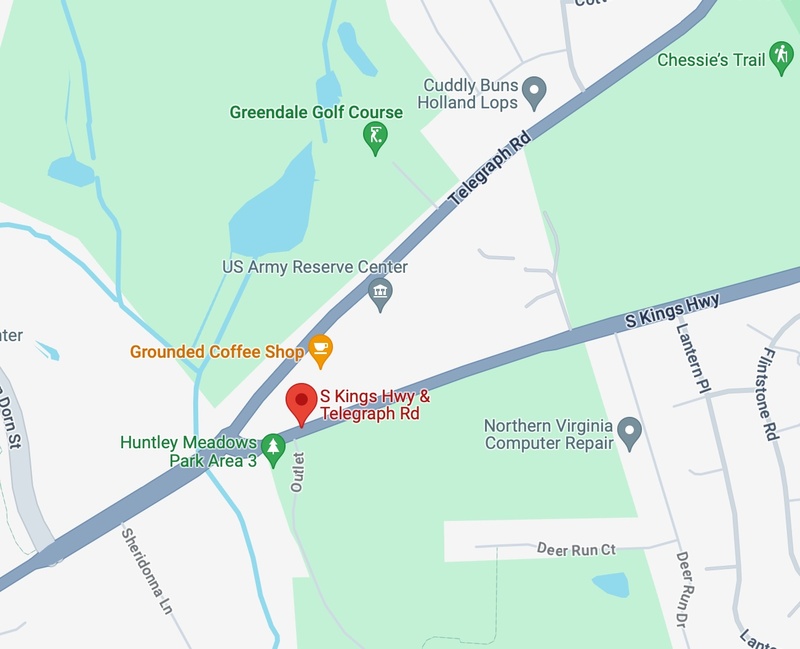
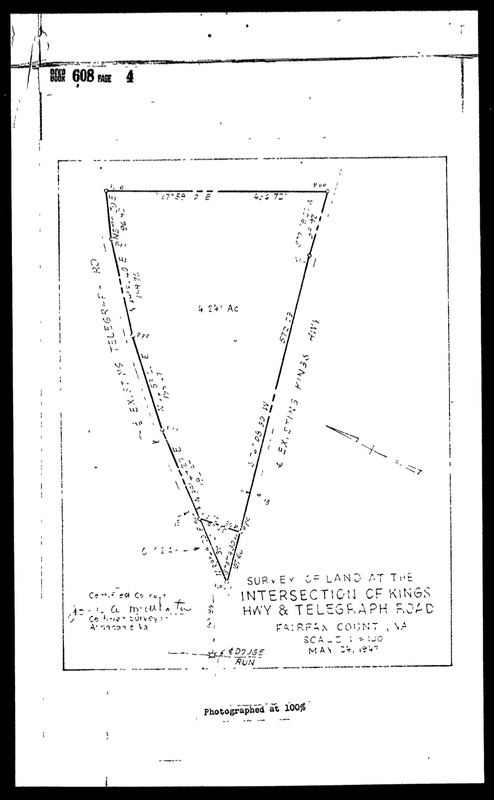
This Google Maps image is the exact location where the Louisa Ferguson property was located. This information was found via the 1948 Ferguson - Davis land deed, which features a diagram of the property and the intersection at which it was located (Telegraph Road and South Kings Highway). The land is now home to a US Army Reserve Center and coffee shop, among other things.
This is a page from the 1900 US Census (incl. William H. Carter denoted as Wm H Carter") with details pertaining to his person, birthplace, his occupation, and his current household members. Of note, not included is "Mary Carter".
This is a page from the 1870 US Federal Census (incl. "William H Carter") with details pertaining to his birthplace, home residence, parents, and if he attended school.
This page, showing a diagram of Louisa Ferguson's Telegraph Road property, is from the 1948 Ferguson - Davis land deed document. It shows measurements of the land and acreage.