
Frozen in Time
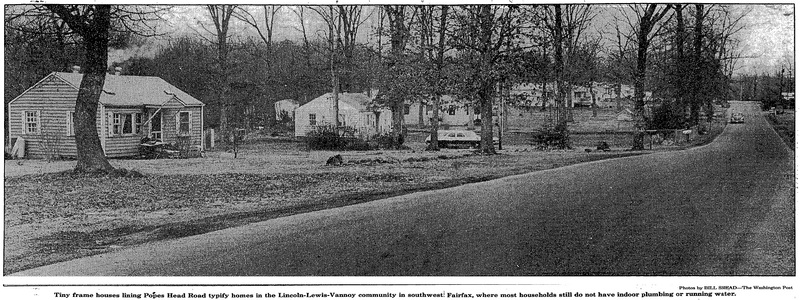
Small homes line a street in the Lincoln-Lewis-Vannoy enclave in Fairfax County, 1982.
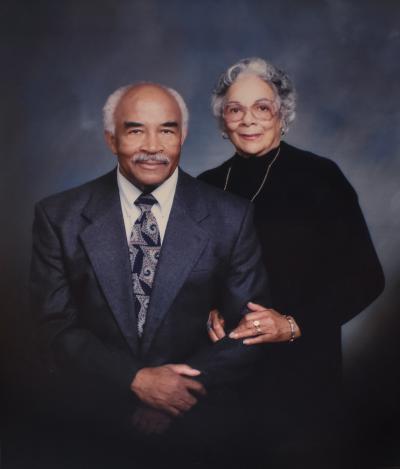
In 1963, Marguerite and James Mott bought a ranch-style house in LLV, looking for more greenspace than their home in Arlington. Marguerite Mott was a long-time administrator for the federal government and her husband James was a lawyer for the US Navy.[9] They looked forward to living in a more rural and quiet neighborhood.
When they bought their home, the neighborhood looked largely frozen in time, a time without running water and indoor plumbing. Marguerite Mott remembered: “when we first came, I guess we were really green. We found it hard to believe the conditions here.”[10]
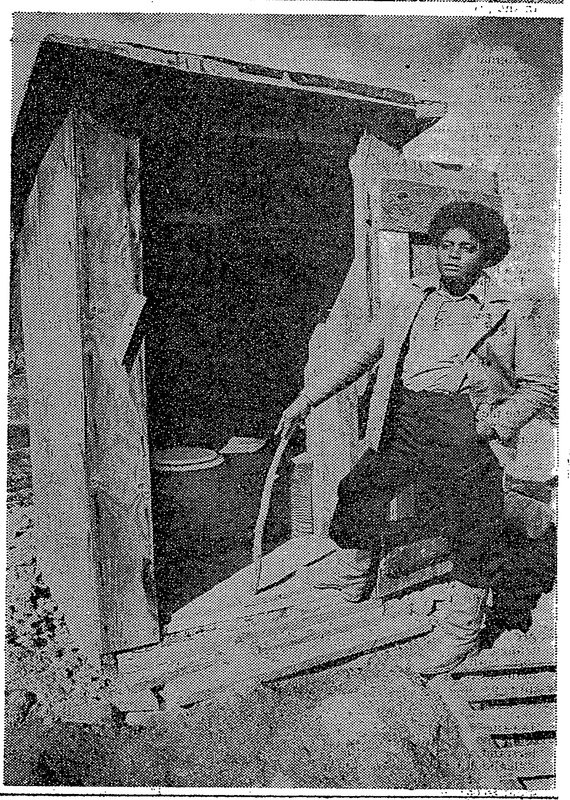
The neighborhood was more dire than just not having indoor plumbing. Without such systems, residents created "solutions" which led to major issues related to waste disposal. The Mott’s nephew Keith spent many summers visiting his aunt and uncle. He remembered that when it got hot outside, that "the pond used to smell" and bubble; he only learned later that "the bubbling was when somebody used the restroom." The pond, it turned out, was receiving the raw sewage from the nearby outhouses.[11]
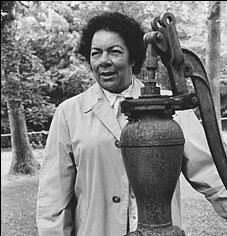
Fairfax County was well aware of the issues LLV residents faced, yet no movement had been made in finding a solution. Frustrated by the county’s inaction on the neighborhood’s sewage problem, the Motts joined the Lewis, Lincoln Park Citizens Association, attended Fairfax board meetings, and advocated for their community.
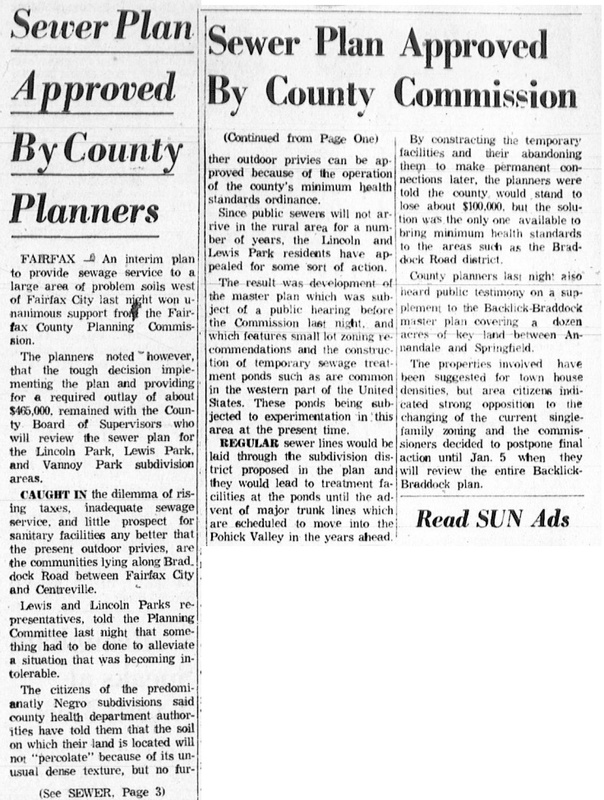
1966 WaPo Article "Sewer Plan Approved by County Planners"
On December 5, 1966, an interim plan to provide sewage service to the residents of LLV received “unanimous support” by the Fairfax County Planning Commission, and was sent to the Board of Supervisors for their approval.[12] The key issue which complicated these plans was the fact that the neighborhood’s soil was apparently unusually dense, which made sewer installation a complicated and more expensive endeavor.[13] Although, one wonders how different the soil composition in this area was to nearby neighborhoods who had existing sewer lines.
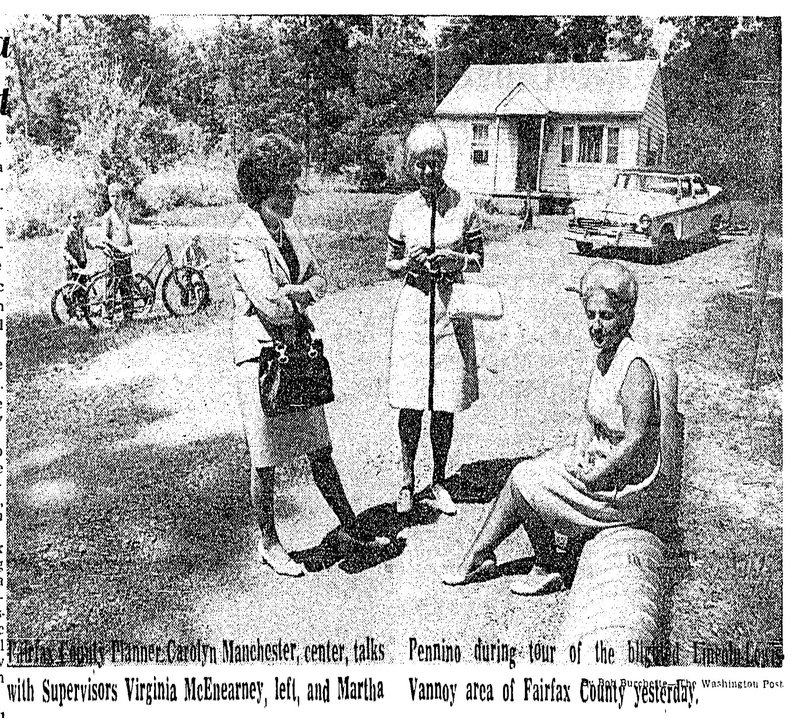
Fairfax City officials visit home in LLV home in 1971
Every few years, local news covered the progress, or lack thereof, of the sewer project. Representatives from the County visited the neighborhood to assess the situation, and agreed that something needed to be done about the neighborhood's infrastructure needs. Five years later, in 1971, the BOS finally “moved to seek federal assistance to bring water and sewer lines to the “blighted” homes in LLV.[14] Board Supervisor Martha Pennino was quoted as saying, “I’m hopeful that the area will have sewage lines in 12 months.”[15]
Despite Supervisor Pennino's hopes, one year passed, on there was still no sewer in LLV. And the situation was now even more dire: a new county ordinance meant that homes with malfunctioning septic fields or homes which were unable to hook up to sewer lines would be condemned.[16] LLV residents would now be punished for the county’s inaction, facing condemnation for a problem they had no power to solve.
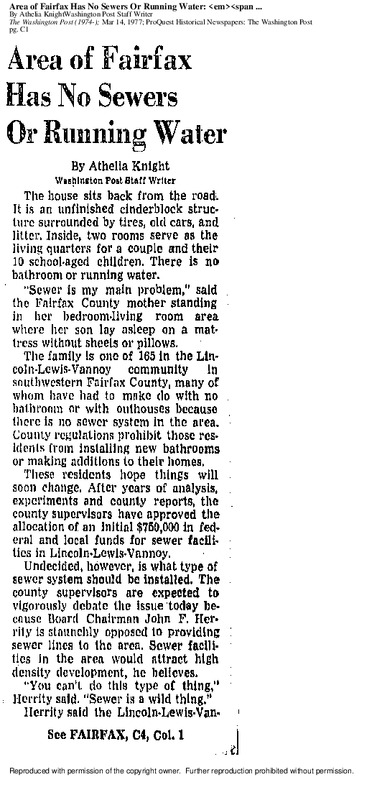
1977 WaPo Article: "Area of Fairfax Has No Sewers or Running Water
Yet another five years passed. In 1977, the Washington Post reported that permanent sewers were finally approved by Fairfax County for the LLV neighborhood and its surroundings, funded by a $1.6 million dollar grant matched with county funds. The system was projected to be operational in 1979…yet, by 1980, only $200k had been spent, primarily on preliminary engineering studies.[17] Then there were the additional delays, this time from the health department, because the proposed sewage system had never been used in the state. Could this issue have been addressed when the County studies were conducted?
Another two years passed, and seemingly no progress was made. Residents were increasingly frustrated, with hope for a fix seeming just beyond reach, time after time.
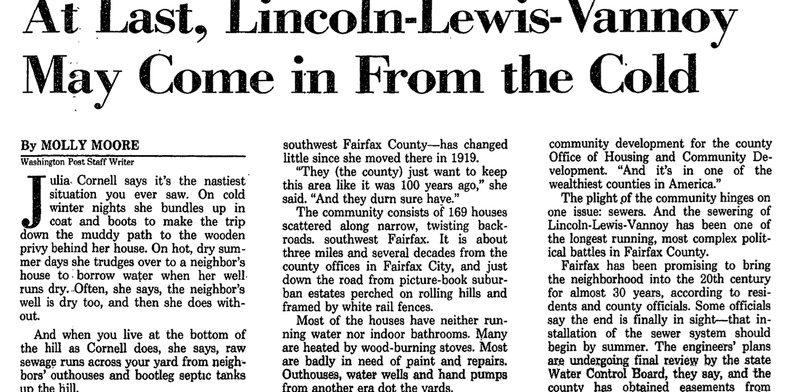
1982 WaPo Article: "At Last, LLV Can Come in from the Cold"
In 1982, the Post reported, “At Last, Lincoln-Lewis-Vannoy May Come in from the Cold,” as the sewer was set to be operational this year.[18] Yet, roughly six months later, county officials announced that the Little Rocky Run Trunk Sewer, which would service the neighborhood, would not be finished until 1984.[19] Finally, on May 13, 1985, supervisors were told that “sanitary sewer service was operational in the Lincoln-Lewis-Vannoy area of Springfield District.”[20]
1985. Almost two decades had passed with the sewer system plans caught up in bureaucratic channels and long-term studies. How could it take almost 20 years for a small neighborhood to get on the grid?
One answer to the question came from a FFX county supervisor Marie Travesky who noted the lack of urgency on the county’s part, as she believed the county wouldn’t wait this long for “very many other projects.”[21] But twenty years? Which neighborhoods did get the County’s attention?
___
[9-10]Susan Feeney, “A Community Crusader,” The Free Lance-Star (Fredericksburg, VA), July 2, 1983.
[11] Keith Mott, “Oral History,” interview by Jayme Kurland, October 26, 2023, video recording on TheirStory.io.
[12-13]“Sewer Plan Approved by County Planners,” Northern Virginia Sun, December 6, 1966.
[14-15]Fairfax County Board of Supervisors, Minute Book Number 68, 1972-01-05 through 1972-04-03, February 7, 1972, 207.
[16] Fairfax County Board of Supervisors, Minute Book Number 68, 1972-01-05 through 1972-04-03, February 7, 1972, 207.
[17-18]Bob Levey, “Tattered Blueprints, Shattered Hopes,” Washington Post, April 24, 1980.
[19-20]Fairfax County Board of Supervisors, Minute Book Series 2, 1981-02-02--1990-08-06, February 7, 1972, 34.
[21]Bob Levey, “Tattered Blueprints, Shattered Hopes,” Washington Post, April 24, 1980.