
Federal Government Involvement
In this next portion, Black lives around the Mount Vernon District- around Matilda Tolison’s land is explored. At the time of Tolison’s land ownership, the community and neighborhoods nearby were driven in large by government and authoritative involvement. Tolison, however, as a Black woman, was unable to vote. A little prior to her newfound ownership of this Mount Vernon district land, there was a spark of excitement concerning the new rights of Black owners. However, there was still an abundance of anger and resentment regarding this decision considering the former Confederates were feverishly against Blacks voting and the idea of being equal to them [1].
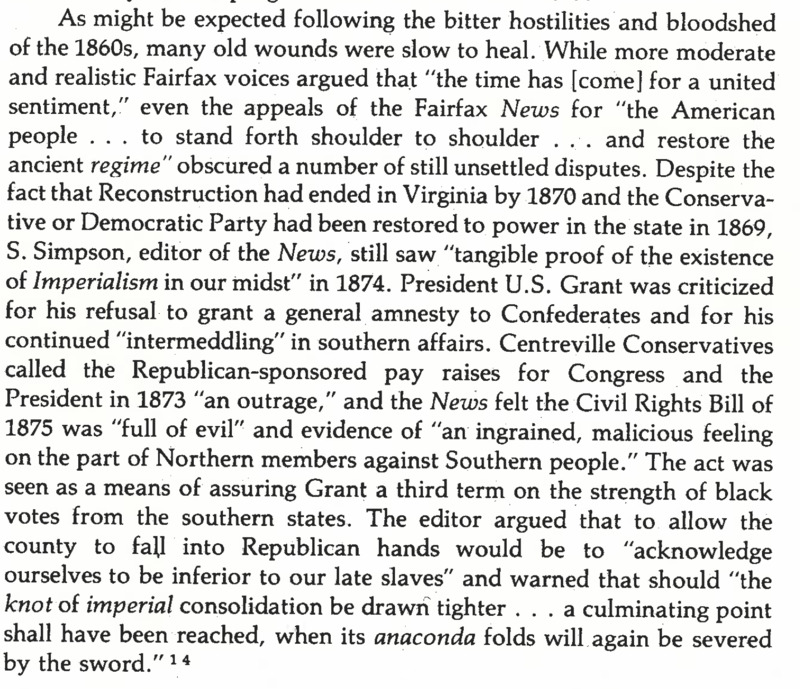
Republicans versus Conservatives in the late 1800s
This explains the struggle between President Grant and the Republicans versus the Conservatives. With Grant refusing a general amnesty to Confederates and standing up for slaves, people- mainly rich whites- were outraged. As shown, the people still saw slaves as lesser and were enraged at the idea of “acknowledging themselves to be inferior to slaves”.
Nonetheless, African Americans in the area were not discouraged as they continued to exercise their newfound right to vote in any election in the future. Their abundance and perseverance were especially recognized in the late 1800s when they served as the main contributors to the voting polls, even outranking the Conservatives at a time when Conservatives were the majority. This could also be attributed to the White apathy displayed, especially in the 1888 Fairfax County Elections [1]. It is notable to add that neither white or Black women could vote during this time period.
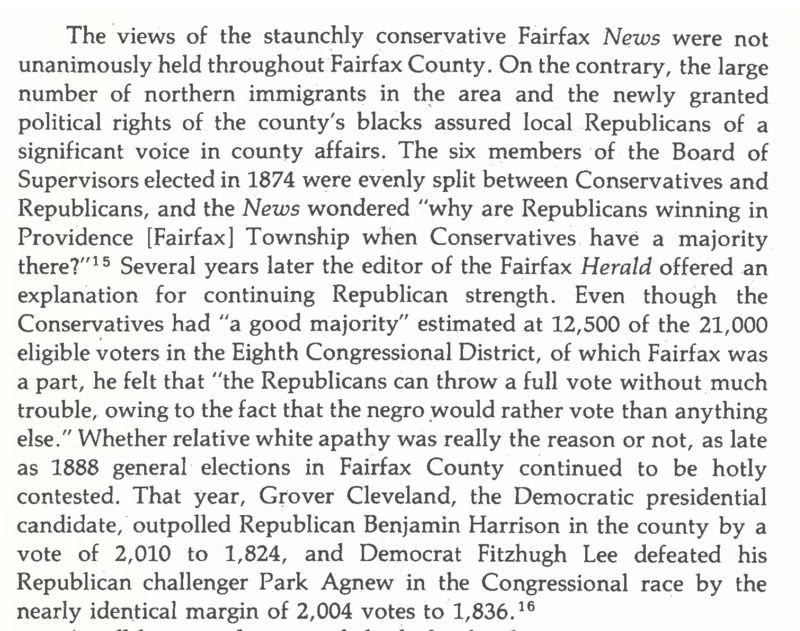
Voting in Fairfax County Elections
This is showing voting details and numbers in the late 1800s. As seen, northern immigrants and blacks had a majority vote. The black voters were main contributors to voting polls- basking in their newfound right, opting to vote for anything than anything else. White apathy was also a present problem especially in the 1888 elections in Fairfax County.
It seems the Black communities in Fairfax County were encouraged by their voting rights and new support, as was seen with President Ulysses S. Grant standing up for the slaves and refusing a general amnesty to the Confederates, composed of white individuals. Concerning the white group’s anger, resentment, and hostility, it seems they gave up and were apathetic of the future results, while the Black communities were simultaneously ignited by their new, influential voices. Indeed, this is further evidential when analyzing the pre-Civil War debt in 1870 [1]. The newly enfranchised Black communities and less conservative middle-class White individuals vouched on one side- to prioritize their livelihoods, public schools, and enriching their communities, while the richer and more powerful individuals- mainly composed of rich White individuals, vouched on the other side- that the debt should be paid in its completion and the development of schools is not necessary in the communities in need. Public schools ended up being developed and extended to the communities in the 1880s and 1890s, thus their voices, evidentially, were heard [1].
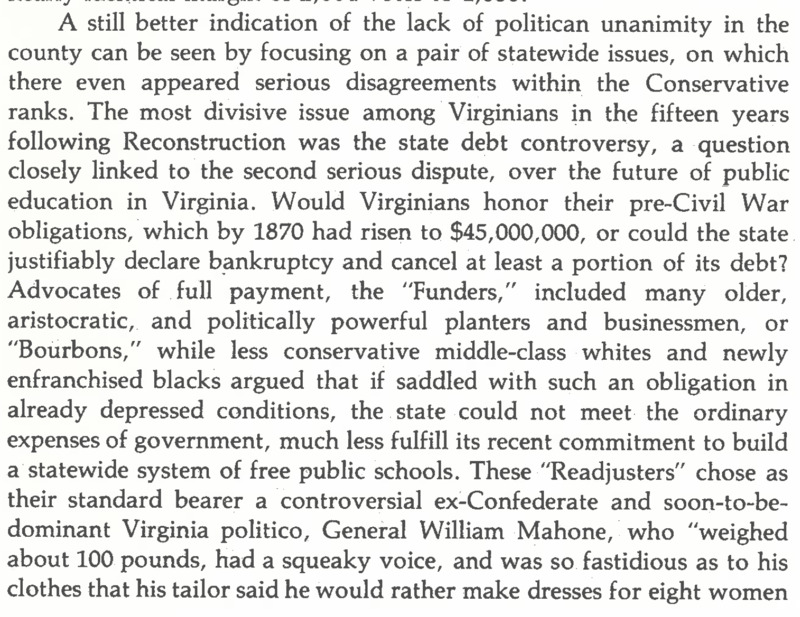
Pre-Civil War Debts - All Parties Involved
This is a piece explaining the pre-Civil War debt in 1870 and how many of the richer and more powerful people (mainly white folks) were advocates of fully paying it off, while the less conservative middle-class whites and newly enfranchised blacks argued that this is not a viable option, instead messing with plans for free public schools. This shows where priorities lie for all parties involved.
Therefore, in the communities surrounding Tolison’s land, her neighborhoods and communities were empowered and encouraged to make their voices heard and understood. This could be a reason why Tolison felt inclined to purchase a land and become a landholder in the region with this newfound enfranchisement and sense of autonomy. She moved into the Fairfax County District shortly after, in the 1890s - present when the schools were filled and utilized by the nearby individuals- students and teachers alike. This is confirmed by the land tax records found in the Historic Records Center Fairfax County Circuit Court dating her first tax payment on her land in Mount Vernon district, Fairfax County, Virginia in 1893.
[1] Nan Netherton, Fairfax County, Virginia: A History (Fairfax: Fairfax County Board of Supervisors, 1978)
By Alaa Guennouni