
The Better Homes in America Movement
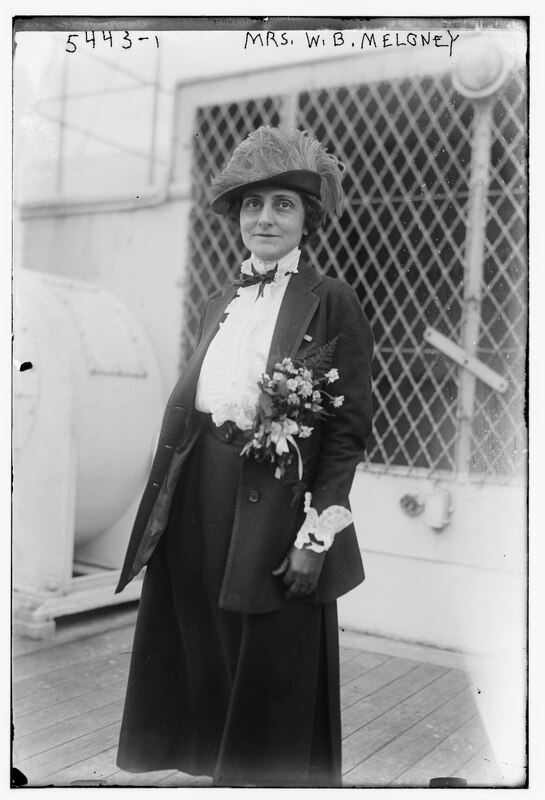
Marie Maloney, 1920.
Conservative retrenchment following World War I gave rise to a government effort to promote a “traditionalizing” form of single-family American homeownership, promoted by federal embrace of a private organization, founded in 1922, devoted to middle class domesticity. Though little known today, the Better Homes in America (BHA) organization shaped a century of U.S. homebuilding and investments not through its model-home blueprints or pretty pictures of White housewives, linens and picket fences, but through its influence on national lending standards. With Commerce Secretary Herbert Hoover chairing its board of directors, BHA was helmed by its founder, journalist Marie Meloney, who advanced the program from her perch as editor of a popular women’s magazine, The Delineator.
BHA based its “ideological vision of the basic home for the typical American middle-class family” on what it called “a wealth of analytical work” about requirements for a safe, respectable and, above all, financially secure household. Best understood as a national political project, deeply invested in regulating racial, class, and gender boundaries, BHA collaborated with a wide range of “civic agencies” with “interests … held in common.” Their national office, based in Washington, D.C., generated a plethora of educational materials to indoctrinate a generation of future home consumers. These materials, and the lasting official standards that grew out of them, valued class and race homogeneity as necessary protection for families’ home investments, and explicitly advised home seekers to look for restricted covenants on any property they might buy.
When home values plummeted during the Great Depression, sinking hundreds of thousands of homeowners “underwater” on their mortgages, the federal government scrambled to prevent mass foreclosures with a public lending program that became the Home Owners Loan Corporation. But before the first dollar could be issued, lending officers needed to decide on borrowers’ ability to pay them back, using standards drawn up in underwriting manuals. These emerged ready-made from the private sector, as historian James L. Greer explains:
"That a public bureaucracy could so rapidly and independently produce such comprehensive and exceedingly detailed standards seems unlikely. This is especially so because these standards covered all feasible facets of the physical construction of a house, all plumbing, heating, and electrical systems, and dictated minimal construction materials and techniques for the home’s substructures, setbacks from the street, and neighborhood standards, including public infrastructure, public facilities, transportation networks, schools, parks, and public facilities, and the social makeup of the community. Rather, the agency relied on a wealth of analytical work that had been previously formulated by a private, nationally prominent organization … [the] Better Homes in America... [Emphasis added.]"
HOLC and its successor program, the Federal Housing Administration, incorporated BHA recommendations in criteria for lending and insurance programs inevitably permeated private-sector lending, as well, with implications for non-urban locales, like Fairfax County, that still stymie local economies.
Better Homes’ influence was broad. It boasted a network of local membership chapters and a magazine and promulgated its advice through an 800-page homeowners’ manual. These promoted the “basic adequate home” as part of an “uncontested” patriotic vision in an era (soon after the Bolshevik Revolution) of deep anti-communist distrust. With encouragement from the administration of President Warren Harding, it “encouraged home ownership as a financial, social, and patriotic undertaking, with homemaking and consumerism at its core.” BHA represented its efforts as “an educational institution for public service ... to make convenient, attractive, and wholesome homes accessible to all American families.” In addition to its educational efforts, the organization created a range of training opportunities to advise owners on navigating the new terrain of zoning restrictions, presenting them as a positive limitation, a bulwark against “decline in desirability for residential purposes due to the encroachment of inharmonious elements.” (Italics added.) “The general type of people living in the neighborhood is important,” the manual further instructed. Such “coded considerations,” historians have concluded, “reinforced segregationist attitudes and housing policies, encouraging White flight” from city to suburb, “as a positive social and financial choice.”
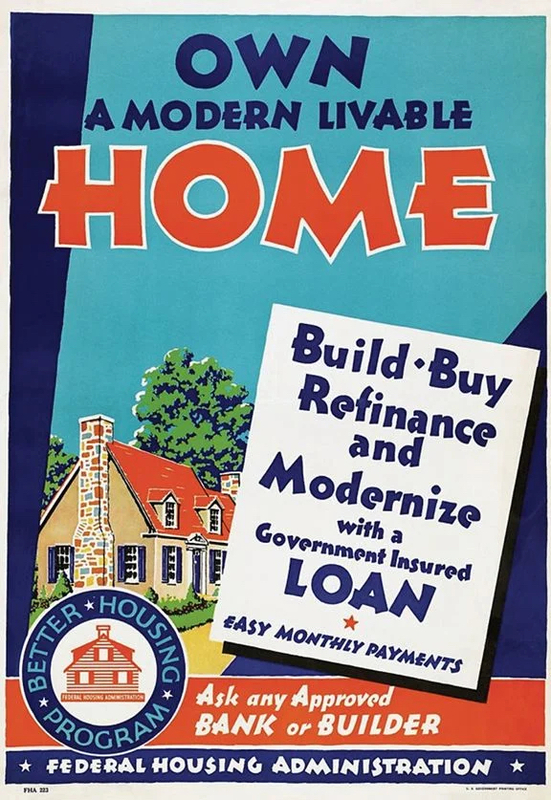
Federal Housing Administration's Better Housing Program Flyer.
To Hoover and Commerce Department officials, zoning brought order, predictability, and control to what was seen as a lamentably chaotic process of residential building. Yet their solution not only failed to address affordable housing shortages or increase access to single-family domesticity; it suggested that an inability to achieve it was “a personal, rather than institutional, failing,” while ignoring institutional challenges facing poor, Black and immigrant Americans. The BHA would fold for financial reasons during the Depression, but by then, Hoover’s committee had made its impact. The number of Americans living in zoned municipalities had quadrupled, just one decade after the Zoning Advisory Committee first met in 1925. The BHA, as a public-private partnership, constructed a powerful ideological, and rhetorical machine that shaped the design of emergent suburban landscapes across the US and the discourse around the process. These national trends help explain how zoning initiatives in Fairfax came to prioritize single-family home construction; they were staying in step with policies and preferences advanced by federal authority.
BHA biases received ratification from the nation’s highest court in a 1926 decision rejecting an Ohio property owner’s claim that single-family zoning infringed his property rights. After the town of Euclid quashed the plaintiff’s plan to build apartments on 68 acres he owned, the U.S. Supreme Court not only upheld the constitutionality of the town’s single-family-only rule but added its dim view of denser configurations or the mixing residential formats.
“[T]he development of detached house sections is greatly retarded by the coming of apartment houses … [which have] resulted in destroying the entire section” for single-family homeowners, they wrote. The opinion pathologized apartments—and by extension, their occupants—as “mere parasite[s], constructed in order to take advantage of the open spaces and attractive surroundings.” (Emphases added.) The wording borrowed from pseudo-scientific rhetoric of the era that, like the eugenicist theories described earlier in this report, cast certain classes and groups of people as contagions that, without careful management, could “infect” healthy, vibrant communities. The Euclid decision solidified the legal basis for racial and class barriers that kept economically disadvantaged families out of suburban neighborhoods. Exclusion was the point. Decrees and choices—by courts, government officials, homebuilders, and homeowners—were coalescing in a labyrinth of laws, policies, regulations, curricula, and promotional campaigns that concretized a single idea of the White single-family suburban home as the American Dream.
Fairfax County embraced these trends. At its own two BHA demonstration houses, including one just west of Falls Church, local officials, civic organizations, parent-teacher groups, garden and landscape clubs, and even librarians gathered to share their knowledge about creating the perfect home. In May 1925, Fairfax BHA hosts welcomed guests all the way from Denmark and Norway to admire American advances in homebuilding. The international guests commented on how fortunate U.S. citizens were to enjoy close collaboration between private associations and their government. For all that, and despite the attendees’ international diversity, these BHA exhibitions in segregated Virginia appear to have included only White people. Northern Virginians absorbed similar messages at the second annual Better Homes and Building Exposition across the Potomac, in 1927, hosted by the Washington Real Estate Board. Its lectures, events, and exhibits by “newspapers and realty developers,” hewed to the BHA’s idealized suburban home model, augmented by domestically focused activities like a student biscuit-baking competition, music recitals, and landscaping workshops. These events did not just showcase how a home could look and function; they were culturally reinforcing, bringing together White community members while solidifying the exclusion of Black and immigrant residents. BHA’s significance, too often ignored in local accounts of housing equality, makes obvious the racialized ideological, architectural, and legal construction of the single-family home as representative of the American Dream.
Contemporary discourse on the history of housing discrimination has focused on redlining. This fixation obscures deeper roots of housing inequity in Fairfax and the United States. Fairfax, notably, contained no FHA-redlined localities. Yet its lending and housing practices rested on a similar set of standards that grew out of the FHA and its predecessor program. The federal Home Owners’ Loan Corporation (HOLC), between 1933 and 1935, refinanced billions of dollars’ worth of loans. At the same time, not surprisingly, it began collecting and evaluating data on mortgage risk and defaults, producing a set of maps that ranked American cities and districts according to the likelihood of their homeowners’ defaulting. On these “Residential Security Maps,” each neighborhood received a letter grade (A, B, C, or D) and was assigned a color: green, blue, yellow, or red. Green zones were considered lowest risk, and red zones highest. No matter their actual financial risk assessment, Black neighborhoods, or even neighborhoods with a small Black population, were always marked in red, for “hazardous.” HOLC rules made “race and ethnicity a part of the real estate appraisal process and propagate[d] the idea that Blacks and other ethnic-minority groups caused property values to fall,” concludes historian Dorceta E. Taylor.
Several underwriting manuals informed the appraisal process, setting valuation models used by county administrators, real estate developers, financial institutions, and realtors. These bureaucrats and practitioners, manuals in hand, produced housing inequity in their wake, including in Fairfax. HOLC and its manuals not only gave rise to racialized stereotypes; they invested them with economic power. The lending policies they spawned legitimated White fears that African Americans, by the mere fact of their presence, introduced measurable “blight” into neighborhoods. Building on HOLC manuals, the National Association of Real Estate Brokers and Frederick Babcock’s influential Valuation of Real Estate set a standard for appraising real estate based on criteria that systematically removed people of color from neighborhoods. HOLC initiatives denied Black residents access to home ownership and generational wealth building. Their policies gave birth to practices that undervalued older, racially mixed neighborhoods, thereby channeling federal funding away from Black communities.
HOLC maps and related land use policies indirectly decimated Black communities in Fairfax. The FHA duplicated HOLC’s assumptions about multiracial neighborhoods. The FHA, established in 1934, published an underwriting manual in 1938 to assist its employees in choosing loans with a minimal chance of foreclosure The FHA manual borrowed its guidelines from HOLC’s assumptions because they, too, were concerned with “inharmonious racial or nationality groups” that might endanger homebuyers’ investments. The bias of federal agency publications stands out in excerpts like these:
- “Similarity of price range does not provide a basis for such comparisons if certain racial aspects render the locations actually noncompetitive.”
- “Natural or artificially established barriers will prove effective in protecting a neighborhood and the locations within it from adverse influences. Usually the protection from adverse influences afforded by these means includes prevention of the infiltration of business and industrial uses, lower class occupancy, and inharmonious racial groups.”
- “Areas surrounding a location are investigated to determine whether incompatible racial and social groups are present, for the purpose of making a prediction regarding the probability of the location being invaded by such groups. If a neighborhood is to retain stability, it is necessary that properties shall continue to be occupied by the same social and racial classes. A change in social or racial occupancy generally contributes to instability and a decline in values.”
- “... if the children of people living in such an area are compelled to attend school where the majority or a considerable number of the pupils represent a far lower level of society or an incompatible racial element, the neighborhood under consideration will prove far less stable and desirable than if this condition did not exist.”
- “The degree of social and racial compatibility of the inhabitants of the neighborhood. The presence of socially or racially inharmonious groups in a neighborhood tends to lessen or destroy owner-occupancy appeal.”
A year after publishing its manual, the FHA praised the success of D.C. and its booming Maryland and Virginia suburbs in applying the agency’s system. FHA guidelines were effective in codifying discriminatory funding policies that were eventually reproduced by Fannie Mae and Freddie Mac.