
Unable to Buy or Rent
A Housing Crisis in the Civil Rights Era
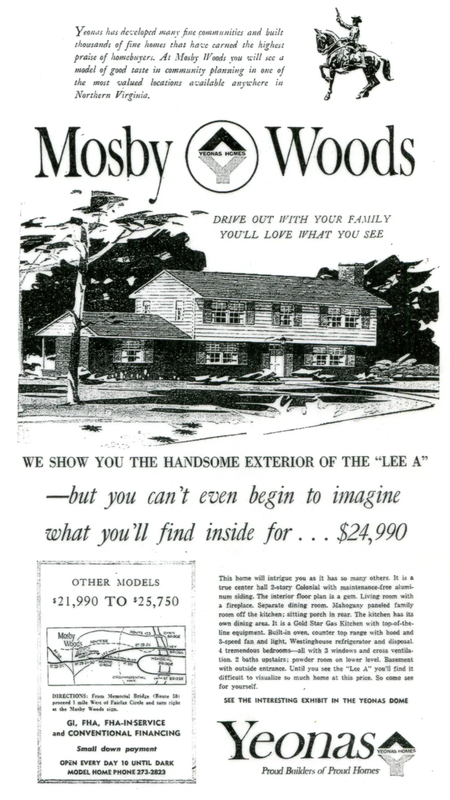
Advirtisement for the homes in the Mosby Woods neighborhood in Fairfax City, 1960s.
Two significant pieces of legislation that grew out of the 1960s reformist zeitgeist, the Civil Rights and Fair Housing Acts, exemplify the combined force of persistent activism, the judicial system, the federal government, cold war exigencies, and the emergent power of the television. Because the Civil Rights Act of 1964 addressed unequal treatment of citizens under the law but did not specifically confront unfair housing practices, President Lyndon Johnson three years later signed the Fair Housing Act, which gained Congressional support only after the assassination of Martin Luther King, Jr. In this environment, Fairfax administrators joined state and local governments around the country in grappling with the complexities of affordable housing, zoning practices, rapid suburbanization, demographic shifts, and the dismantling of de jure racial segregation. The county faced a jumble of conflicting interests and tensions among local, state, and federal authorities, developers, White middle-class residents, and marginalized Black communities.
In November 1961, the Fairfax County Council on Human Relations released a damning report highlighting the enduring legacy of segregation in the county. Despite some progress since 1954, Black residents continued to face systemic barriers, particularly in accessing decent housing. The report underscored how poor housing conditions perpetuated a cycle of poverty and limited educational opportunities, reflecting broader patterns of racial inequality. Exactly one year later, President John F. Kennedy’s Executive Order 11063 “prohibit[ed] discrimination in the sale, leasing, rental, or other disposition of properties and facilities owned or operated by the federal government or provided with federal funds,” fulfilling Kennedy’s pledge to end racial discrimination in federally assisted housing.
For many African Americans, the order gave reason for optimism. Yet, dismantling systemic housing inequality and expanding access to affordable housing would prove daunting. In Fairfax, those efforts to correct the problem of dilapidated housing, lack of affordable accommodations, and housing discrimination often fell to local advocacy groups. For example, in January 1965, the 12-member Citizens Advisory Committee of the Board of Supervisors, League of Women Voters, and the Citizens Committee on Adequate Housing promoted the pursuit of federal funds to construct public housing in the “County’s scattered pockets of poverty.”
Two years later, in 1963, an official body formed to research and develop solutions to the county’s housing problems released its comprehensive report, “Housing in Fairfax: A Report and Recommendation.” The Fairfax County Housing Committee report used housing categories from the 1960 U.S. Census, descriptions like “sound,” “deteriorating,” and “dilapidated” to denote “blighted areas” of Fairfax, defined as “the location of enumeration districts with substantial percentages of dilapidated or deteriorating housing.” The use of this terminology shows how even seemingly well-intentioned programs like construction funding integrated demeaning discriminatory racial biases about disease and crime into supposedly data-driven diagnoses of blight, linking dilapidated structures to unhealthiness and attributing their condition not to systemic hardships but to pathological characteristics. Urban renewal policymakers’ vocabulary made finding, naming, and defining “blight” appear (deceptively) objective and politically neutral.
1960s urban renewal efforts in Fairfax were entangled with the twin interests of promoting capital investment and ending socio-environmental conditions that might reflect negatively on the county. The interconnected interests of a diverse set of actors—local government, state government, federal government, private sector and business interests, citizens’ groups, residential associations, renters, and homeowners—created the context for unlikely collaboration and partnership.