
Rise of Civic Associations
Most subdivisions, soon after their first occupants moved in, occasionally with organizational or financial support from the builders who developed them, sprouted incorporated membership organizations. Formed for quality-of-life purposes like barbecues and school fundraisers, these homeowners’ groups and other civic associations inevitably also addressed themselves to enhancing the value of members’ homes—for most families, their largest investment. They pressed for improvements, sometimes from developers, sometimes from the county, demanding amenities and infrastructure including playgrounds, sidewalks, fire hydrants, and trash pick-up.
In the area of recreation, absent robust, taxpayer-funded programs, some even built private pools and tennis clubs, or assumed management of those provided by builders. Their recreation centers’ use was available exclusively to (dues-paying) residents. Into the mid-twentieth century, an overstretched Fairfax government proved happy to see private entities handle such functions. Yet this delegation of authority to quasi-private entities would prove problematic when, as the Supreme Court ruled in Sullivan v. Little Hunting Park (discussed later in this report), that delegation offered cover for race discrimination.
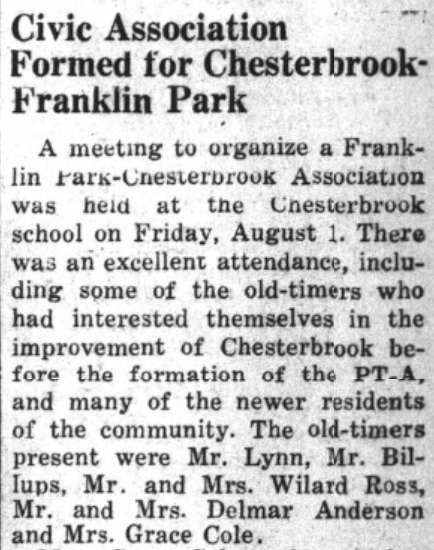
News of the establishment of a Fairfax neighborhood's civic association in The Providence Journal, August 7, 1947.
These groups also influenced matters weightier than recreation, with broader regional impact. Their organizational capacity, enhanced by new suburbanites’ generally high levels of education, professional experience and income, enabled them to influence decisions on zoning law, infrastructure, parks and long-term county growth. They exercised ongoing political and social influence through petition-gathering, voter registration drives, and prominent attendance at public meetings. Further enhancing their clout before the Board of Supervisors, some elected members like Anne A. Wilkins and Richard C. Ovenshine, actually crossed into government from leadership roles in community associations. These groups used their influence to steer big-ticket improvements, like road and sewer enhancements and new and renovated schools. On the flip side, they often weighed in against the encroachment of major infrastructure, like highways, near their perimeters. They also vociferously, and frequently, opposed the construction of affordable housing. Though it was hardly their stated purpose, and even as they paid lip service to solving chronic housing shortages, civic associations frequently pressed the county government to quash rezoning requests needed to build multi-housing or trailer parks.
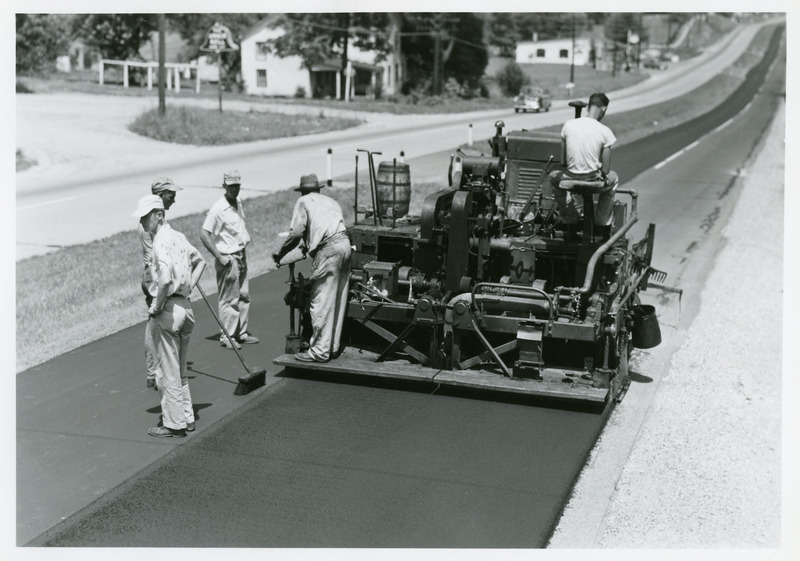
Road contruction on US 211 in Fairfax, 1953.
The widespread emergence of these groups—and their internal solidarity, rooted in the natural geographic and economic cohesion of a subdivision—gave rise to a system where concerns of affluent White neighborhoods overshadowed the needs and voices of marginalized communities. For decades, economically disadvantaged residents, especially African Americans, endured precarious circumstances invisible to developers, county officials, and the wealthier residents (often newer to the county) who reaped the benefits of Fairfax’s much celebrated suburbanization and modernization. Black neighborhoods were often more dispersed, their residents’ votes and political influence watered down by years of concerted disenfranchisement, and their economic power diminished by race discrimination in the workplace. Marked as disposable, many of their communities were not just erased but forgotten. This difficult and painful narrative suggests that, despite Fairfax County’s progress, a long history of exclusion still haunts the region.