
Class Based Exclusions
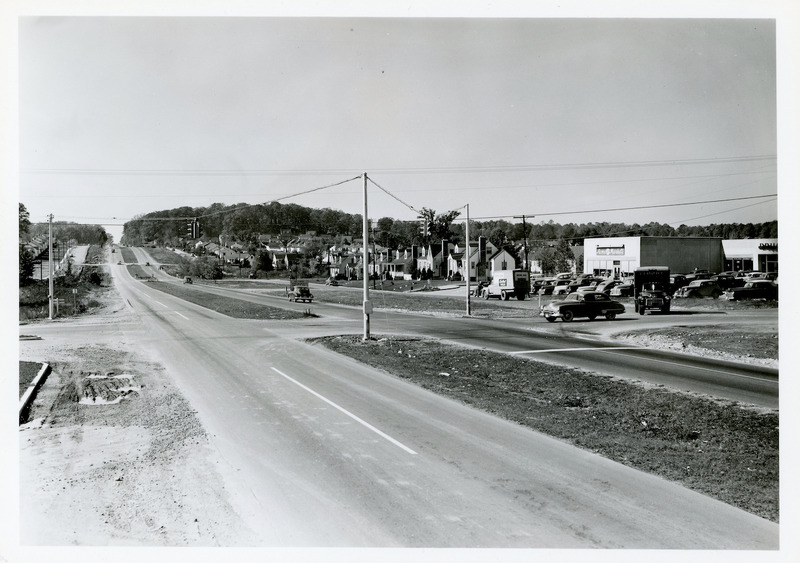
Jefferson Village Shopping Center in Falls Church, 1949.
Creative solutions to address the housing crisis faced persistent resistance from multiple constituencies, most notably White homeowners. Developers’ need to appeal zoning changes to the Board of Supervisors opened up an arena for opposition, not just to public (subsidized) housing, but to low-income dwellings in almost any form. One 1962 plan for an affordable apartment complex drew objections from owners in the nearby, all-White Jefferson Village subdivision on the grounds that it would lower their homes’ value. It might have gratified the 1920s writers of Better Homes in America manuals to see their precepts so clearly internalized and politicized. While rarely objecting explicitly on racial grounds, blocking affordable development effectively kept neighborhoods white.
When county supervisors voted in 1950 to rezone an eight-acre tract near Falls Church to enable multifamily housing for African Americans, members of the nearby City Park-Jefferson Village and Hillwood Citizens Associations claimed their vociferous objections centered not on the race of potential residents but on the idea of any multifamily housing in the area. At least one Supervisor, Maurice Fox, echoed their claim, declaring, “no racial element was involved.”
Veiled bias and exclusionary zoning affected not only vulnerable Black residents but African Americans of means, as well, when they sought homes in the county. On this point, one developer offered his frank assessment that, “many Northern Virginia Negro Families can afford good housing, but have been unable to buy or rent in their own areas.” Ultimately, the leveraging of colorblind rhetoric illustrates an emerging political awareness among some White residents and elected officials. Their new rule: avoid appearing overtly racist. The colorblind veneer had a two-fold impact. One, the negation of racial bias denied the multiplicative impact of racism and classism, and two, class-conscious rejection of potential neighbors of color was acceptable. Classism in the name of protecting property value and community culture, even if informed by unnamed racial bias, was justifiable. Thus, economic segregation and class-based exclusionary zoning emerged and persisted as legal and even moral justification for the implementation of restrictive policies and decisions. In the 1926 landmark Supreme Court case Village of Euclid v. Ambler Realty Co, the presiding judge defended the exclusion of undesirable people who are “like a pig in the parlor instead of the barnyard.” Four decades later, in the 1971 James v. Valtierra case, the Supreme Court defended the right of San Jose California residents to vote by referendum on whether to allow construction of low-income housing. In similar cases that ensued across far-flung jurisdictions, courts repeatedly deemed it lawful to exclude potential renters or homeowners based on class. The exclusion of renters—based not overtly on racial animus but on the “protection” of property values— was thus sanctioned as a legal form of discrimination. Moreover this judicially approved exclusion retained lasting effect even beyond the Civil Rights era, as it offered a speciously colorblind, economic defense compatible with state and county practices.
"a Negro ghetto in a County that now has none"
It is no surprise then that discriminatory discourse among White residents about public housing and fears of a Fairfax “ghetto” persisted unrelentingly. Debates around the construction of public projects put race and class bias on full display. A 1961 report by the Fairfax County Council on Human Relations concluded that, despite some improvement in housing since the landmark 1954 Brown decision (on segregated schools), “segregation is still the predominant pattern in the lives of our people,” and especially so in housing. It recommended that the County “give top priority to the serious remaining problems of exclusion of Negroes from housing, employment, public accommodations, and community life.” Still, Supervisors vacillated. Finally, in 1965, the Board, under pressure from multiple constituencies and wary of committing local tax dollars to affordable housing, consented to seek federal housing funds for Fairfax, to help “redevelop its widely scattered slum areas,” an outcome that outraged White residents and developers. The Northern Virginia Builders Association and the Home Builders of Suburban Virginia objected on the grounds that “the needs of the poor can be met without government financing.”
The following year, a developer wanting to build a 750-unit apartment complex for Black residents in Gum Springs tried to exploit a zoning exemption—a special permit usually granted only to charitable organizations like churches. Zoning officials’ application of the loophole for this project was so controversial that, within weeks, the Board of Supervisors had “plugged” it, eliminating the exemption. Supervisors condemned county zoning administrators for “rezoning land without having the legal power to rezone.” But their real offense had less to do with bureaucratic overreach than with defying powerful White interests. The zoning board, supervisors complained, had disregarded concerns of “Supervisors, planners, school officials, and nearby citizens” about the project’s “creat[ing] a Negro ghetto in a County that now has none.”
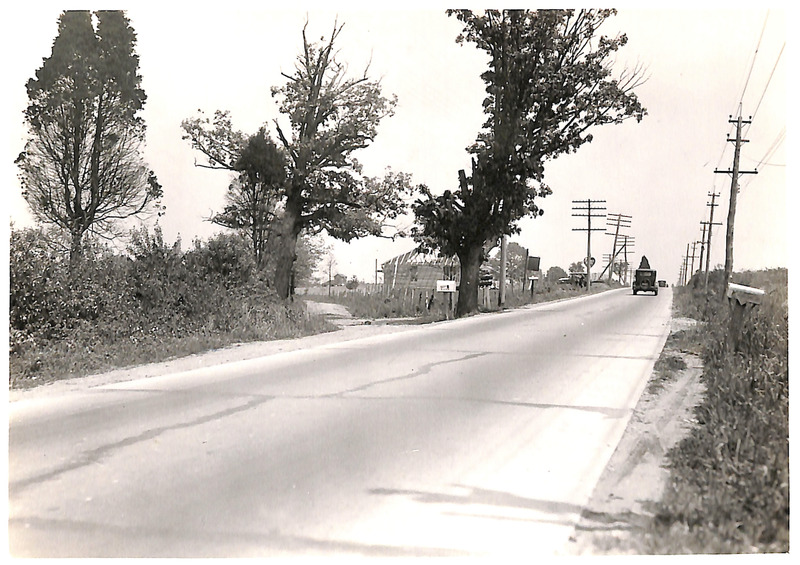
Route 1 near Gum Springs, 1930.
Their position, in the view of the project’s Black supporters, neatly aligned with that of vocal White homeowners. Their antipathy to project laying bare the cold truth that supervisors simply opposed any low-cost housing for Gum Springs. In other words, for African American residents, their elected officials were against them. Weary but intrepid Gum Springs families were once again disappointed.