
Segregation Begat Disinvestment: Conclusion
Conclusion
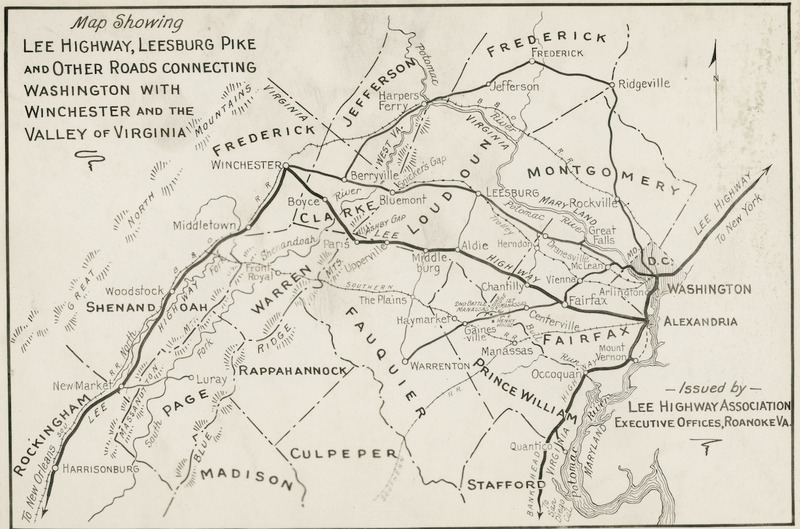
Map of Lee Highway in Northern Virginia, 1920.
The history of housing inequality in Fairfax County is a story about land-use policy, other forms of governance, economics, and racial politics. The interplay of these factors reveals a consistent lack of investment in affordable housing and a pattern of neglectfulness, especially towards Black communities. This report identifies neglect and over-investment not as uncommon practices or principles enacted by rare, prejudiced individuals but as the operating standard for over one hundred years. Neglect and overinvestment are processes that are maintained and produce patterns. The patterns become normalized to the point that we do not recognize that they have a history—an origin story—that we carry with us in 2024.
This through-line shows up starkly in the example of repeated controversy around a proposed complex, One University, on a tract on the edge of Fairfax City. It was targeted four years ago by a Change.Org petition with 508 signatures, “Oppose University One Project,” addressed to the Fairfax County Planning Commission. (The petition misstates the name.) Supporting documents it once linked to are gone, but its signers, said to be residents of 11 nearby neighborhoods, raised a range of concerns about the public-private residential project that can still be seen online: traffic, the local elementary school and “impact on emergency services” all are mentioned. But the objections also include “density,” “public housing” and “compatibility with adjoining neighborhoods.” Wrote one signer, “This proposed development is incompatible with the surrounding land use and its impacts to the environment and adjacent residential communities cannot be properly mitigated.”
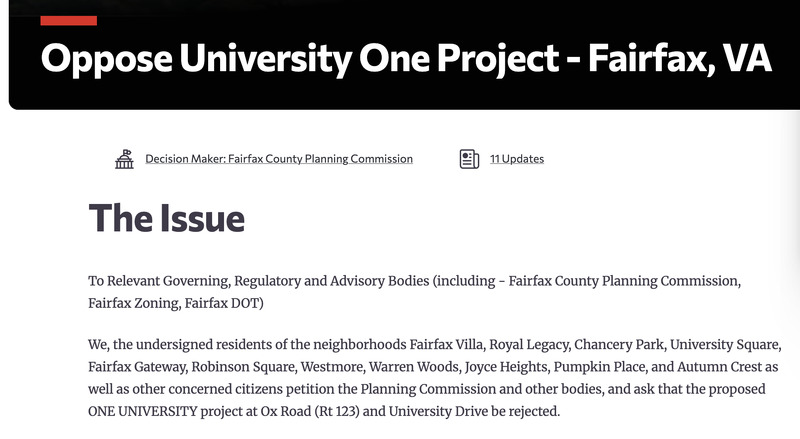
The locked change.org petition opposing the One University project.
The project prevailed nevertheless, and its mix of student, senior and affordable housing is currently under construction. Its completion might indeed aggravate traffic and pedestrian safety along an already congested corridor. But underlying these practical concerns about the capacity of public roads and services are more fundamental assumptions about land use that have shaped development in Fairfax County for nearly a century. Ideas about density, “compatibility” and another oft-cited planning criterion, “appropriateness,” rest as much on historically constructed ideas about what types of people belong in a community as subjective interpretation of traffic data and school censuses. And for that reason, decisions and political choices based on those interpretations have often, sometimes intentionally, worked to the exclusion of economically vulnerable residents and members of minoritized groups—especially, as this research shows, African Americans
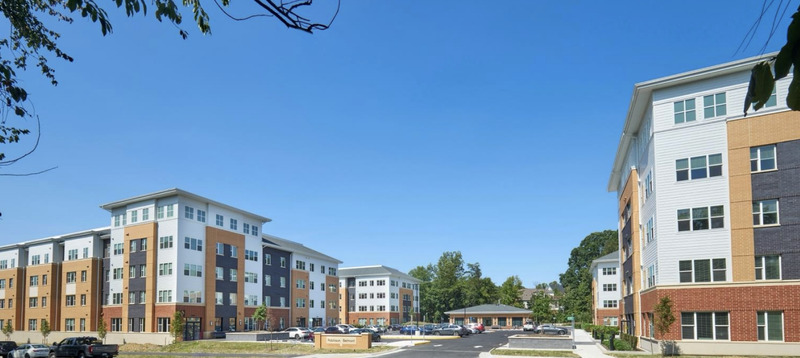
One University, 2025.
This contestation over “appropriateness” of some residents is a pattern. In September 1959, for instance, the denial of a rezoning application to enable the construction of a complex of 68 semi-detached homes in the traditionally Black enclave around Quander Road showcases how racial and class considerations play into zoning decisions. Despite arguments from residents such as Mrs. Lettie Jackson, Alice Quander, and Gilchrist Stokes about the need for homes for their community, the Board voted unanimously to deny the application. The Board’s decision was framed around zoning needs and housing types, yet the undercurrent of racial bias was evident in the discussion and objections. The difficulties faced by Quander Road residents, also faced by Gum Springs community members, highlights the constant barriers faced by African Americans attempting to secure adequate and affordable living spaces. The Board of Supervisors, in 1961, rejected what would have been “the County’s first Negro apartments” in what was referred to as its “worst slum.” The rezoning application by local landowner Sadie Parker to enable construction of 180 units tailored to Black tenants revealed a double standard on expanding local communities that dimmed Supervisors’ zeal to address area conditions. Its proposed monthly rents of $70 to $90 would exceed Gum Springs incomes, they surmised, creating what, in racist terms, constituted a dilemma, as explained by board member William H. Moss: “We must face up to the problem of colored housing in this County, but something of this size is sure to draw people from other areas.” The Board, usually intent on attracting new citizens from outside Fairfax, criticized Parker’s plan for its potential to do just that.
Even many Fairfax County trailer parks, which offered some affordable housing options, would not “accept Negroes.” Housing discrimination permeated life in Fairfax.
Seemingly race-neutral language facilitated the maintenance of racial exclusivity. For affluent Fairfax homeowners, their property represented a significant financial and ideological investment deserving of protection. Defending their homes, tree-lined neighborhoods, and White middle-class way of life from potential threats was entangled with the increasing discomfort generated by the 1954 Brown decision and civil rights reform. For these homeowners, housing was about more than where their children slept or the family gathered for an evening meal. Housing was political, and as the civil rights movement gained momentum, the invocation of property rights was never a neutral defense. It was a tool for preserving racial exclusion that continued even after the Fair Housing Act of 1968 was passed. Advertisements for housing, instead touted the "absolute right to control their neighborhoods" and the power to “enjoin and remove nuisances in any form.” Without zoning laws, racially restrictive covenants, and other exclusionary tools, persistent suburban homeowners used economically discriminatory, superficially colorblind, practices. These patterns reveal the explicit and implicit biases that shaped the Fairfax housing landscape.
Thus some 50 years before the new One University apartments are set to receive their final coat of paint, these terms were already shaping development on the site, then known to county planners of the 1970s by the name of its recent owner, as the “Brownstein Tract.” That the county owned these fifty-five acres in the first place owed to an ambitious effort in planning reform the Board of Supervisors undertook in the early 1970s. The “PLUS” (Planning and Land Use System) reforms signed into law in 1974 created a modest “land bank” (funded at $2 million initially but later cut back) to acquire acreage for low- and moderate-income public housing. Its funds supported the creation of the townhome community already on the One University tract when the petitions were posted, Robinson Square. But those forty-six townhouses were but a fraction of the 226 sorely needed public housing units proposed for the site in 1975 by the county’s Department of Housing and Community Development.
That proposal ran into opposition from hundreds of local citizens. Appearing before the Supervisors in May 1975, thick petition sheaves in hand, they represented a “Concerned Citizens Group” as well as community organizations from some of the same subdivisions named in the 2019 petition. Their allies included elected officials of Fairfax City, which edges the site. Almost all objected to upzoning the tract beyond its by-right (as-zoned, single-family) density of fifty-five total units. Planning staff and all but two supervisors held fast and approved the rezoning, nevertheless. HCD’s ambitions were quashed, anyway, in the end, by Fairfax City’s leverage in the form of essential access to water hook-ups, which the city declined to provide. Hence the drastic downsizing to just the forty-six townhomes, belatedly rectified, perhaps, by today’s federally supported upzoning.
Advocacy for trailer parks, federal initiatives and innovative zoning arrangements between the county and developers could not come close to counter-balancing the longstanding preference for structural investment in business over people. This conundrum, with colonial-era roots, is not simply a feature of a particular political affiliation, corporate influence, racial identity, social-economic status, or educational attainment; rather, as one local observer noted in the 1980s, it arises because most Fairfax residents want to “help their fellow man ... but they don’t want to do it in [their] neighborhood.” Foreshadowing twenty-first century NIMBYism (the not in my backyard movement), the exclusionary suburban culture disdains renters and working-class residents, of whom many are people of color. This form of snobbery empowers homeowners on sleepy tree-lined streets to legally manipulate the opportunity for residents to find affordable, often multifamily, housing options. In the past, racial exclusion was easy to see. Today, economic exclusion, presumptively non-racial and legal, can be difficult to identify.
Ultimately, the so-called affordable housing problem has been (and remains) a manufactured problem with racial bias and economic discrimination playing significant roles. Federal, state, and county governments have a long history, as Richard Kahlenberg describes it, “of overinvest[ing] in White communities and starv[ing] Black ones.” In Fairfax, this underinvestment led to a cascade of social problems that reinforced racist and classist stereotypes, fueling White apprehension about living near economically disadvantaged individuals, especially if they were African American. This report has demonstrated that one critical way overinvestment occurred was through a series of small decisions, decade after decade, about zoning and local land use regulations. Shifting interests from one Board of Supervisors to the next and the absence of a standardized process suggest no single causality. Instead, quotidian choices facilitated development in some areas and restricted resources in others. A 2023 report, Analysis of Impediments to Fair Housing Choice in the Commonwealth of Virginia, concludes that purposefully or not, “building regulations, zoning, and other ordinances … [are] possible barriers to fair housing choice at the state and local levels.” Land use and zoning regulations significantly influence property values, which then limit housing options for African Americans and economically disadvantaged individuals. The shortage of affordable housing options continues to have a ripple effect, leading to increased segregation and inequality in Fairfax County. Or, as Sheryll Cashin contends in White Space, Black Hood, “Segregation begat disinvestment.”
Fairfax County faced decades of affordable housing scarcity because of federal subsidies to White homeowners and developers, a pattern of neglect and disinvestment in Black communities, in addition to pervasive racial discrimination. These factors, individually disastrous, have cumulative consequences. This painful past haunts the present, staining the county and its residents. But it is not too late to move toward affordable, secure, and safe housing for all Fairfax residents. Some argue that this requires more than just abolishing exclusionary zoning policies but embracing inclusionary zoning policies. According to Matthew Desmond, Pulitzer Prize-winning author of Evicted, many jurisdictions can still receive “federal dollars to repair sidewalks or update sewer systems or construct a public park" while maintaining exclusionary zoning. What if, he asks, Congress cut off funding to towns and cities that do not embrace inclusive zoning policies? Others contend that we must shake off tired twentieth-century narratives that pit resident against resident. This will not be easy.
The history of the HOLC’s successful propaganda campaign reveals how the supremacy of single-family homes over multifamily housing, suburban over urban, and White homogeneity over multiethnic households was ingrained and normalized. This ideology, reinforced by government policies and practices, became self-fulfilling. Most importantly, these ideas make it extremely difficult to envision progress and prosperity without the scarcity of affordable housing. However, those of us who live, work, play, learn, and worship in Fairfax do not have to succumb to a scarcity mindset; we can choose to move forward with a mindset of mutuality. If we prioritize mutuality, we all win. Our children win.
Fairfax County stands at a critical juncture. The historical and systemic roots of housing inequality have been laid bare, providing a clear picture of how deliberate actions and policies have perpetuated racial disparities and economic segregation. The challenge before us is not just to acknowledge these injustices but to act decisively to rectify them. Creating affordable, secure, and safe housing for all residents requires bold, inclusive policies and community engagement. It means embracing inclusive zoning policies that promote diverse, integrated communities. It also means challenging the ingrained ideologies that have long upheld single-family homes as the pinnacle of success, to the detriment of multifamily housing and diverse neighborhoods. We must ask ourselves: What kind of community do we want to build for future generations? One that perpetuates the same patterns of exclusion and scarcity? Or one that values and prioritizes mutuality, ensuring all residents have access to safe and affordable housing?
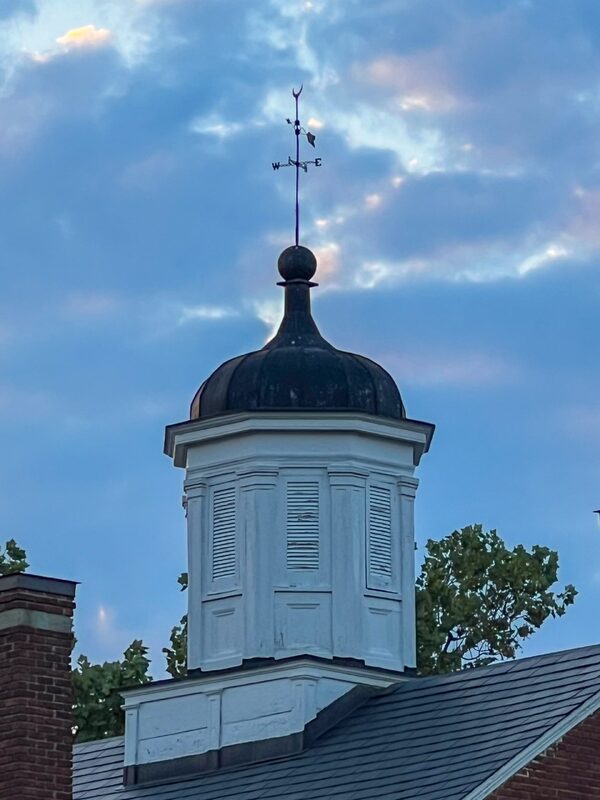
Top of the Historic Fairfax Courthouse.
This report calls for action. It urges Fairfax County officials, community leaders, and residents to come together and reimagine a more inclusive and equitable future. By adopting inclusive zoning policies and challenging exclusionary practices, we can create a Fairfax where everyone can thrive regardless of background, race, educational attainment, or even the language they speak. Consequently, the journey toward affordable, secure, and safe housing for all Fairfax residents is not just a policy challenge but a moral imperative. It is about choosing a mindset of mutuality over scarcity, recognizing that our collective success hinges on the well-being of each community member. By taking bold steps, we can ensure a more just and prosperous “One Fairfax” for future generations—a community where everyone has a place to call home.