
A Culture of Clearance
The Politics of Weaponized Suburbaization
Fairfax’s rise in economic prominence as one of the wealthiest counties in the United States is well documented in works that focus on a story of economic development fueled by the reliance on federal government jobs and “private sector citizens” who promoted an agenda of growth “often to the chagrin of local government officials.” This narrative concentrates on the racial underpinnings of the county’s agenda of growth—an agenda that actively created and perpetuated disadvantage through the pro- development actions of county administrators and other government officials. The collection of actions and policies that supported this agenda created a culture of harm, targeting Black communities as disposable while investing heavily in the development of the modern White suburban dream.
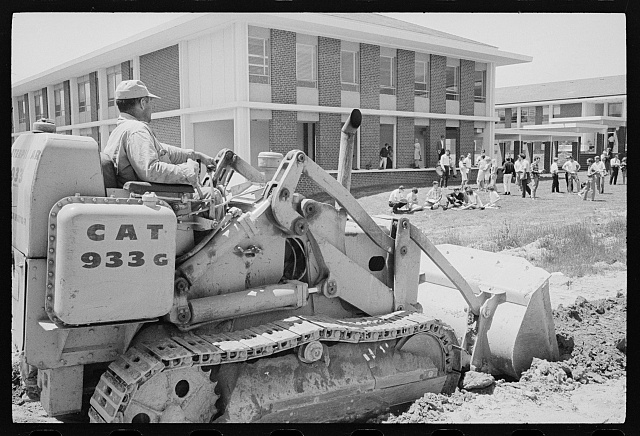
Bulldozer on the grounds of George Mason Community College, as student sit on lawn outside buildings, Fairfax County, Virginia.
To understand the birth of White suburbia in Fairfax, this report traces the dual formation of affluent, predominantly White residential areas, termed "islands of advantage," and the origins of Black communities as “islands of disadvantage.” It identifies four key mechanisms used to enforce these inequalities: a culture of clearance, racial restrictive covenants, federal lending and borrowing practices, zoning, and myth of “ideal” American home. These mechanisms collectively and systemically limited Black residents’ access to resources, services, and opportunities, while concentrating investment in White affluent suburbia, perpetuating a cycle of White advantage.
Neglect is a process, and its consequences weaponized against those most harmed, endowing it with even greater power. The County’s neglect and selective investment supported Northern Virginia’s self-serving narrative of exceptionalism. The problems of dilapidated housing, inadequate sewerage and plumbing, and muddy roads fueled uninterrogated assumptions that “blighted” conditions harmed home values, threatened public health, and increased criminal activities. Black communities were identified as deserving of containment or removal. For example, in1962, as Fairfax Supervisors confronted soaring estimates to alleviate Gum Springs’ unrelenting road flooding (for which public roadbuilding was the unacknowledged cause), member Anne Wilkins wondered whether “it would be better if we found some means of relocating the residents of this area” rather than use taxpayer funds to fix their neglected community. Wilkins’ words capture the painful fact that communities like Gum Springs could not marshal county resources in the way that their White neighbors could.
"Neglect is a process..."
Compounding the structural neglect was a set of policies and practices. Racial covenants, until their nullification in 1948, legally barred Black individuals from purchasing or occupying homes in certain neighborhoods, creating enduring social patterns. Redlining practices by federal and private entities designated Black neighborhoods as high-risk, resulting in mortgage loan denials and disinvestment, while restrictive zoning laws further segregated communities by race and class. Governmental decisions also consistently prioritized infrastructure development in White suburban areas while neglecting or destroying Black neighborhoods. In particular, the federal government’s actions created and reinforced racial boundaries through its Federal Housing Administration (FHA) and Veterans Administration (VA) home loan programs. In summary, this document provides a thorough historical analysis of housing inequality, exclusion, and erasure in Fairfax County, shedding light on the deliberate and systemic nature of racial disparities in housing.