
Cycle of Deprivation
In 1973, the county also continued to grapple with the pressing issue of homelessness, resorting to spending $41,388.78 over two years to accommodate unhoused families in motels. Officials suggested they lacked alternatives, as the homeless population continued to grow. The plight was stark: In 1972, 35 families had taken refuge in motels, escalating to 39 families by 1973. These families faced dire circumstances, from inhabiting condemned, unsafe, or overcrowded housing to the danger of living in a structure that was a likely fire hazard to impending evictions. In the winter of 1973, with gas prices climbing and winter coming, a housing official warned of an even worse crisis. Yet, amidst these challenges came a proposal to bolster the county’s minimum housing hygiene standards. The ordinance would have strengthened building requirements to be weathertight, watertight, and rodent-proof, and devoid of structural flaws “exceeding one-fourth inch in width.” Critics argued that the new standards would fall hardest on elderly and low-income residents and potentially lead to more mass evictions. James Goins, representing the Sideburn Civic Association, voiced such apprehensions, stating, “I’m afraid this ordinance is too powerful for poor people. There are a lot of widows in our neighborhood, and they would zero in on them and condemn their homes because they don’t have money to fix them.” Goins’ sentiment was echoed by Francis Honesty, residing at 10400 Zion Drive, who asserted that “90 percent of the older homes in our community would be condemned on cracks alone.” His words reflected the precarity of vulnerable community members and the likelihood of their displacement due to financial constraints. The cycle of deprivation, maintained by exclusionary spatial policies that invested in islands of privilege, locked Black and poor White families into generations of crushing poverty.
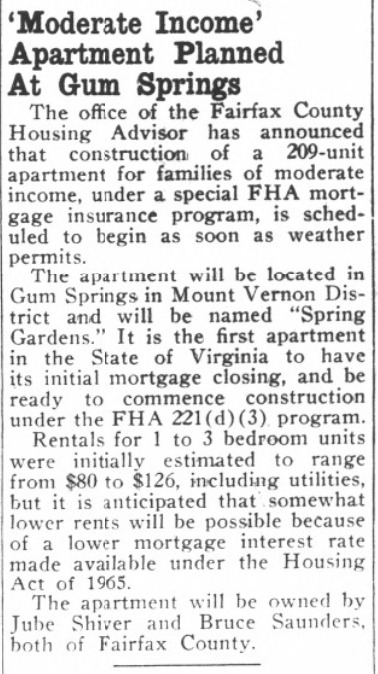
McLean Providence Journal, February 18, 1966.
Many individuals at risk of eviction lived in Gum Springs where, after a heavy rainfall, unpaved roads became treacherous. As one long-time resident described it, “When it rains heavily in Gum Springs, cars spin up and down muddy, unpaved roads, and booted pedestrians slip and slide on muddy footpaths.” The landscape, characterized by wooden shacks and outdoor latrines, was home to approximately 1,400 people. After decades of mostly fruitless petitioning for government services, Gum Springs in 1966 became the focus of the Fairfax Community Action Program, a new, federally funded anti-poverty initiative. One of its tangible outcomes was the establishment of the Saunders B. Moon Center, aimed at addressing community challenges.
Kay E. Holland, a Moon Center housing specialist, described the organization’s goals. “We want a variety of income levels,” she said. “We want some professionals; we want some middle and upper-income people in the community… We don’t want people to look at Gum Springs 10 years from now and say that this is still just a ghetto.” The program also bore fruit in the creation of Gabriel Plaza, a twenty-eight-unit subdivision for low- and moderate-income families at the heart of Gum Springs. Among those eagerly anticipating a new home there were James Chisley, his wife, and their three children. Chisley, a baggage handler at National Airport, even as he decried delays in its completion, told the Washington Post the project was, “just about the best thing that has ever happened to Gum Spring.” Chisley’s household was one of 106 that applied to purchase in Gabriel Plaza, spurring plans to expand the subdivision to include fifty additional homes. The goal was to dispel the notion that Gum Springs was just a muddy hole, a ghetto, or a site of blighted homes without value. Longtime residents knew that their community represented so much more.
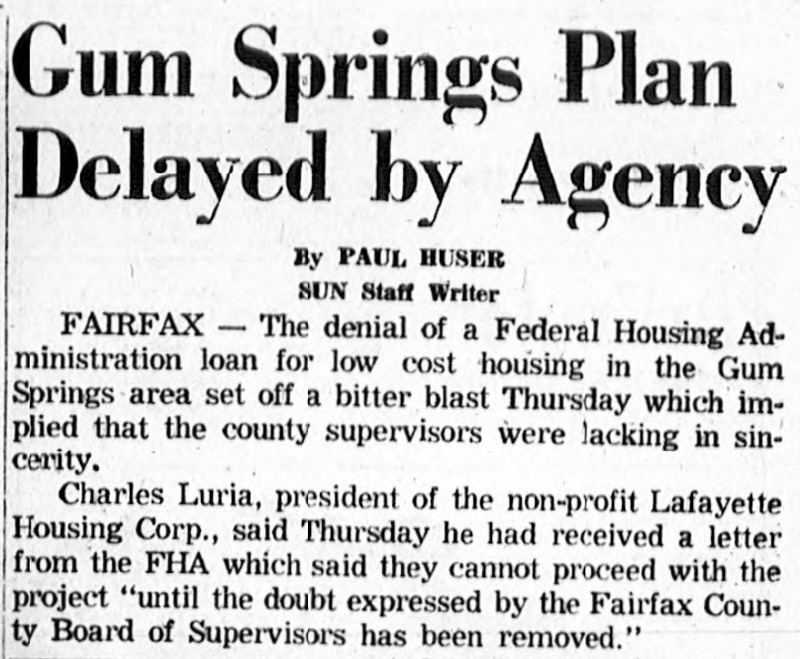
Northern Virginia Sun, June 3, 1966.
As Lincoln-Lewis-Vannoy’s experience shows, Gabriel Plaza’s hopefuls were far from alone in their wait. Whether stemming from lengthy studies, reprioritization, or simple inaction, delays disproportionately affected many projects for communities of color in Fairfax County. The rutted roads of the 1971 lawsuit and sub-standard living conditions of Lincoln-Lewis-Vannoy exposed weak links in Fairfax County’s supposedly comprehensive suburbanization and modernization of the 1950s and ‘60s. One local, Julia Cornell, who had lived in her home since 1919, told the Washington Post sixty-three years later that “[the county] just want to keep this area like it was 100 years ago, and they durn sure have.” In the same article, Robert C. Counts, director of community development for the Fairfax County Office of Housing and Community Development, noted, “It’s like what you would see in Appalachia, and it’s in one of the wealthiest counties in America.”