
Til Hazel and Eminent Domain
Businessmen with astute instincts for land acquisition, large-scale builders like John Tilghman (“Til”) Hazel, Jr., and Milton V. Petersen wielded considerable influence in shaping the county’s suburban landscape Hazel, who was described by the Mason’s current president, Gregory Washington, as a “founding father” of the university, was also a consequential architect of the structural inequality in the region. A zoning attorney turned developer, Hazel helped create, by some estimates, fully thirty-five percent of the county’s high-density subdivisions. From 1960 to 1972, as the “bulldozer” interests’ principal advocate for rezoning large tracts, he managed to circumvent a variety of ordinances that might have stymied suburban growth—and builders’ profits. Hazel has been lauded uncritically as a “builder” of the university and an avatar of Fairfax County “progress,” a view that ignores how his goals and those of his allies deliberately elevated extractive progress and profit over broader civic interests.
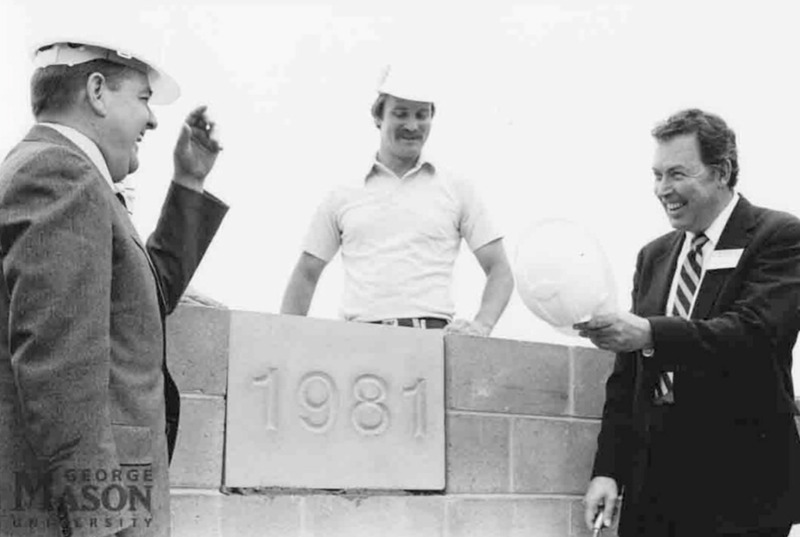
George Mason University President Johnson and Til Hazel celebrate new university construction, 1981.
Author Russ Banham, in The Fight for Fairfax, celebrated the combined impact of Hazel and Petersen on the county, by 1987, as “representing more than fifteen thousand new residential dwellings and 9.5 million square feet of commercial property on 5,500 acres in Fairfax County.” Their actions, admiringly chronicled by Banham, unequivocally led to widespread displacement and quashed the availability of affordable housing. Correspondence between John Ticer, Chairman of George Mason College’s Board of Control, and John Wood, in January 1967, emphasized the willingness of their colleague, Hazel, to undertake land acquisition by any available means. Hazel, Ticer wrote, would “be very happy to undertake any condemn work which we may encounter. Furthermore, I have talked to Mac Downs about being one of the appraisers for the Board.”
Condemnation and eminent domain were useful mechanisms employed by Hazel and his colleagues. Hazel’s use of eminent domain, the practice of taking private property for public use, has a long history in the United States, having been outlined in the Fifth Amendment to the Constitution. Enacted as a protection for citizens and property owners against untrammeled government seizure for public use, it requires just compensation for government takings. In modern application, however, it has served as an ever broader tool for government acquisition, under an expanding definition of “public good” for which land can be appropriated. “Just” compensation, meanwhile, can be a malleable target when powerful entities acquiring the property are also determining its valuation (a circumstance described above by the university’s effort to see a supporter, Mac Downs, serving on the appraisal board).
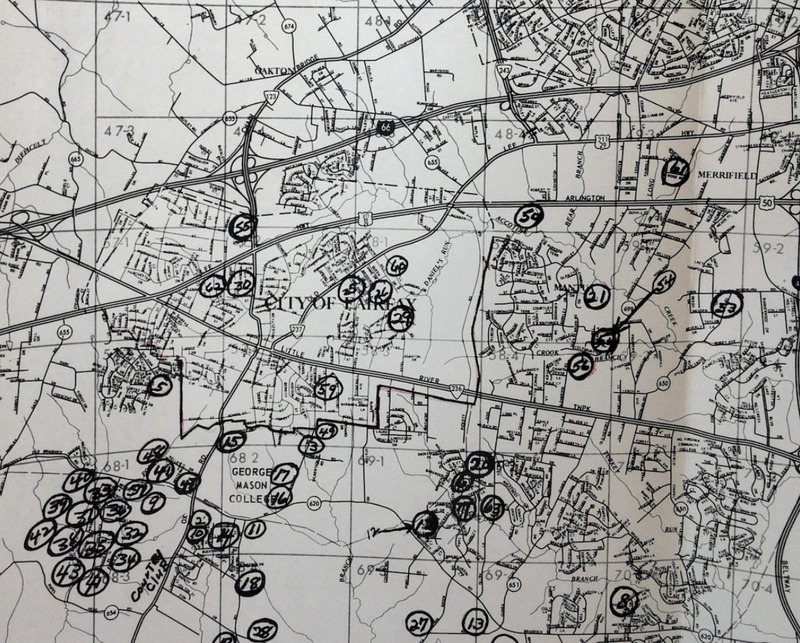
This 1960s map of the George Mason campus area shows the many home lots (circled) identified by the college’s developers and boosters for possible acquisition through eminent domain or other means.
Eminent domain could be wielded in tandem with zoning and other initiatives to extract favorable terms for reshaping the modern suburban environment. Leaders of George Mason College, for example, joined with Fairfax officials and land use attorneys to use eminent domain and housing condemnation to expand the college’s footprint. These land acquisitions proved an essential ingredient for expanding the college into a four-year institution, now a university. At the center of its growth strategy stood Til Hazel, shepherding these and other development projects across Northern Virginia. The map above, from university archives, shows land parcels around the 1960s George Mason College campus that its Board of Control was targeting for possible eminent domain, many in African American hands. In correspondence with John Wood, Fairfax City’s former mayor, Hazel’s team strategized the use of Virginia state laws to acquire properties across multiple Northern Virginia jurisdictions.
Fairfax’s anti-growth forces and supporters of rural preservation criticized mass production of “dense” (albeit single-family) subdivisions. But Hazel was unmoved, maintaining that the “monotonous line of houses evenly spaced” was “what people want[ed].” The market, he insisted, would not prove them wrong as his cohort sought to maximize profits and exert control over county land-use decisions. In pursuit of those interests (and increasingly, as he crossed to the builder side, his own), Hazel relied on more than a lifelong a familiarity with the Fairfax landscape and local authorities; he also cultivated close ties to the segregationist machine of Democratic Senator Harry F. Byrd.
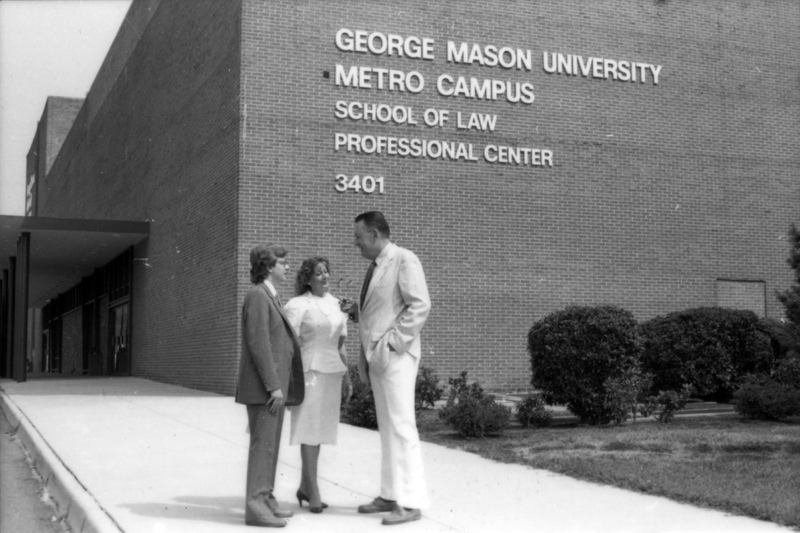
John "Til" Hazel and students in front of George Mason Univeristy, 1987.
But the county’s slow-growth interests surged in 1972, when the election of a new Board of Supervisors signaled a shift in the county’s approach. Their concern over uncontrolled sprawl prompted a six-month ban on rezoning applications to stymie what they saw as unchecked development. Developers, represented by Hazel, fought back in the courts. In a 1975 lawsuit, Hazel called Fairfax County’s plan to restrict lot sizes “nothing more than a $3 million regulatory zoning,” and won. “We’ve got a tiger by the tail,” he crowed, as his lawsuits ate away at county efforts, “and we’re going to hold on till we tame that tiger... It’s war.” Nearly fifty years later, in 2014, in a lecture at George Mason University he referred to his longtime strategy as “growth management through litigation.” When county priorities tilted from preservation to affordable housing, the legal challenges continued, as a way for developers to resist mandates to include low-cost units in new projects.