
Emma Stotts and Generational Displacement
The story of Emma Stotts and her two teenage sons demonstrates how sanitation enforcement served to displace Black and marginalized families from land owned and handed down for generations. In the 1940s and ‘50s, Stotts and her children moved back and forth, for unknown reasons, between the family plot and land owned and occupied by Stotts’ sister and brother-in-law.
A 1950 Census snapshot suggests the lack of adequate alternatives: the image on the right shows Stotts and her children to be one of three nuclear families – fifteen people – living under one roof. About a decade later, according to a March 1963 Washington Post article, sixty-two families were compelled by county regulations to “vacate dilapidated dwellings,” Stotts was the only one of these residents to buck the vacate orders, appealing the findings of health inspectors, fighting eviction from the “small frame shack” she lived in with her two teenage children on property owned by her family for years. Officials offered the Stotts family a five-month reprieve under a hardship clause given their financial difficulties. Contemporaneous reports reveal that county officials also told Ms. Stotts she could receive “Federal financial assistance” to construct “a new house on the lot, which she own[ed].” It is unclear what financial aid she was given, but by 1967 the land tax records show that there were no buildings of value on the property. Faced with the evidence uncovered so far, we are left to surmise that the house was razed.
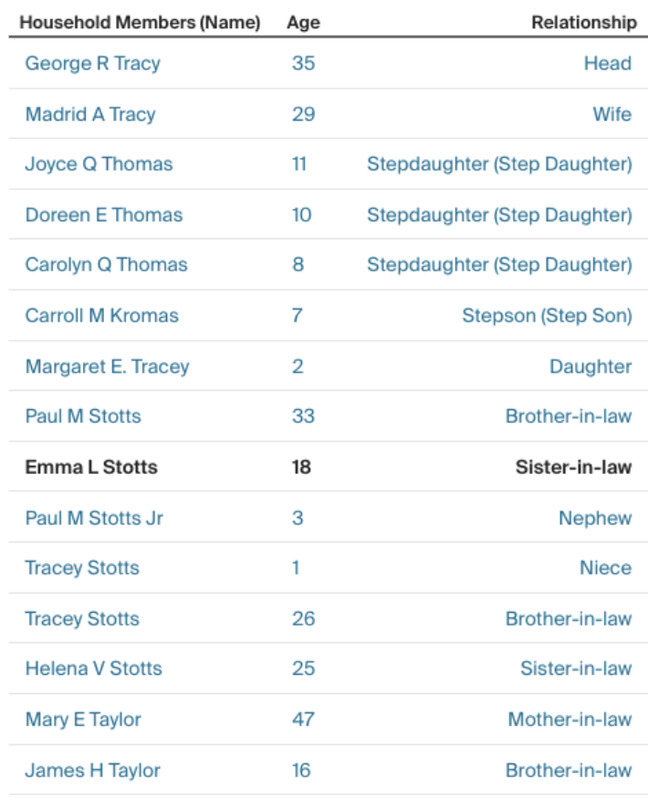
1950 U.S. Census shows the Stotts family moved in with their Tracey kin.
By 1971, the property, in the Brooks family for eighty-seven years, was sold due to a chancery suit. In 1990, nineteen years after the family lost the property, aerial photographs show that the area remained undeveloped. However, by 1997 the photographs reveal the construction of a new community of large million-dollar single-family homes. Forgotten and unaccounted for is the generational wealth denied Emma Stotts and the other families forced to abandon their family homesteads to make way for tract housing and homogenous residential neighborhoods.
In the end the archival records on Emma Stotts’ appeal remain elusive. The final records revealing the strength and legacy of her love as a mother. The Washington Post announcing that she died on October 21, 2002, just four months after her husband. The death notice described her as “devoted mother of Frances Foxwell and Paul F. Stotts,” and also survived by seven grandchildren, 23 great-grandchildren” and a numerous other family and friends. Her viewing and funeral were held at the First Baptist Church in Vienna.