
History of Exclusion
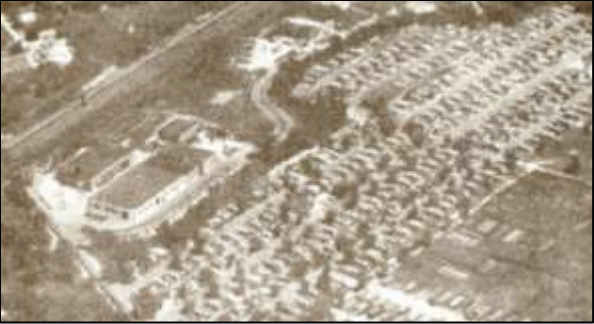
Aerial image of Temple Trailer Village in Alexandria, 1953. Courtesy of Alexandria Times.
The influence of citizens’ and homeowners’ associations was never more apparent than in the regional housing shortage spurred by the Second World War and its aftermath, when the combination of an expanded federal work force combined with mass demobilization to grossly exacerbate an already dire shortage. The national government responded with a series of public housing measures, yet the inability of even fully employed Black workers filling essential roles at Fort Belvoir to find housing speaks to the inadequacy of these efforts. Even the most modest proposed fixes met with local resistance. The furor over a 1943 plan to temporarily house displaced Black defense workers from Fort Belvoir typifies the fight.
The Federal Public Housing Authority, in order to build a multifamily complex for African American residents (with segregation still mandated by law), selected an area of land in Alexandria already in Black hands, which it acquired at below-market rates through condemnation. To house the more than 100 African American families displaced during the construction, it proposed to erect a “Federal Negro trailer camp” nearby. In response, residents, along with the Alexandria Chamber of Commerce and Housing Authority complained to their city council that the camps would “create unsanitary, unsightly” conditions and facilitate “moral conditions detrimental to the best interests of the city.”
They couched their objections in the superficially race-neutral language frequently employed by other federal and state entities, arguing to exclude African Americans not for overtly racial reasons but out of purportedly “moral” and cultural reasons. Despite strong initial resistance, local officials ultimately relented to the trailer park to temporarily “house colored employees of Fort Belvoir,” but only until appropriate civilian housing could be made available. The entire complex, asserted an official of the Alexandria Housing Authority, would be “disbanded … six months after the Negro project [was] completed.”
The Fort Belvoir situation was a rare instance in that period of government attention to a widespread and otherwise mostly ignored predicament around affordable housing in Fairfax. When the county did turn its focus to the problem, just like the wartime federal government struggling to house essential Black workers, officials faced obstruction and delay centered on a myriad of concerns about potential social risks of creating low- or moderate-income units. Some of the most intense opposition was directed at proposals for trailer parks, whether expanding over-subscribed existing properties or building new ones.
Again, a case involving beleaguered Fort Belvoir workers illustrates the extent of the problem. A 1943 application sought to rezone a lot from “Agricultural” to “Industrial” district to accommodate a new trailer camp near the fort. Undoubtedly understating the pressing need for it, the site’s owner and her attorney cited the need to serve the “many people working at Fort Belvoir who want to be located near their work.” She raised the patriotic argument that defense workers’ inability to find housing hindered the nation’s war effort. But an unmoved Fairfax Planning Commission, Assistant Director of Rural Health, and citizens who signed a petition objected on grounds (echoing the Alexandria fight) of “public health” and the absence of a “method of taxation” for occupants. The landowner insisted her facility would comply with all County Health Department requirements. Her attorney noted the presence of other trailer parks in the county, including one with over 300 trailers.
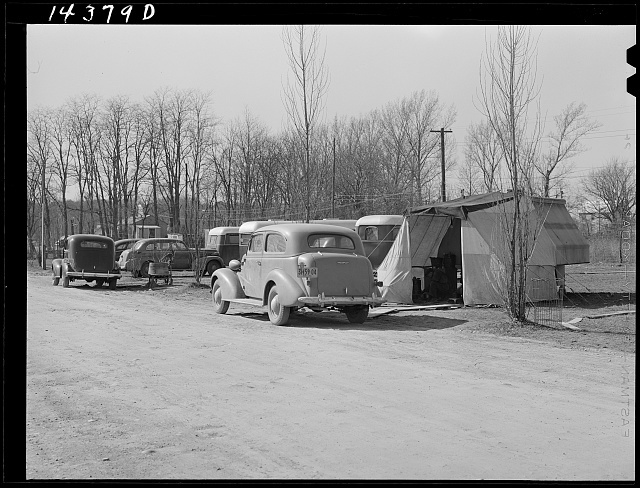
Trailer camp for federal defense workers in or near Alexandria, 1941.
The project’s opponents were unmoved. Avis Booth, leader of the citizens’ group fighting the trailer park, decried a lack of control over who would occupy the trailers—that just anyone, in effect, could move in. By running a “public place,” he argued, the park’s owner would “have to rent trailer space available to whoever might apply for it … [with] no guarantee that the occupants of the trailer camp would not be objectionable.” The Board of Supervisors unanimously agreed, and their response highlights how racially coded terminology, based on vague pejoratives like “objectionable,” served as an effective political tool. Property owners asserted the right to protect their homes’ values and conceptual sanctity as a virtually unimpeachable argument against racial integration and the need for denser housing.