
Exclusion Within the Neighborhood
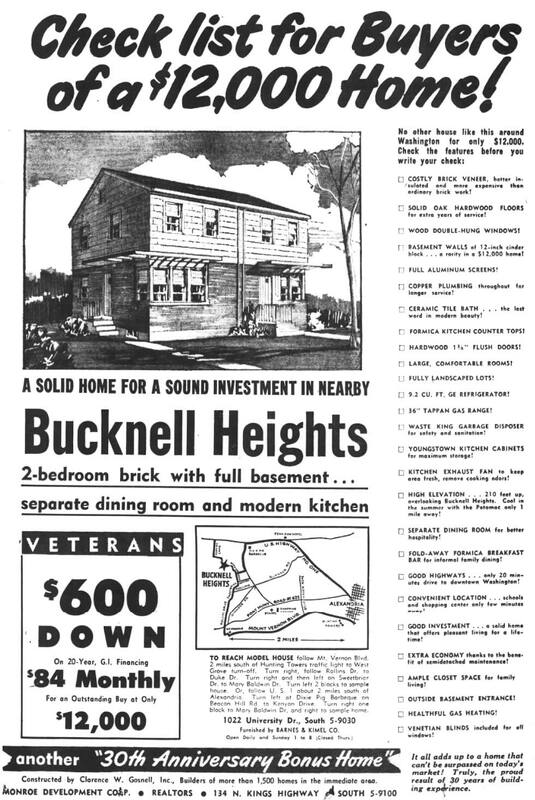
Advertisment for Bucknell Heights.
Neighborhood response to the ruling was mixed. A Mrs. Roger Gary was pleased and sent the Sullivans a congratulatory poinsettia plant. “I’m very proud of the Sullivans, they have done what the rest of us should have done,” she told a reporter. “I admire them for their courage and determination. If we don’t support civil rights in this country, we’re going to be in a very bad way.” Some were less positive. Three of fifteen neighborhood families reached by the same reporter said they opposed the ruling but did not want their names published. Some said they would be moving out, and one asserted that the matter “may be far from over. We feel we’re right about this, and we’re going to take a real good look at that decision before we give up.”
Despite the victory, none of the twenty or so Black families residing in Bucknell Manor or its sister subdivisions, Bucknell Heights, Beacon Manor and White Oaks, joined the shared pool that year. It was not until 1970 that James L. Malloy, an Air Force sergeant nearing retirement, became the club’s first Black member. Upon learning of his admission, he stated “I certainly am looking forward to going swimming there,” but feared he and his family would not be welcomed.
The experiences and concerns of two Black families, the Freemans and the Malloys, highly educated with positions of federal responsibility, were not enough to uproot the deep-seated anti-Black prejudices that permeated suburban life in Fairfax. Even after legal victories were won, emotional scars lingered for Black families. Their stories of exclusion have been relegated to the margins in the construction of a narrative about Fairfax as one of the wealthiest U.S. counties.
With increased suburbanization of the county came increased privatization of recreational spaces like pools, golf courses and country clubs. Though they in many ways appeared public, these amenities operated as segregated private entities, using their “members only” rules to maintain their all-White clientele. By keeping their local community centers, parks, and pools for residents only, subdivisions, too, relied on de facto and ordained segregation to suppress Black membership. Given the spatial geography of Fairfax County, even the few parks located in subdivisions but open to the public, in theory, were in fact hard for the public to reach.