
Frederick ("Freddie") Foote, Jr. and Tinner Hill
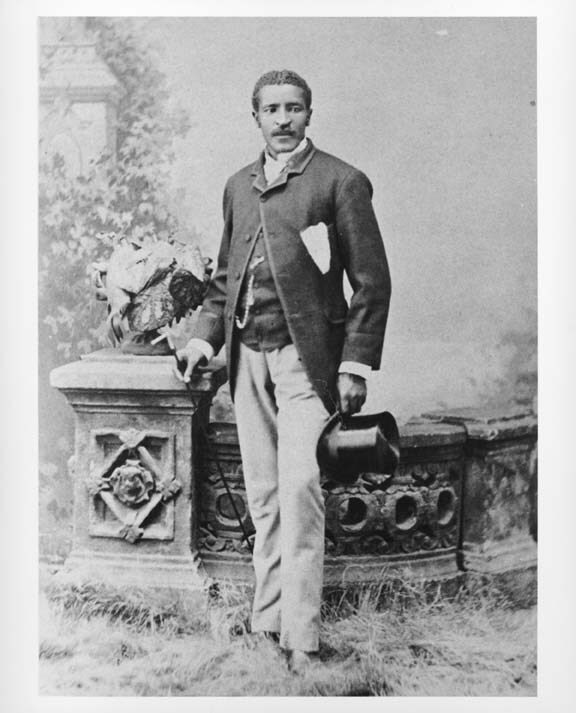
Frederick Forrest Foote, Jr. Mary Riley Styles Public Library, Falls Church History Collection, Falls Church, VA.
Falls Church was one of hundreds of towns where White residents proved willing to tolerate proximity only so long as the law and social institutions kept their Black neighbors subordinated. Though separately governed today, Falls Church was part of Fairfax County until the 1940s. Under Reconstruction, biracial habitation emerged as a threat. In an effort to halt the changing social, cultural and political dynamics, elected officials harnessed legal devices like covenants and zoning laws to redefine the boundaries of White public space on behalf of the White majority.
The 1880 election of local shoemaker and merchant Frederick (“Freddie”) Foote, Jr., as the first—and, for decades, only—Black member of the Falls Church town council raised local alarm about Black electoral power. Foote’s political rise was brief and troubled, as it threatened the county’s racial hierarchy. While on the council, he unsuccessfully fought the first of what would become a string of racial redistricting efforts designed to crush the power of Falls Church’s Black electorate, and spur the growth of Tinner Hill as a center for Black activism. Foote’s win owed to his community’s numeric strength among the town’s registered voters; by 1873, Black citizens accounted for more than a third—232 out of 632, overall—in Falls Church.
Soon after Foote ascended to the council, despite his strenuous efforts to stop them, the majority began looking for ways to reduce that vote by decreasing the town’s Black population. In 1887, they voted to cleave through its well established African American neighborhoods, “retroceding” roughly a third of the town back to the surrounding county and reducing its Black voters to fifteen percent. Foote died in 1889, still in office, shortly before that gerrymandering was approved in the state capital.
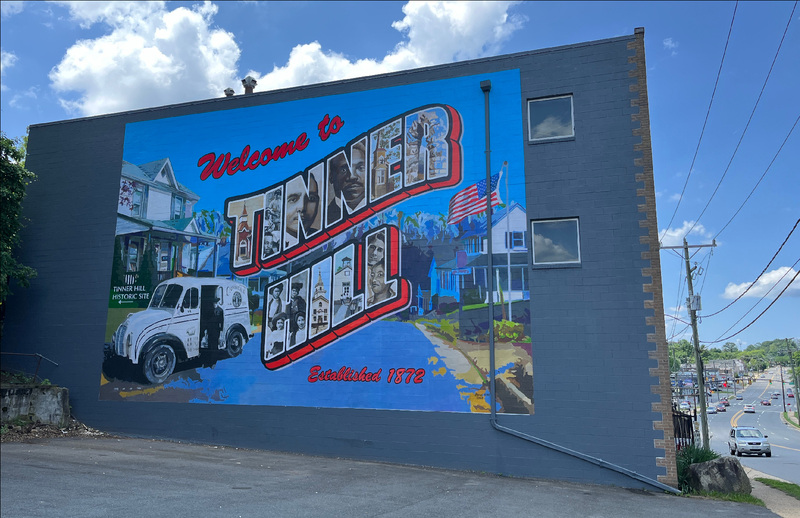
Tinner Hill mural, 2024.
In 1915, the council engineered a new device to marginalize non-White households, by emulating the type of segregation districts that had been imposed a few years earlier in Richmond. The racial zoning in Falls Church was designed to forcibly relocate Black residents of Falls Church from the centrally located enclave of Tinner Hill.
This effort met with an unexpected result, however: powerful resistance from a well-organized local Black community. Edwin (“E.B.”) Henderson, one of the chief activists involved, later described the events in a booklet printed by the town’s Black community:
"In January 1915, the Town Council of Falls Church proposed an ordinance which would have confined Negro residents to a small section of the town, and would have prevented them from living in the area designated for whites even though their homes were already in the restricted districts. Disturbed by this action, I called together some of the leading colored citizens. We met at the home of Mr. Joseph B. Tinner, and nine persons responded to the call."
Tinner, the host and a respected local stonemason known for his oratory, was elected president of the group emerging from that meeting, the Colored Citizens Protective League (CCPL); Henderson was secretary. CCPL members penned letters of protest to the mayor and every council member and also wrote to business owners and visited Black churches to understand their concerns about “the issue of creating four segregated districts and separating the races in Falls Church.” Perhaps most significant, they hired an attorney, former state legislator Thomas L. Jones of Washington, to block the segregation plan. In addition, the CCPL wrote to W. E. B. Du Bois, the leading voice of African American civil rights and co-founder of the nascent NAACP, about joining forces with the new national organization. The outreach led to the creation of the NAACP’s first rural branch in 1918 at Falls Church.
In the Tinner Hill case, the expectations of local governments were competing against the claims of individual White landowners to utilize market forces to promote individual wealth.
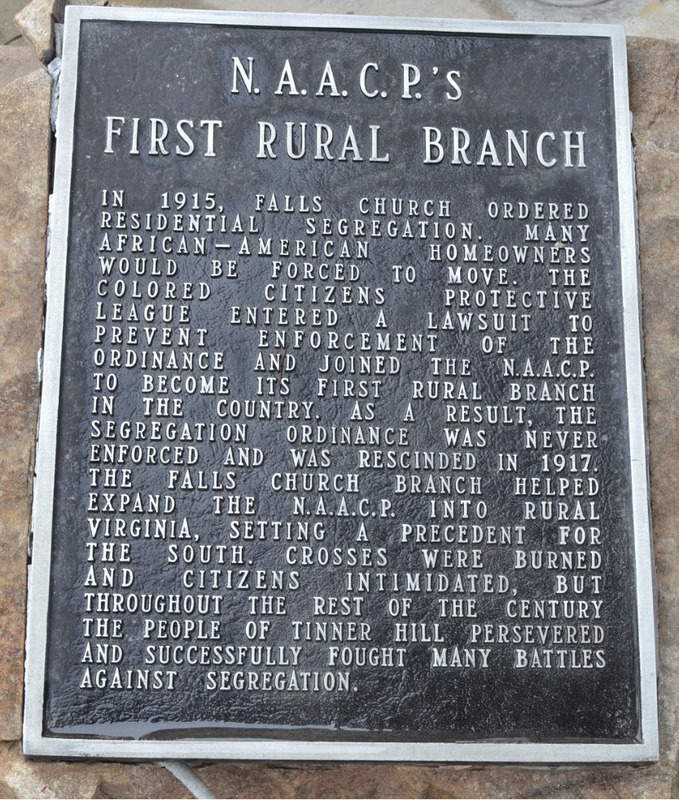
Marker in Falls Church for the NAACP's first rural branch.
A judge of the County Circuit Court “surveyed the town in terms of the proposed ordinance” but withheld his opinion, pending results of a case, Buchanan v. Warley, that reached the U.S. Supreme Court in 1917. Buchanan concerned a municipal ordinance in Kentucky that forbade “colored persons” from occupying “houses in blocks where the greater number of houses [were] occupied by White persons.” In its ruling, the Court deemed racial zoning unconstitutional not because it violated the liberties of residents (Black people and others barred from segregated districts), but because it impinged on the rights of landowners to maximize their properties’ value. Falls Church, like the entire state of Virginia, consequently had to abandon its segregation plans.