
Freehill Amendment
So urgent was the need for sanitation improvements—adequate sewer and water lines, chiefly—that could keep up with fast-paced development in the 1950s that Fairfax Supervisors tried to block new growth to allow county infrastructure to catch up. The resulting “Freehill Amendment” would spark the Board of Supervisors’ most consequential early fight over land use and trigger its first significant legal loss against pro-development forces. While not directly related to low-income households, the Freehill struggle illustrates how power centers shifted and re-formed at the heart of county government, with marked implications for policymaking. And it underscores the significance of sanitation infrastructure in creating county policies that undermined Black households.
To allow county infrastructure more time to keep up with population growth, Supervisors in 1956 amended an existing zoning law to stanch development in the county’s western two thirds. Fairfax’s 1941 zoning ordinance was amended in 1954 to create seven district types: agricultural, rural, suburban, urban residential, rural business, general business, and industrial.
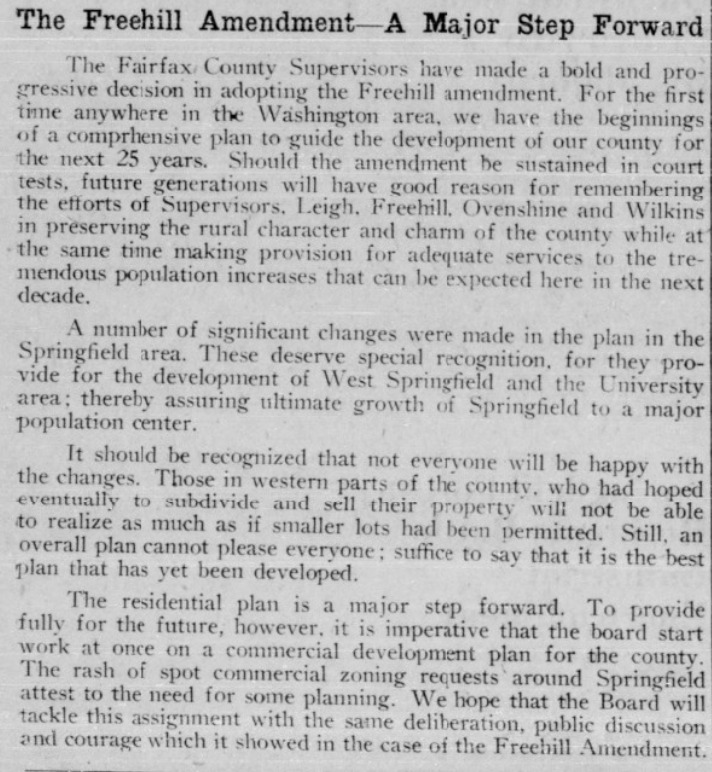
Springfield Independent, July 18, 1956.
Under the Freehill proposal, most land in western Fairfax was redesignated “agricultural,” subjecting it to far larger minimum lot sizes than the county’s denser eastern part. The “residential” zoning districts that covered most of the eastern third required minimums of less than half an acre; in agricultural districts, by contrast, the minimum lot size was two acres. The anti-Freehill battle brought together the seemingly unlikely bedfellows of rural landowners and commercial developers. Backed by the latter, thirty-two property owners, possessing a combined six thousand acres of west-county land, sued the Supervisors for unconstitutionally curbing their potential profits from subdivision development. A Fairfax Circuit Court Judge and the state Supreme Court agreed, calling the amendment’s purpose, of channeling growth to areas “where the cost of the government would be more economical,” an impermissible “barrier … against the natural influx of citizens who desire to live in an area.” To the courts, potential infrastructure costs alone could not justify a zoning ordinance. The adverse ruling in 1956 would not be the last time the Board’s efforts to contain growth faced defeat. Litigious landowners and developers tussled with authorities for decades to follow. Throughout these tussles among propertied and influential partisans, economically vulnerable residents, concentrated mainly in the county’s eastern region, carried on without any guarantee of basic county services. Consequently, the wrangling over Freehill, while limiting the Board’s administrative arsenal, also highlighted whose concerns received the most concentrated attention.