
The Freeman Family
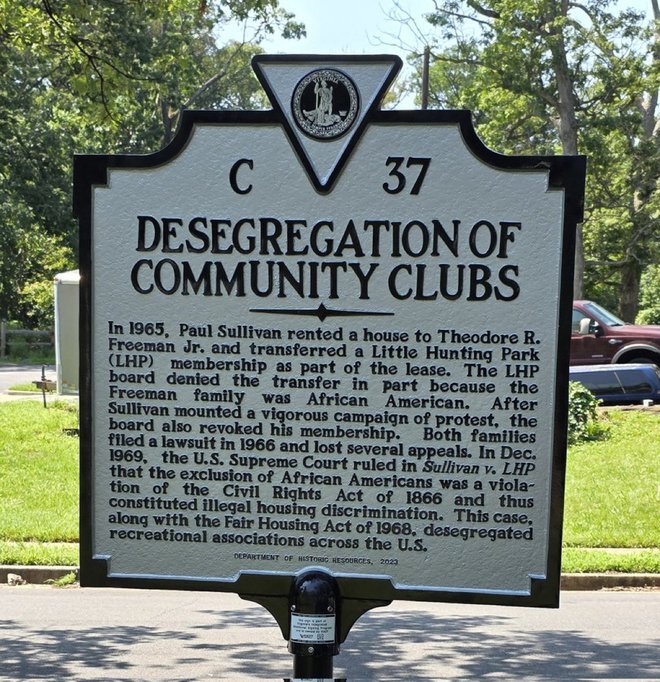
Historical Marker for Sullivan v. Little Hunting Park, Inc.
The battle for equal access to community swimming pools raged across the region. These symbols of leisure and recreation became battlegrounds where White and Black residents battled over differing versions of the American Dream. In March 1966, the Washington Post reported a pivotal moment in Fairfax, as a White landlord faced expulsion from a private swimming club after attempting to secure membership for his Black tenants, the family of Dr. Theodore R. Freeman, Jr., a doctor of agricultural economics and former attaché with the U.S. Embassy in Tokyo, his wife Laura and their two children. The Freemans had in 1964 begun renting a home in the Bucknell Manor development, at 6810 Quander Road, from another federal employee, Paul E. Sullivan. Sullivan’s previous tenants had no trouble using the neighborhood pool via a membership Sullivan owned and for which he billed them as part of their monthly rent. But the Freemans were the neighborhood’s first black family. When the weather warmed, Theodore, Laura, and their sons went for a swim but were turned away. Pool management claimed the exclusion was “made on grounds other than race,” but more painful than the threadbare lie was the fact that the whole White community seemed to turn their backs.
When the Freemans had first moved in, according to Washington Post reporting, “they were made welcome. Neighbors dropped by to say hello, lent them furniture when their own was delayed.” This hospitality ceased after they tried to enter the local pool. Laura Freeman told a Washington Post reporter that the family grew “isolated” as neighbors stopped visiting. Worse than her own exclusion, she was tortured by what her young sons were forced to endure.
When they first moved in, they had made friends in the neighborhood and regularly gone out to play. That all changed, she tearfully recounted “[M]y boys couldn’t walk in their own streets without being called names.” Eventually, as news about the court case drew more attention, the family was violently harassed, and their home attacked. None of them could escape the pressure. Theodore Freeman disclosed that “it got to the point where I couldn’t do my work… I was always calling home to see if my wife was all right and if anything had happened to my kids on their way home from school.” Eventually, he decided the best thing to do was leave Quander Road. The house was no longer a safe home for his family.
"...on grounds other than race."
Their landlord, a National Security Agency employee, fought back against this mistreatment of his Black tenants. After insisting they be admitted to the pool club, he himself was expelled. The Pool Association, Little Hunting Park, Inc., justified its bylaws and membership decisions as based on “appropriateness” and financial means, not race. Sullivan responded by suing.
The case lasted through five years and two sets of Sullivan’s Black tenants’ faced exclusion from the pool; eventually in 1969 it reached the U.S. Supreme Court in Sullivan v. Little Hunting Park, Inc. The pool corporation’s defense throughout was that, as a private social club, it was not bound by civil rights laws.
The ruling described the exclusion as thinly veiled racial discrimination. Little Hunting Park was not, it held, the private “club” it claimed to be, but a looser neighborhood group requiring only that membership reside in the community and pay membership fees. The exclusions in question therefore amounted to “a device functionally comparable to a racial restrictive covenant.” (Emphasis added.) The decision wielded a lasting impact on privately owned swimming pools and country clubs around the country.

Little Hunting Park pool present day.
Though the outcome would turn on legal questions like the definition of “private club,” the case was not without personal poignance. During cross-examination by pool corporation attorney John D. Harris, Laura Freeman shared how, as a child in Texas, she had attended public schools and used segregated public facilities. In response, Harris boldly queried, “Why are you so concerned that something that has happened all your life has happened one more time?” She replied, “I’ve never felt it as much as this time.” Perhaps this time it felt different because she experienced the pain of racial discrimination inflicted on her two Black sons.