
Seeking a Future in Fairfax
Sam Henry Gordon and his family faced harsh challenges when seeking housing in the county, which exemplified the discriminatory conditions ACCESS was fighting against. In 1967, Mr. Gordon and his wife struggled to secure a suitable residence for their seven children. Despite relocating north from Alabama years earlier to pursue a better life, their search for a home proved fraught with obstacles. Mrs. Gordon was a nurse at an Annandale nursing home, while Mr. Gordon worked in Arlington County’s vehicle maintenance shop. That the Gordons were employed with good jobs did not matter to the landlords they contacted. Their countless inquiries in pursuit of a new home were met with frustration and discrimination, as many landlords balked at the prospect of renting to a Black family. Mr. Gordon lamented the prejudice they encountered, stating, “When I tell them I’m a Negro, they say they don’t want me.” When their prospects seemed bleak, a stroke of fortune intervened, and they secured a residence at 7834 Fordson Road in Gum Springs. Owned by the nearby Bethlehem Baptist Church, the four-bedroom house offered a lifeline to the Gordon family.
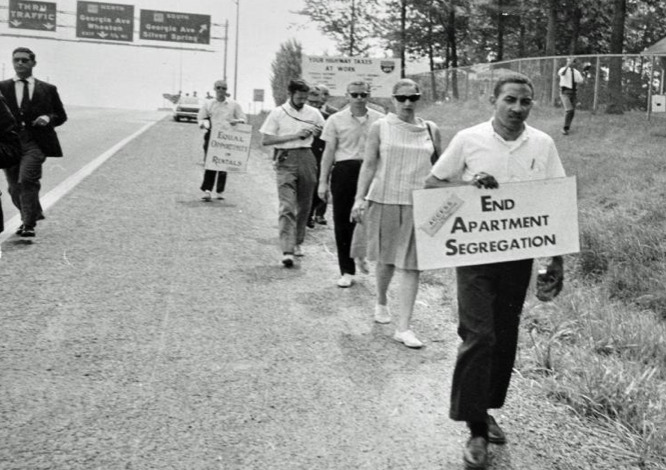
ACCESS founder Joseph C. Jones leading a 66-mile protest walk around the Beltway in June 1966.
For Black householders who did own or rent freestanding houses, the fight for fair access often centered on public services. The neighborhoods of Lincoln Park, Lewis Park and Vannoy Park, commonly linked as “Lincoln-Lewis-Vannoy,” off Braddock Road, fought for more than three decades, into the 1980s, for services considered basic in most of the county, from indoor plumbing and sewage systems to streetlights and paved roads. While their communities faced infrastructural neglect and “architectural exclusion,” other Black neighborhoods in Fairfax contended with “spatial enclosure.” This was the case in Springdale, near Bailey’s Crossroads, where isolating road design required a ten-year battle to open a blocked street linking their neighborhood to main roads through an adjacent White subdivision.