
Growth Management Through Litigation
Exclusionary Legal Tools
The 1970s brought Fairfax officials little relief from persistent housing problems. In a decade defined by soaring inflation, social upheaval, and seismic national political change, inequality throughout the county came into sharp relief. Black residents and leaders and increasingly organized Black and multiracial non-profits had grown institutionally and honed effective new tactics and plans for affordable housing, yet even the best organized crusades still met intractable resistance from single-family homeowners, profit-minded land developers, and county officials. While some of this opposition was rooted in racial and class bias, much of it rested on concerns over profitability and property rights. Consequently, the county remained largely segregated and inaccessible to Black and low-income residents.
A 1970 study by the Washington Suburban Institute, “Land Development,” spoke to the ways deep-seated institutional racism had shaped land development practices that then perpetuated racially and economically exclusive neighborhoods. Fairfax, as the Washington Post put it, was, “White and getting Whiter… [and] rich and getting richer.” “Whiter” residents and greater affluence fueled the reluctance to admit lower-income housing into tree-shaded oases of affluence.
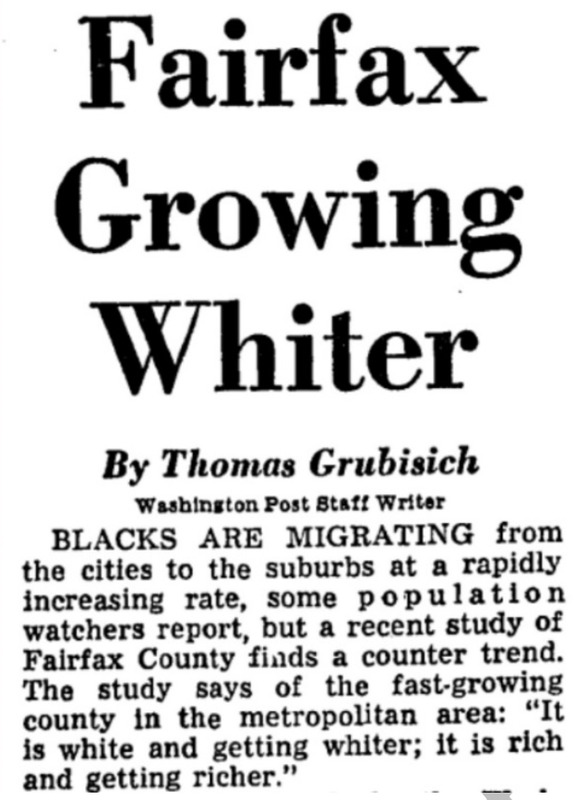
Washington Post, October 29, 1970.
Objections to changes in neighborhoods’ “character” reflected more concrete fears of declining property values—fed not solely or simply by racism but also by decades of discrimination in lending, zoning and infrastructure policy. In an article about local opposition to Rolling Road Estates, a proposed low-to-moderate-income project, a nearby White neighbor, “Veronica” voiced some locals’ worries about integration’s market effects. She defended her opposition to what she called “an eyesore around the corner” on the grounds that she and her Navy budget-analyst husband had invested heavily in improving their family home and were counting on selling it in five years to fund their retirement.
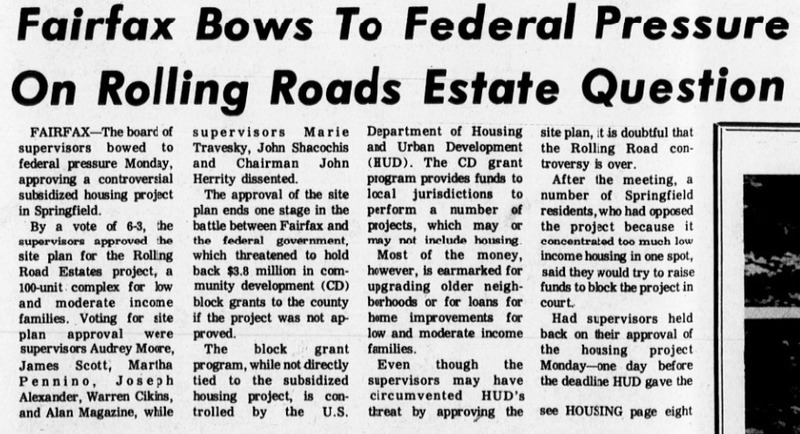
A later excerpt showing local disdain for the project. Northern Virginia Sun, June 27, 1978.
Keenly aware of such opinions, developers likewise resisted the inclusion of affordable units among market-rate offerings, even when offered financial incentives, for fear of deterring potential buyers. One builder plainly explained that potential home buyers might hesitate to purchase a house “at the thought of ‘poor people’ living down the road.” This resistance underscored the deep-seated biases and structural inequalities that permeated Fairfax County’s housing landscape.
When it came to affordable housing, the interests of developers and local government, with its various constituencies, interacted in complex ways. Even apart from the needs of low-income communities, their interests only sometimes aligned. Fairfax County operated at the nexus of competing interests and constituencies that wanted it, variously, to finance its growth, control its growth, develop open spaces, and preserve its rural character. In this mix, armed with financial influence, political ties and legal savvy, developers often managed to drive the discourse and, usually, come out on top. The most ignored constituencies, meanwhile, were African American and economically disadvantaged communities.