
Uneven Investments in Infrastructure
By the 1950s, demographic growth and the housing gap were accelerating. Supervisor Wilkins noted in 1955 that the population had nearly quadrupled over 15 years, from 40,000 residents in 1940 to 157,000. In that decade alone, from 1950 to 1957, it went from 98,000 to 201,000, earning the designation of “fastest growing county in the United States.” Unfortunately, this growth was not dispersed across the county’s approximately 400 square miles but confined almost entirely (90 percent) to its easternmost third. The county’s housing stock and, even more urgent, its water and sewer infrastructure, appeared inadequate to projected new growth. Census data from 1950 showed that only 73.6 percent of dwelling units in Fairfax County met even basic livability standards, such as hot running water, private toilets, and baths in non-dilapidated conditions. This disparity was stark when compared to neighboring Arlington, where nearly all homes were identified as structurally sound.
National and regional attention to these imbalances, and a 1950s focus on infrastructure, helped shape changing sets of political choices and investments. Post-war urban renewal efforts in Fairfax coincided with construction of massive new federal complexes and infrastructure projects in the region. National (now Reagan) Airport opened in 1941, the Pentagon in 1943, the CIA headquarters in 1961, Dulles Airport in 1962 and the Capital Beltway (I-495) in 1964. As Fairfax was transformed into a critical locus in the nascent Dulles Corridor, the county began sipping from a new spigot of federal development funding: urban renewal initiatives.
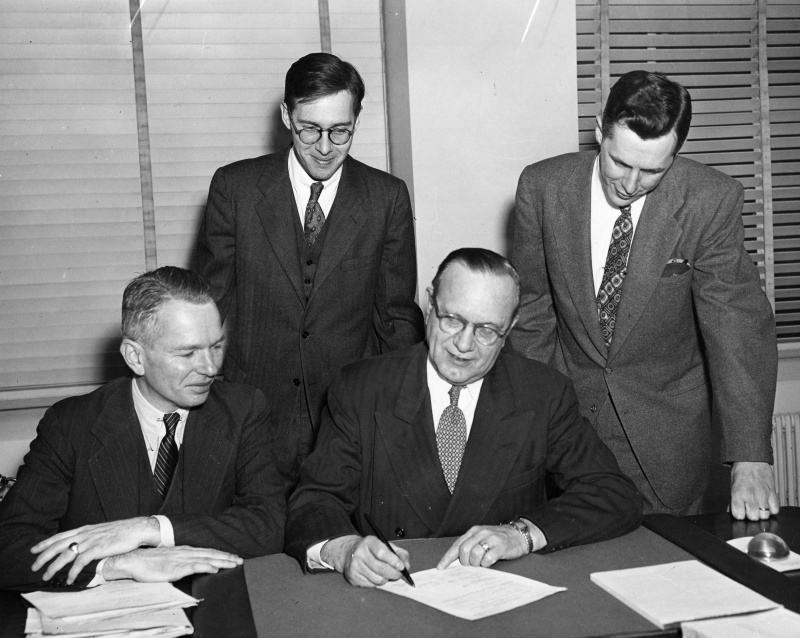
First signing of reservations under Title I of the Housing Act of 1949.
The 1949 Federal Housing Act was passed when, in the aftermath of the Great Depression and World War II, housing and urban issues topped the domestic policy agenda. Amid alarm about supposed racial-social pathologies spreading throughout American cities, urban renewal was newly defined as a government responsibility, leading to federal aid for “slum clearance” and redevelopment programs. In 1949, Congress authorized the Housing and Home Finance Agency to assist locally planned projects. Title I, “Slum Clearance and Community Development and Redevelopment,” aimed to induce private investors to replace dilapidated housing stock with new residential housing and marked the first federal recognition, written into the law’s very titles, of “slums” as a national problem.
These were the terms and context in which Fairfax County operated, but few have attempted to understand the local effects of anti-slum and pro-“sanitation” initiatives for marginalized communities. A cache of documents on sanitation inspections and policies from the 1950s, including early planning reports on new sewage treatment centers and other core infrastructure, demonstrate how local policymaking undermined Black communities like Gum Springs and Oak Grove. While it was withholding basic services from vulnerable communities, the county invested heavily in infrastructure consultants and planning for a new sanitation system. Its growth was predicated on creating the desired healthy living conditions for those whose homes were new enough and resources ample enough to be able to connect to an upgraded sanitation system; this modernized infrastructure in turn ensured that the value of newly developed properties would increase. Sanitation Campaign: A System of Surveillance describes in detail how seemingly benign sanitation policy proved itself a pernicious mechanism promoting Black displacement.
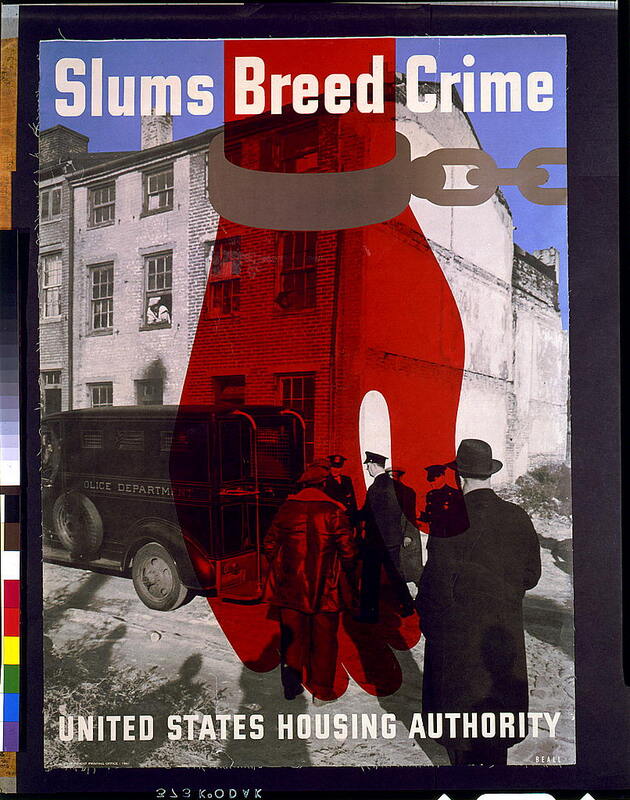
US Housing Authority anti-slums poster, 1941.