
We Were Not a Part of the Change: Introduction
An Introduction to the Origins of Housing Inequality in Fairfax County
Fairfax County, one of the most prosperous areas in the U.S., is not immune to the stark realities of racial inequality and economic segregation. A long history of intersecting economic policies, political decisions, and social movements produced the landscape of Fairfax County that we know today and has had lasting impacts on the county’s population of Black residents.
Fairfax County’s Black communities have a rich history of struggling for equality, social justice, and improved living conditions. These communities faced significant challenges throughout the 20th century. These challenges included racial segregation, under-resourced education; a lack of access to affordable housing; denial of public services, health care. This report presents this disturbing yet often unknown historical narrative of uneven and contested progress in Fairfax County.
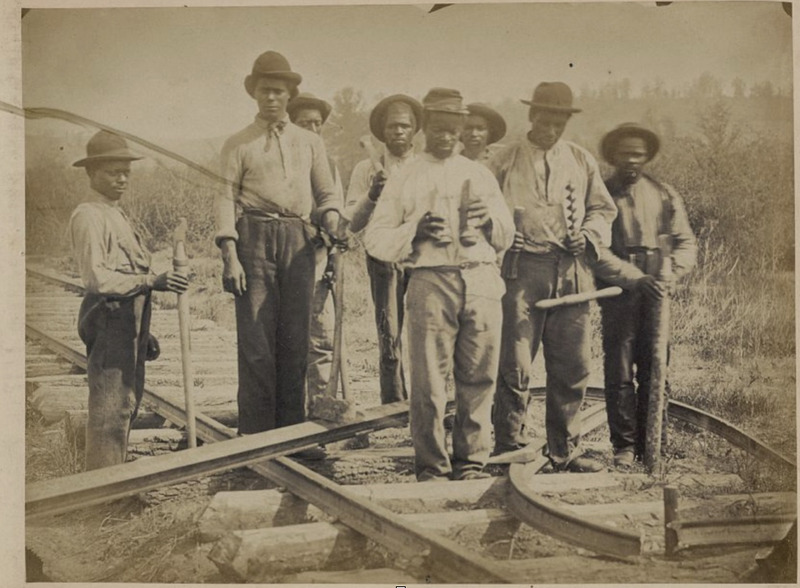
African American men during Civil War military operations in Northern Virginia, where they were employed to chop wood and repair railroad tracks, including at Fairfax’s Burke Station.
White residents, builders and developers, and elected officials and government administrators designed a system of racial exclusion while constructing islands of advantage that assured the accumulation of White economic wealth. The report also highlights the dogged resilience of Black communities, making plain that the lack of affordable housing in Fairfax was neither a secret nor an accident. It supports the conclusion, presented by The Commission to Examine Racial Inequity in Virginia Law, that “[r]acial disparities in housing are widely acknowledged to be the direct result of government action, including state and local zoning and lending choices.” The structural inequity is deeply rooted in Virginia, but so too is the fight for equality. This report is a call to action—an invitation—to listen, repair, and to act.
Traditional scholarship on Fairfax County highlights stories of progress and fabricate a myth of Fairfax as a modern suburban paradise that welcomes people of all types, from all around the world, to contribute to the economic success of Northern Virginia and the American democratic experiment. In this narrative, the bulldozer represents ingenuity, pluck, and progress. It could clear entire landscapes, removing all reminders of what came before. Yet to make way for Fairfax’s version of the “typical” American suburban dream, those same dozers removed all traces of many early and cohesive Black communities. This dream, pulled together through exclusionary public and private partnerships, utilizing policies from the state and national levels, intertwined with local regulation, to further a growth agenda. What resulted was a literal Whitening of the population.
The vibrant Black communities born in the post-Civil War era—testament to strong Black culture and community bonds—were replaced by White and suburban geographies. Alongside the bulldozers, from one end of Fairfax to the other, rode a longstanding commitment to constructing a single uncontested narrative about the County that supported the removal, exclusion, and erasure of Black life and community in Fairfax. As one longtime resident and Black community elder put it, “As the community changed, we were not part of the change… The worst thing that can happen is to be erased.” The suburbanization of Fairfax, long touted as the result of progress and modernity, was built on the marginalization and neglect of Black residents.
The agriculture-based plantation system and its colonial foundations rapidly disintegrated at the turn of the twentieth century. The expansion of federal bureaucracies, supporting industries, and contractors created a machine that required labor and significant infrastructure to support the emergence of the United States as an international superpower. Local landowners, builders, developers, and county officials saw an opportunity to exploit the county’s attributes: big swaths of dairy farmland and close proximity to the nation’s capital city. Fairfax’s geographic location attracted hundreds of thousands of new White residents, causing unprecedented growth in the post-war era.
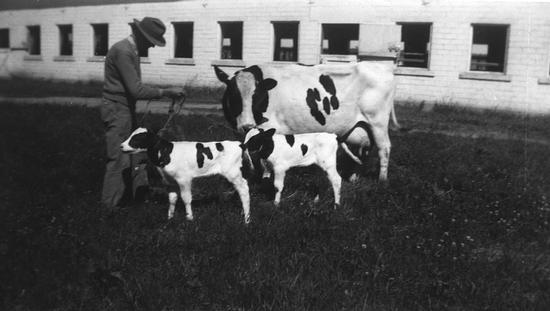
A Fairfax dairy farmer tending to a dairy cow and calves.
At the same time, longstanding Black communities were being pushed out of the county through segregation districts, racial covenants, sanitation ordinances, zoning, denial of basic investments into community roads, modern sewage systems, and condemnation of property.
Fairfax County refused to provide adequate affordable housing for Black residents. African Americans moving to the region seeking jobs were often boxed out of employment that would have allowed them the financial means to buy even a small tract house. Even when personal finance wasn’t a concern, the real estate protocols, abetted by local, state and federal policy, barred Black residents from safe, affordable housing. Fairfax was not welcoming to African American families seeking a Virginia community in which to raise a family. In contrast, the county unrolled the welcome mat for White professionals and corporations, many of them contracted by federal agencies in the Cold War effort. Corporate access to federal tax dollars through government contracts certainly hastened suburbanization, while selectively friendly policies encouraged an influx of White people into the Fairfax suburbs, spurred expansion of the ubiquitous subdivision, hastening the unsentimental displacement of Black communities and denial of generational wealth accumulation. This history of Black communities in Fairfax County reveals a process of White suburbanization that created an unwelcoming and unjust landscape for African Americans. The scarcity of affordable housing is not a flaw in the system but a deliberate feature.