
Joseph Charles Jones and ACCESS
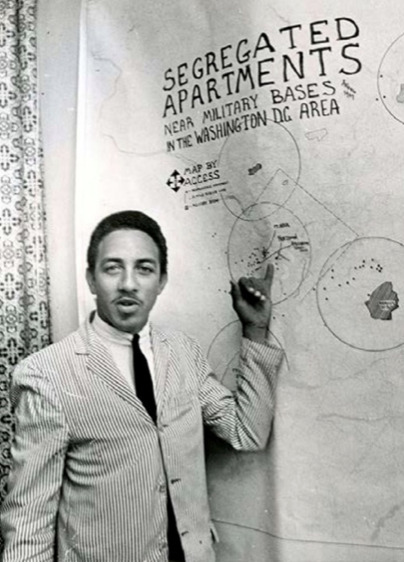
ACCESS Chairman Charles Jones displays a map of segregated housing near area service installations, May 1967.
After decades of disinvestment, rolling sanitation campaigns, and the contrived lie that African American failed to make good neighbors, Black and white civil rights activists organized to protest the unjust conditions facing many Fairfax residents. In 1966, civil rights activist Joseph Charles Jones formed the Action Coordinating Committee to End Segregation in the Suburbs (ACCESS), aiming to mobilize communities against discriminatory housing practices and demand open occupancy in the suburbs. With civil rights movement experience already under his belt when he arrived to study at Howard University Law School, Jones perceived the structural pattern of racialized exclusion throughout the D.C. metropolitan area. He characterized the stark housing disparities in Washington and its suburbs as a “White ghetto surrounding the black ghetto.” His plan for ACCESS drew on lessons from James Meredith’s 1966 Mississippi March Against Fear and from Jones’s own experience—as a founding member of the Student Non-Violent Coordinating Committee—helping organize the 1963 March on Washington for Jobs and Freedom alongside Dr. Martin Luther King, Jr.
ACCESS began mounting large-scale demonstrations in Northern Virginia and the Washington metropolitan area, gaining momentum that attracted activists, organizers, and concerned citizens from diverse backgrounds. ACCESS’s first significant demonstration was a historic protest march along the entire 65-mile circumference of the Capitol Beltway, opened just two years earlier.
On June 8, 1966, demonstrators embarked on a four-day journey beside multi-lane traffic to draw attention to the region’s entrenched patterns of segregated housing, its “Negro homes, shacks, and fire traps.” Despite hostility from some passersby, marchers received support from sympathetic onlookers who provided food and drinks to sustain their journey. The local march, part of a larger civil rights campaign for fair housing, made a powerful statement, capturing the attention of local and national media outlets. Jones and other ACCESS leaders took the opportunity to broadcast their call for open occupancy and an end to apartment segregation. After the Capitol Beltway march, ACCESS emerged as a formidable force in the fight for housing equality in the region and expanded its activism to Fairfax and other exclusionary locations throughout Northern Virginia where housing segregation remained deeply entrenched.
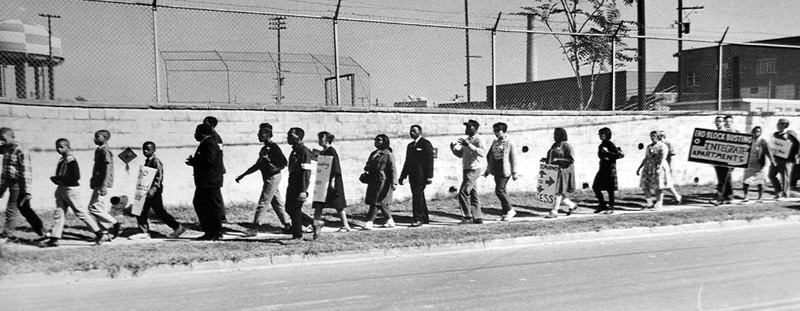
ACCESS members on day one of a three-day, fourteen-mile march for racially inclusive housing in Northern Virginia that commenced October 8, 1966, in Alexandria.
In October 1966, Jones and ACCESS organizers orchestrated a second march, focused on Northern Virginia. The march aimed to shed light on discriminatory housing practices and rally support for integrated neighborhoods in Alexandria, Arlington and Fairfax County. The three-day, 14-mile trek was routed to highlight differences between White and Black suburban housing. Explained ACCESS Vice Chair William Hobbs, “We specifically mapped this out to pass through some representative White areas” and include three large black areas “to connect them in people’s minds.” Beginning in Gum Springs, the prominent Black community in Fairfax, twenty-five demonstrators walked for three days through Alexandria and Arlington county. Their first leg started at Fordson and Sherwood Streets in Gum Springs and went seven miles along Route 1 to Alexandria, before covering another four miles to South Glebe and Shirlington Roads in Green Valley, where plans called for an evening block party and rally. The following day’s goal was the Buckingham rental office through Fillmore Street and Pershing Drive and then Lubber Run Park—three miles total. Along the route, they held rallies at significant sites, including the James Bland public housing development in Alexandria and the Buckingham apartments in Arlington. These locations were deliberately selected to bring into sharp relief the cruel disparities in housing conditions faced by Black residents. Once again, this laid bare the vast regime of spatial control throughout Northern Virginia that kept out or at the margins far too many African Americans.