
Lack of Investment
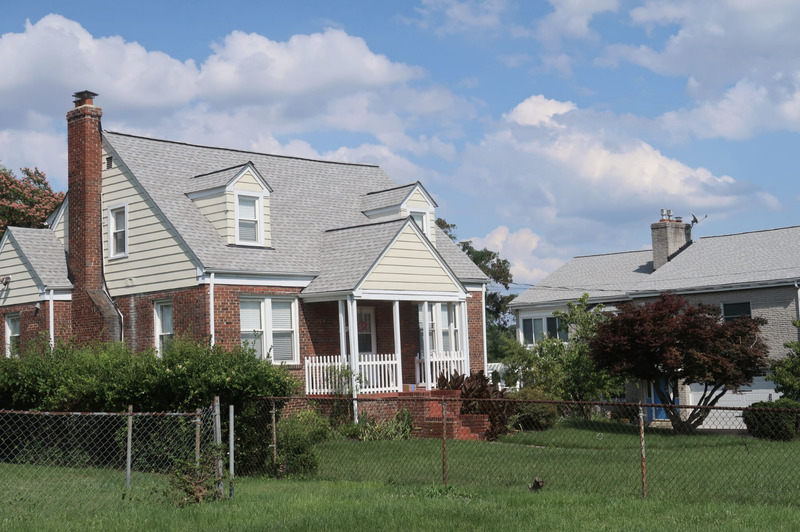
A remaining original Springdale home, 2023. Courtesy of Annandale Times.
In the case of Springdale, whose access to main roads ran through the White subdivision of Dowden Terrace (along the Alexandria-Fairfax border, Black residents complained as early as 1963 about the artificial dead end on Lacey Boulevard that made it hard to enter or exit their community. Civil rights attorney Allison W. Brown, Jr., described their lack of road access as “part of a racially discriminatory pattern that occurred as the subdivisions grew around them.” Resident Charles Robinson agreed. Robinson, who moved into Springdale in 1963, becoming president of its civic association, came to see “a racial attitude” in local opposition to road extensions. “They don’t want us in their neighborhood,” he told the Washington Post of adjacent communities.
In 1971, Brown brought suit over road issues on behalf of Springdale’s and three other Black citizens’ associations along with several individual residents. Their complaint covered not just the Lacey Boulevard blockage but “89 rutted, unpaved roads in poor black neighborhoods.” In a settlement reached the following year, county and state highway officials committed $700,000 for the work demanded, to be completed over three years, with additional funding if needed. Plans included grading and paving as well as connecting Springdale’s streets to White-occupied blocks nearby, despite the objections of Dowden Terrace residents.
It had taken decades, but thanks to these communities’ resistance and persistence, the two dead-end signs standing seventy-five yards apart—a physical manifestation of what the Post called “a racial stigma out of the past”—finally came down.
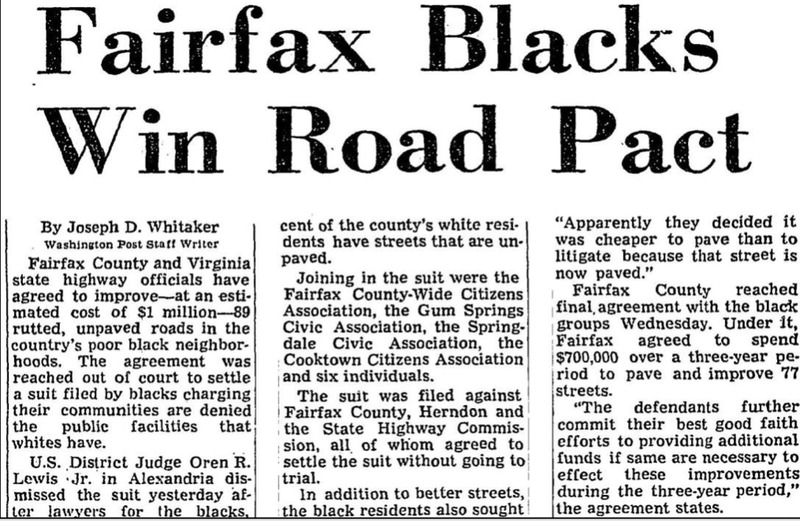
Washington Post, June 2, 1972.
The 1972 Fairfax County and Virginia State highway agreement to invest in public services for the county’s Black neighborhoods also benefited Gum Springs. At the time of the settlement and according to land records, African Americans still owned about sixty percent of Gum Springs land, averaging half-acre lots. Gum Springs residents, who had attained, on average, education through the eighth grade and who tended to work as janitors, domestic workers, and construction laborers, still believed in their community, despite its challenges. This commitment led them to pursue their own lawsuit against Fairfax County, in August 1971, alleging they had been deprived of facilities readily provided to White citizens. This denial of public services reflected overall racist policies that denied African Americans the same opportunities and access as the county’s White residents. The result of the denial was “blighted Negro neighborhoods.”
The suit charged that sixty-two percent of 13,471 African Americans living in Fairfax County resided in neighborhoods that were unpaved, compared to less than one percent of the county’s White residents. In addition to better streets, the lawsuit sought improved water and sewer facilities, streetlights, sidewalks, and fire protection. The Fairfax County Citizens Association, the Gum Spring Civic Association, the Cooktown Citizens Association, and six additional individuals joined the suit. Allison Brown, their lawyer (who also litigated Springdale’s case and Little Hunting Park), declared that the “streets had been nothing but a muddy morass for a hundred years.” Again, in Brown’s view, the county “decided it was cheaper to pave than to litigate,” and the case was settled. Fairfax officials agreed to bring the streets up to appropriate standards, and the county’s 1973 budget included $500,000 to improve streets, water, and sewer facilities in “underdeveloped” communities. The improvements were a welcome change, but the state and county investments still fell short of addressing decades of Black homeowners’ lost property value.