
Land Development and Racism
The transformation of farms and fields into bedroom communities made Fairfax a site of White prosperity and Black displacement. Consequently, by the 1940s, longstanding Black communities were being pushed out of the county, removed from the Virginia landscape, and wiped from local memory. This harsh reality substantiated in a report written in 1970 titled “Land Development and Racism in Fairfax County” found that the County’s “land development process” was “institutionally” racist and resulted in “blacks who do not now reside here being kept out of the County’s housing and jobs while also providing poorer housing; fewer public facilities, worse jobs and lower incomes than Whites” for current Black residents. Further, despite being presented with evidence of this practice in Fairfax local land developers, politicians, and government officials refused to institute plans to reverse these processes. They choose instead to downplay histories of inequality that facilitated the growth of townhomes and single-family houses.
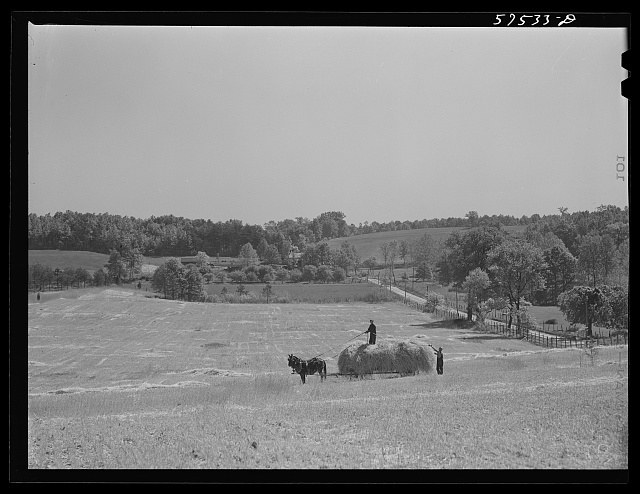
Farmers taking in rye after it had been cut near Vienna, Virginia.
As a result, many of the County’s housing and job opportunities were inaccessible to Black residents, and the quality of the housing and job opportunities available to them were often inferior to the options available to White residents. A 1963 report produced by the Fairfax County Housing Committee suggests that many county employees found the identification of good affordable housing in Fairfax exceedingly difficult, regardless of race, and, yet racism exacerbated the already difficult circumstances.
"It is particularly difficult for Negro teachers to obtain suitable housing near the school where they work. This situation deprives the local community of the leadership and example which most educators provide. In several Negro schools approximately half the faculty commutes about 40 miles daily to and from the District of Columbia… Negroes in all income brackets find few willing sellers or lessors in most parts of the county."
Moreover, despite being presented with evidence of this institutional racism, those in power chose not to take measures to improve the situation for Black residents, instead opting to ignore the history of inequality that had shaped the development of the area. Fairfax was not welcoming to African American families seeking a Virginia community to raise a family. In contrast, a welcoming environment was created for White professionals, as well as for corporations contracted by federal agencies to assist in national Cold War efforts. Corporate access to federal tax dollars through government contracts certainly quickened suburbanization, and the welcoming policies led to an influx of White people into the Fairfax suburbs, the expansion of the ubiquitous subdivision, and the unsentimental displacement of Black communities. The history of Black communities in Fairfax County reveals the process of White suburbanization that created an unwelcoming and unjust landscape for African Americans.
"...surveillance and forced removal of Black residents."
Scholars have persuasively detailed the impact over time of racial stereotypes debasing Black people and their communities as inherently pathological, dirty, and content to occupy unhealthy spaces. These tropes ignore the various institutional practices that confined African Americans to undesirable spaces. Twin practices—the strategic labeling of “racial blight” to support urban renewal paired with an embrace of “redevelopment” and “improvement”—facilitated the displacement. These practices, deployed in the name of economic growth, sanitation, and community health, were predicated on deep-seated cultural biases not easily repudiated. This discourse around blight denied Black communities in Fairfax County the opportunity to benefit from the resources and services needed to create healthy, vibrant communities.