
Bigotry in Legal Language
As eugenics and segregation gained influence in governance, under the guise of “scientific management,” property covenants (and, later, zoning) emerged as a legal tool to impose them across the geographies of Fairfax County and other jurisdictions across the Commonwealth and the country, all in service to the new, White suburban American Dream. A new class of professionalized government officials trained in land use, social services, and property values, to which they brought cultural assumptions about social purity, American imperial prowess, and class politics. In Fairfax, writes Northern Virginia historian Krystyn Moon, this led to policies that “privileged the production of wealth for White middle- and upper-class homeowners by prioritizing single-family dwellings and their property values over all other types of development.”
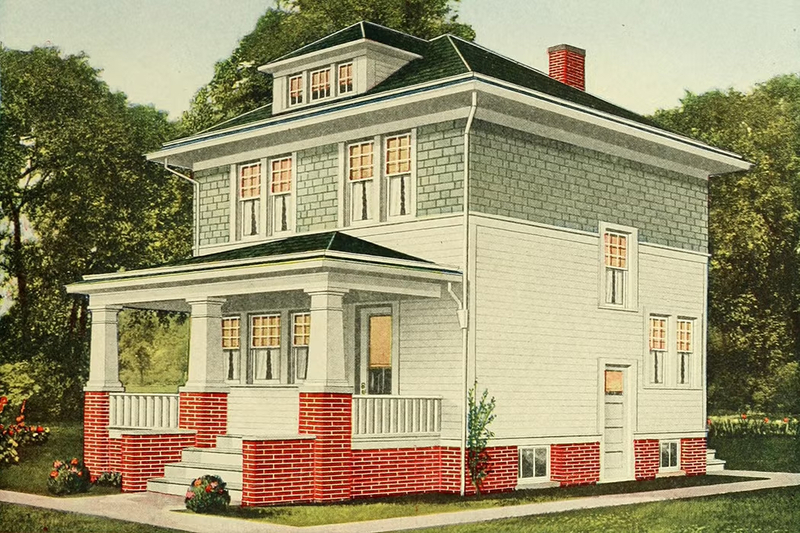
Image from Central Lumber Company's Book of Homes, 1920.
What these legal documents and many zoning laws did was to make these divisions explicit. The 1929 corporate deed for Whites-only Gunston Manor provides an example of how legal language could express a neighborhood’s racial exclusivity:
"No part of the said land shall be granted, leased, sold or conveyed to a person or persons of African descent, nor for the use and/or occupancy of a person or persons of African descent; and any attempt to grant, lease, sell or convey any part of said land to a person or persons of African descent, or for the use and/or occupancy of a person or persons of African descent, shall be a mere nullity, and the grantor shall retain full title thereto the same as though said deed or lease had not been made; and adjoining property owners, or the Gunston Manor Property Owners Association may eject such person or persons of African descent from said property, or cause them to be so ejected by proper action in the courts of the State of Virginia."
Beyond the blatant, unsettling bigotry apparent in the deed, this language represents a critical ideological shift. Before this, the laissez-faire understanding of property ownership was that landowners retained unquestioned rights to their property and its disposition. This fundamental understanding of American society, a fruit of settler colonialism and Atlantic slavery, had to be refashioned once formerly enslaved Black people and other people of color could acquire property. By the early twentieth century, racial covenants had become the vehicle for this transformation. Strikingly, to maintain White, homogeneous neighborhoods, owners were willing to relinquish even their own rights (to sell to all comers). This model became standard across many localities, including Charlotte, North Carolina (1875), Kansas City, Missouri (1908), Richmond (1912) and Washington, D.C. (1921). These racial restrictions were validated by the U.S. Supreme Court in Corrigan v. Buckley in 1926. The court confirmed that racial covenants were private contracts and not public actions, and thus protected by the Fourteenth Amendment.
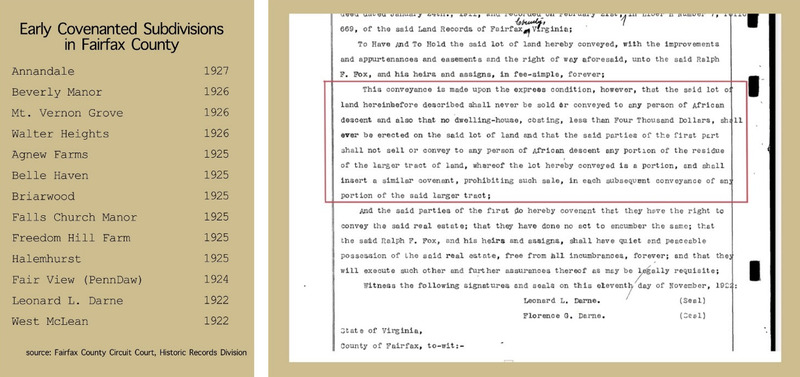
List of early Fairfax subdivisions subject to racially restrictive covenants and excerpt of such a covenant attached to deeds in the Darne subdivision.
The application of racial covenants in Fairfax, like other jurisdictions in the United States, demonstrates suburban homeowners’ commitment to protecting racial homogeneity. These contractual arrangements guaranteed exclusive property rights to White home buyers by compromising their autonomy. They could not sell or rent based on market forces instead their choices as homeowners reinforced that African Americans neighbors threatened the value of their financial investment.
- In 1925 the Halemhurst neighborhood, near present-day Fair Oaks, instituted one of the earliest covenants in the county to assure the “[s]ubdivision is made, however, under and upon the express conditions that neither said lots nor any interest therein, shall ever be sold, leased, devised, given, granted or conveyed to any one not of the Caucasian Race.”
- In 1938, East Fairfax Park near modern day Springfield the residential covenants required “[t]hat neither the said lots nor any interest therein shall be sold, leased, conveyed or devised to, or occupied by, any person not a member of the Caucasian Race.”
- Six years later, in 1944, Fairfax Acres, near Oakton, crafted very detailed requirements for homeowners, stipulating that lots in the subdivision “shall never be occupied by, sold, leased, devised, conveyed or in any manner alienated to any person of the Negro Race, except that this covenant shall not prevent the use by any owner or tenant of said lots for domestic servants of the Negro race.” (Notably, this example demonstrates that White homeowners’ property investment was not threatened by the presence of Black women as domestic laborers.)
- An ironic local application of covenant law covered a sixty-acre subdivision created in Annandale in 1950, near the bygone community of Ilda. Founded shortly after the Civil War, Ilda was named for the Black-owned farms and blacksmith shop that once anchored it, but only one Black family was left by 1951, when entrepreneur Gareth Neville began advertising forty home sites in the new neighborhood he had launched with a Confederate name: “Lee Forest is just a breeze away from Washington,” read the ads. Neville attached to every deed of sale a covenant banning outdoor privies, livestock and the future sale or conveyance of any subdivision property “to any person not of the Caucasian race.”
Such covenants would not be struck down by the Supreme Court until 1948 in Shelley v. Kraemer. In the wake of Shelley, suburbanites in Fairfax became skilled at defending their exclusionary housing politics in other ways. Consequently, while Shelley was a legal milestone that ended race-based covenants under the law, facially race-neutral workarounds persisted and grew. According to the American Enterprise Institute, other legal mechanisms served as “a backdoor to achieving constitutionally prohibited racial segregation.”