
Legal Battles
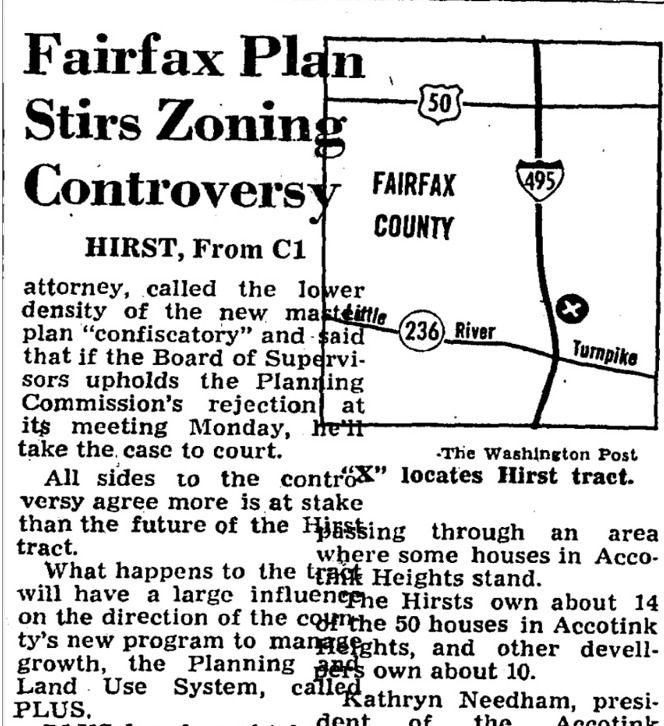
Excerpt from Washington Post article about the PLUS (Planning and Land Use System) program’s land-acquisition challenges, “New Plan Pits Fairfax, Family in Zoning Fight,” July 18, 1975.
Attempts to implement zoning ordinances to address housing affordability were met with unrelenting legal challenges and setbacks. Preservationist and other anti-growth opposition restrictions faced impassioned backlash from large-tract landowners wanting the highest price for their land. A property owner shared with a Washington Post reporter, “If I can’t subdivide it will be a financial disaster for me.” These conflicts formed the ground for legal battles that would vex Fairfax planning for years to come.
Court rulings in favor of development interests repeatedly struck down ordinances that could have led to more construction of low- and moderate-cost housing. In the early 1970s, county officials recognized a pressing need for 10,500 units of affordable housing. This was the rare case in which eminent domain was deployed by the county to address the interests of a politically vulnerable population. They required developers to donate 15% of their land to low- and moderate-income housing as a condition of approval for development.
This effort culminated in the 1973 decision, Board of Supervisors of Fairfax County v. DeGroff Enterprises. When the case reached the Virginia Supreme Court, a judge ruled the requirement an overreach in its attempt at “socio-economic zoning.” According to the ruling, if 15% of housing units were limited to low- and moderate-income tenants, the income that could be realized from those units would necessarily be limited, thereby controlling compensation for the land’s use. Two earlier decisions were cited by the court, the Board of Zoning Appeals of Fairfax County v. Columbia Pike, Ltd., and Mooreland v. Young. These decisions established that controlling land use compensation constituted an unconstitutional taking of private lands without just compensation. The judge was not unsympathetic to the county’s housing problems but concluded that its proposed solution was invalid.
The case illustrates the ethical and legal challenges associated with using eminent domain to address housing inequality. The case also highlights the tension between the need for affordable housing and the protection of property rights. It is however worth noting that even though county officials lost many legal battles against developers when using eminent domain to resolve housing shortages, they were more successful when utilizing their power to displace African American residents for infrastructure projects.
Most cases of eminent domain occurred in the post-World War II era, but one early example is found in the construction of Lee Highway. In 1920, White town officials in Falls Church encouraged the arrival of the highway to increase their land values. However, the construction had adverse consequences for the historic African American Tinner Hill neighborhood. Several Black owners had their properties divided by the highway, including well-known community leaders Edwin and Mary Ellen Henderson. The family was forced to move their home from its original location. In the end, eminent domain cut both ways for the county. The complex legal landscape surrounding eminent domain forced Fairfax County officials to balance growth management, social equity, and property rights.
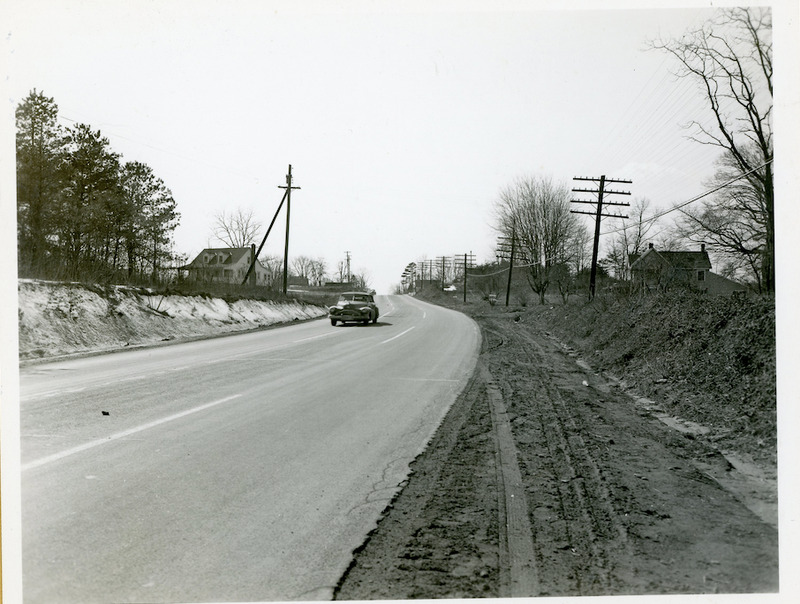
Lee Highway east of Merrifield, Virginia, 1947.