
Poll Tax
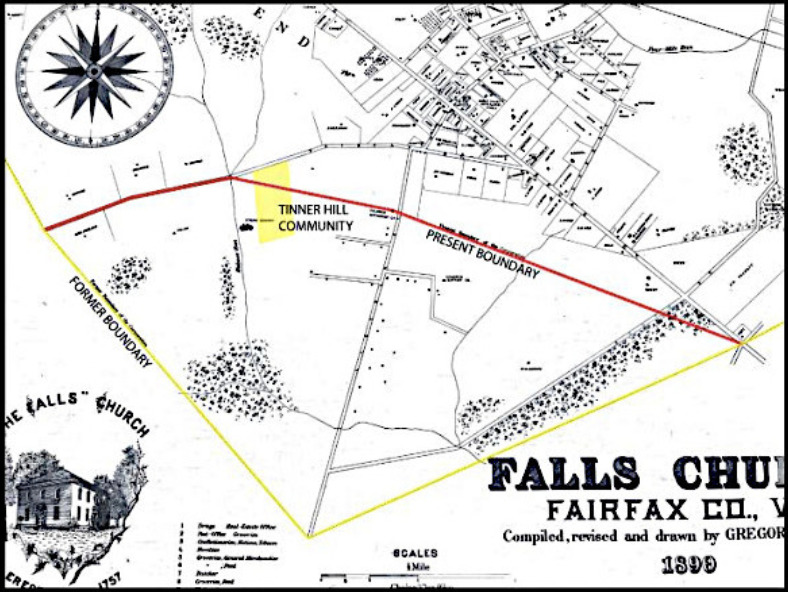
Map showing 1880s boundary changes that removed Black neighborhoods from Falls Church and “retroceded” them to Fairfax County.
The struggle for Black political representation only worsened with the century’s close. In 1902, revisions to the Virginia Constitution dramatically suppressed the Black vote through a poll tax, a constitutional literacy test, and other oppressive measures. The poll tax, a tool of disenfranchisement, had a profound and oppressive impact on Black residents of Fairfax County, part of a broader agenda of disenfranchisement. Virginia’s revised 1902 constitution overtly aimed at disenfranchising African Americans, a topic that consumed debate during the Constitutional Convention in Richmond. Delegate Carter Glass openly admitted the discriminatory intent behind the poll tax provision, arguing that it would, " eliminate the darkey as a political factor in this State in less than five years.” Glass’s bluntness was matched by attorney Eppa Hunton, Jr., representing Fauquier at the Constitutional Convention, who called for “disfranchising the ignorant colored people of the state but disfranchising no white man...”
Virginia Attorney General (later Governor) John Garland Pollard declared the poll tax, according to the Alexandria Gazette, a safeguard against "negro domination," a specter which could also be undercut by a grandfather clause granting unfettered voter registration to anyone who had served in the United States or Confederate Armies, or whose fathers had served, thus bolstering the White electorate. Pollard continued in the Gazette by arguing, “The effort was to eliminate the negro from control and at the same time disfranchise as few as possible white men…The real safeguard against negro domination is the poll-tax provision.”
By all accounts, it worked. Of eighty-seven registered voters in the Gum Springs Precinct in 1902-1903, sixty-seven were subject to the poll tax and disenfranchisement if they lacked means to pay for the privilege of choosing their representatives. By the 1960s, only a handful of Southern states still clung to the practice. Virginia was among them. As late as 1966, it officially required $1.50 of every voter registrant, along with literacy tests. Unofficially but also widespread, the threat of racial violence deterred African Americans from voting, undercutting their political power in Fairfax and elsewhere.
It was resistance by a denizen of Gum Springs, in fact, that helped bring about the poll tax’s demise not only in Virginia, but nationally. Annie Harper, a 79-year-old retired domestic worker joined forces with three other African American women from Virginia—Gladys Berry, Myrtle Burr, and Evelyn Butts—to mount a courageous 1966 legal challenge against the Virginia Board of Elections. These women, all living on modest incomes and dependent on social security, embodied the very people the poll tax was designed to disenfranchise. Their case, Harper v. Virginia Board of Elections, claiming the tax denied equal protection guaranteed by the Constitution’s Fourteenth Amendment, was argued before the U.S. Supreme Court by towering civil rights litigator (and future Justice) Thurgood Marshall. Marshall argued that the poll tax was not just an economic barrier but a direct affront to democracy and equality, winning a 6-3 decision. Annie Harper, often overshadowed by more prominent Civil Rights figures, reminds us of the contribution of ordinary Fairfax citizens, as well.
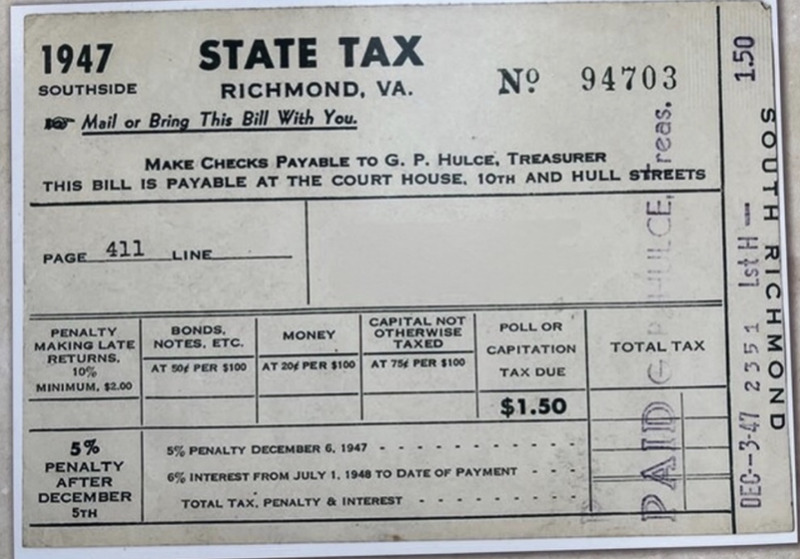
For 64 years, from 1902 to 1966, the tax was imposed on every individual seeking to register to vote in Virginia.