
Resentment, Anger, and Violence
White resentment and, for some, rage toward Black people and their increasing social and financial stability in Fairfax County centered on active Black participation in public life. Historians have studied the history of this anger, finding that White resentment and rage was not only expressed as “visible violence, but rather it work[ed] its way through the courts, the legislatures, and a range of government bureaucracies. [It] doesn’t have to wear sheets, burn crosses, or take to the streets. Working the halls of power, it can achieve its ends far more effectively, far more destructively.” The fact of this historical argument is evident in Fairfax.
When local newspapers reported on African American men who dared exercise their newly acquired rights to assemble and vote, their meetings were often described in extreme terms like “RADICAL,” using labels like the “Radical party of Mount Vernon township.” In 1870, fear of anti-Black violence pervaded a meeting of a multi-racial group of citizens at the “Gum Spring School-house,” where local Black leaders like William Ford, Lovelace Brown, and Joseph Fantery were elected. Veteran and noted African American leader John A. Seaton addressed the group, encouraging their continued support for a Republican candidate in his bid for reelection to Congress. The Washington Evening Star reported (suggesting a whiff of scandal) that, “[a]bout 200 were present, a portion of whom were White.” (Emphasis added.) Other local news reports also conveyed animus for multiracial meetings. The Fairfax News, which catered to White Democrat interests, mocked the 1873 post-election barbecue of a multiracial Republican coalition as an “attempt to harmonize the races,” highlighting not the comity of the gathering but a fight that erupted, in which “colored blood was made to flow.” A careful reading suggests that a group of bigoted Whites provoked that melee, in which stones were thrown and guns fired. As the Star reported, “rocks were in demand and some powered burnt... [and] propelled lead flew wide of its mark.”
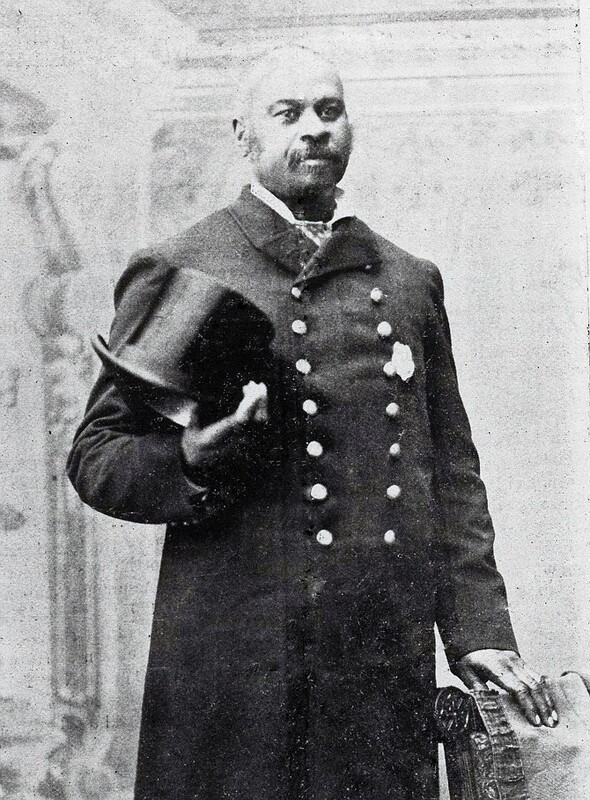
John A. Seaton (1837-1898).
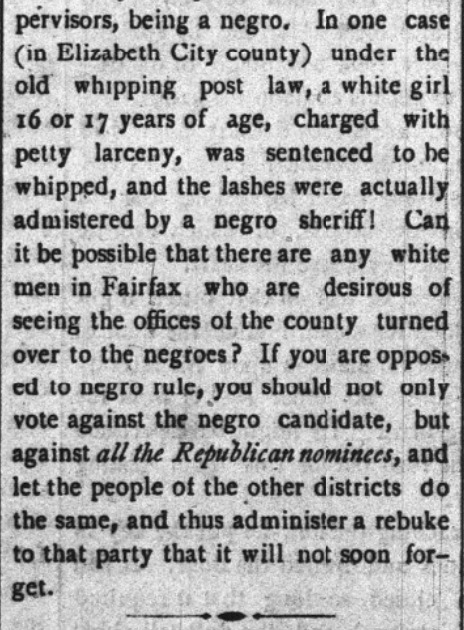
Excerpt from the Fairfax Herald, Volume 7, Number 51, May 17, 1889.
The disparaging coverage as much as the violent attack itself demonstrate the antipathy of many in Fairfax toward attempts by African Americans and their White allies to create a community where two races could live as social and political equals. Ratcheting up the fear was the possibility of a Black political leader in a position of power. In 1889, in reporting the news that a Black man in Fairfax had been nominated to serve as constable, the Fairfax Herald emphasized that this would confer on him the authority to discipline Whites at the “whipping post.” The paper inflamed similar fears regarding allegations in “Elizabeth City County” that a Black Republican sheriff had whipped “a White girl 16 or 17 years of age, charged with petty larceny.” The editor encouraged all “opposed to negro rule” to vote “against all the Republican nominees.”
These few examples reveal the violent political culture constructed to remove the social, political, and economic potentiality of the Emancipation era. In their place, in Fairfax and other localities across the south, emancipation—Black freedom—became a “non-event.”