
The Motts and Lincoln-Lewis-Vannoy
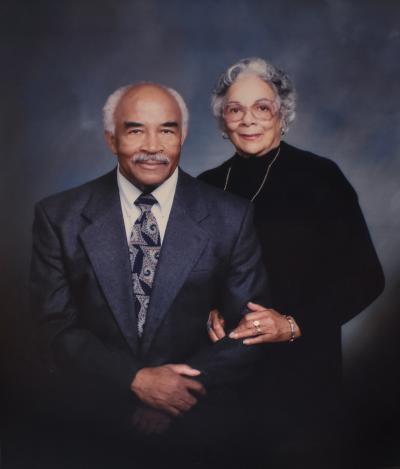
Marguerite and James Mott
In February 1972, James Mott appeared at a Fairfax County Board of Supervisors meeting on behalf of the Lewis, Lincoln Park Citizens Association and the United Communities for Improvement. James and Marguerite Mott had bought their ranch-style house there in 1963, seeking, like most suburban arrivals, a home with more green space in the Washington metro area. While their home was in an area subdivided in the 1940s, some of their neighbors lived in homes that dated back much further, to a time were when it was still common to rely on outhouses and wells for water and, in the absence of gas hookups, wood ovens for heat.
What was not common in Fairfax County was for such conditions to persist well beyond the century’s half-way mark, yet at Lincoln-Lewis-Vannoy, they did persist. Keith Mott, a nephew of James and Marguerite, described summers visiting the couple in their home. He later recalled a “cesspool that they used to tell us was a pond… [W]hen it got real hot, that pond used to smell... And then the pond would bubble. I found out later [that] the bubbling was when somebody used the restroom.”
At the 1972 supervisors’ meeting, Mott and fellow residents, both homeowners and renters, expressed concern over a proposed ordinance to condemn homes with malfunctioning septic fields or unable to hook up to a sewer line, starting that July. Mott testified that the county had previously promised to deal with the neighborhoods’ sewage problems. In 1966, he reminded them, the Division of Planning had presented a report on a proposed sewer system plan at a Board of Supervisors meeting, showing the area’s septic fields and pit privies to be an urgent health hazard. After “three more years of studies and presentations,” Mott said, and Board allocation of $331,000 to tackle the problem, “no evidence of the implementation of this program.” A 1969 socioeconomic survey of the neighborhood showed that twenty-one percent of residents had no cars or did not drive, yet no bus routes passed near. The closest grocery stores and libraries were some five miles away. Given these factors and the lack of urgency from the county, the Motts created the Braddock Community Center in a small cabin in 1969 and co-founded a community aid organization, the Lincoln- Lewis-Vannoy Communities for Assistance and Improvement, Inc. (later named the James Mott Community Assistance Program).
Despite the Motts’ persistent advocacy on behalf of Lincoln-Lewis-Vannoy and admissions from the board that more help was needed, another five years passed before the Washington Post reported that “Supervisors had approved a $1.6 million sewer system” for 169 families in the Lincoln-Lewis-Vannoy neighborhood, “more than half of whom are now using outdoor toilets.” The system was projected to be operational in 1979, but further delays ensued. It wasn’t until 1982 that the Post could report, “At Last, Lincoln- Lewis-Vannoy May Come in from the Cold,” based on county projections that the sewer would be complete that summer. Even that proved overly optimistic: At a 1983 Board of Supervisors meeting, county officials announced that the Little Rocky Run Trunk Sewer, which would service the neighborhood, would not be finished until 1984. Finally, in May 1985, supervisors heard that “sanitary sewer service was operational in the Lincoln-Lewis-Vannoy area of Springfield District.”
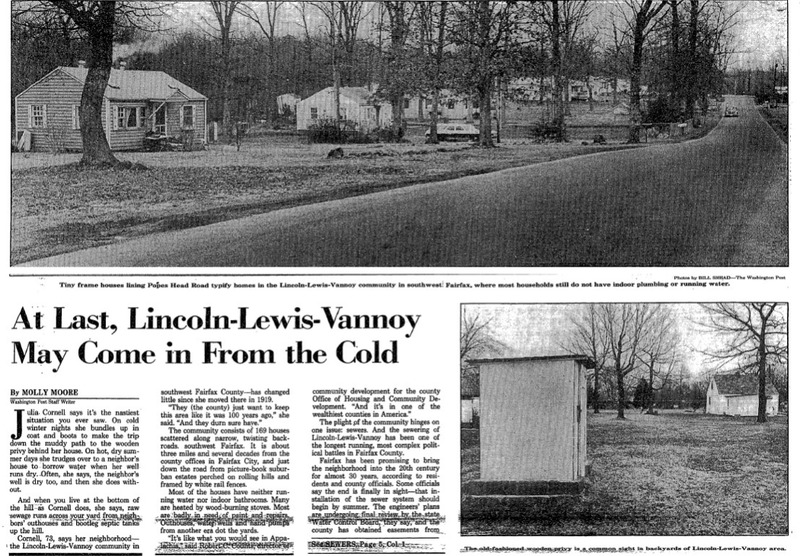
1982 Washington Post coverage of delayed steps to modernize the Lincoln-Lewis-Vannoy neighborhood.
This community waited three decades to have basic needs met, facing delay after delay and a lack of urgency by officials, who took no action but to commission long-term studies. When the Motts moved into Lincoln-Lewis-Vannoy in the early 1960s, its population were mostly moderate-income and mixed in race, with 61 percent White and 39 percent Black households. Later studies would find the neighborhood predominantly Black. Yet once county services finally came, fewer Black families reaped the rewards. Mott and his neighbors told supervisors, back in 1972, that they feared the arrival in their community of sewage lines “would bring development of the land, with the result that these tenants could not remain on the land.” Indeed, as they foretold, developers saw the updates and did build new homes there. Since selling out was more affordable than taking on major changes themselves, cash-poor owners of older homes often took their buyout offers. Today, most older homes of the Lincoln-Lewis-Vannoy neighborhood have been razed, replaced by much larger, newer homes that sell for upwards of one million dollars. The county’s indifference and delay caused irreversible generational harm.