
Walter Plecker's Legacy: Jim Crow and Eugenics in Virginia

Portrait of Walter A. Plecker at his desk originally published in the Richmond Times-Dispatch.
The system of legal fetters developed under Jim Crow used segregation to constrain Black uses of space and imposed poll taxes and other ballot barriers to curtail Black political power. These set the state for a new form of restrictions leveled against Black agency in the 1920s, and nowhere more thoroughly than in Virginia, in the exercise of eugenic policies over Black bodies and identity. The head of Virginia’s Bureau of Vital Statistics, Walter Ashby Plecker, was a nationally recognized leader in the effort to “purify” White genetics through the identification and separation (along with suppression) of racial groups, supposedly scientifically defined. Plecker viewed as an essential health intervention his attempt to meticulously sort all individuals by race from the moment of their birth. Although ostensibly intended to promote population health via “racial integrity,” the eugenics-based measures in fact instrumentalized spatial and biological racism.
In 1924, the state enacted the Racial Integrity and Sterilization Act authorized the government to forcibly sterilize and segregate “imbeciles” and “undesirables,” effectively perpetuating pseudoscientific links between race purity and disability.
The Racial Integrity Act institutionalized segregation by prohibiting interracial marriages and requiring separate Black and White accommodations in public areas. Further legislation soon followed to extend this architecture of racial hierarchy. The Public Assemblages Act of 1926 expanded the Racial Integrity Act’s segregation to all public meeting spaces in the state. A 1930 law defined “colored” as applying it to all individuals with even a trace of “negro blood” or Indigenous ancestry, codifying the notorious “one-drop” rule enacted in 1924.
Plecker enjoyed the support of influential entities like the Richmond Times-Dispatch and the Anglo-Saxon Club of America, founded in 1922 in Richmond. Plecker shared their cultural objections to interracial social and political mingling, objecting, in a 1925 letter to the Richmond Times-Dispatch, to White women’s attendance at “fish-fries” with African American men. More significantly, however, he undergirded these objections with a vast, purportedly scientific program of eugenicist, establishing a decades-long regimen of persecution in Virginia that served as a model for racist policies beyond state lines, as well. In a 1924 address to fellow health officials at a meeting of the American Public Health Association, “Virginia’s Attempt to Adjust the Color Problem,” Plecker outlined the policies’ racist bases. “Two races as materially divergent as the white and the negro, in morals, mental powers, and cultural fitness, cannot live in close contact without injury to the higher [race],” he explained. “…The lower never has been and never can be raised to the level of the higher. This statement is not an opinion … but is an unquestionable scientific fact.” Plecker’s hierarchy was absolute: “When two races live together,” he continued, “there is but one possible outcome, and that is the amalgamation of the races. The result of this will be the elimination of the higher type, the one on which progress depends.”
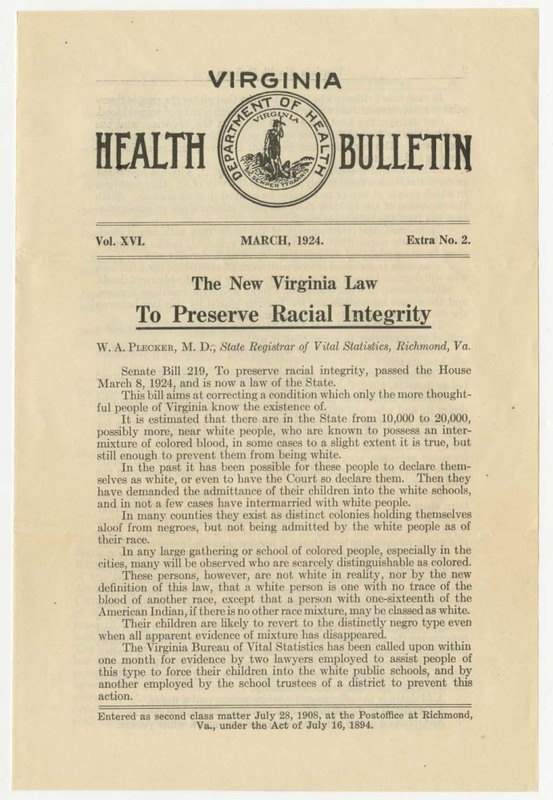
Virginia Health Bulletin: The New Virginia Law To Preserve Racial Integrity, March 1924.
Predicting the growth of Virginia’s African American population from its then-current twelve million to “possibly thirty millions,” with similar increase expected elsewhere (including growth of “Mongolian,” meaning Asian, numbers in the western states), he warned his audience of statisticians and bureaucrats to seek legislation in their own states to help forestall “the evil day when this is no longer a white man’s country.” Indeed, under the influence of not just Plecker but a broader eugenicist groundswell, the 1920s saw the rise of new state sterilization codes, and at the federal level, adoption of the National Immigration Restriction Act of 1924.