
Conclusion
When Mason and his fellow patriarchs and slaveholders sought to rest “under their own Vine and fig tree” it was not without this labor and profit that underpinned their standing. Their wealth, their independence, and their success were furthered by the enslaved. By his own attestation, Mason’s legacy cannot be one that claims universal rights and liberty for all. Instead when illuminated as an historical figure, he stands as a mirror reflecting the values derived from his public pronouncements as a scion of liberty and promoter of law. In 1950 Mason’s likeness was included as one of 23 relief portraits of prominent men whose contributions established American jurisprudence. Thus the “Sage of Gunston Hall” who served as the “Champion of Rights” through his work as a “Constitutionalist” and “Reluctant Statesman” yet became a “Forgotten Founder.” Within the recognition of his commitment to political liberties there must be a recognition of the legacies of George Mason a patriarchal slaveholder. The sins of the father, and mother, were passed along through the Mason family line, with consequences that reverberate to this day. This shared legacy requires an active reassessment of the past. A reassessment which recognizes the influence of race played to securing the wealth and power of the elite. Though this acknowledgement we may be able to live up to Mason’s aspirational words that all “are born equally free and independent and have certain inherent natural Rights of which they can not by any Compact, deprive or divest their Posterity; among which are the Enjoyment of Life and Liberty, with the Means of acquiring and possessing Property, and pursueing and obtaining Happiness and Safety.”[1]
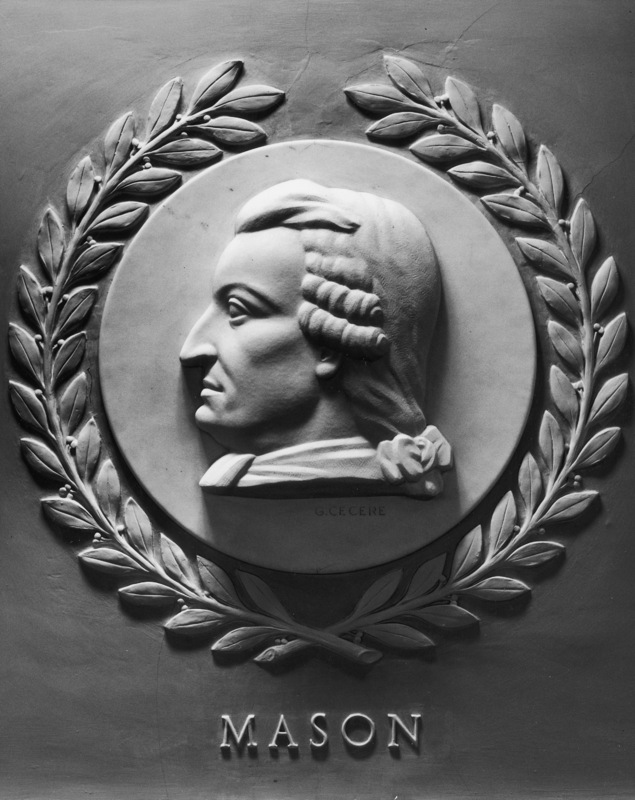
[1]Architect of the Capitol, “About Relief Portrait Plaques of Lawgivers,” https://www.aoc.gov/explore-capitol-campus/art/about-relief-portrait-plaques-lawgivers [accessed 19 December 2020]. These five descriptive phrases in this sentence are drawn from the scholarly works.major biographies of George Mason. Helen Hill Miller, George Mason, Constitutionalist (Gloucester, MA: PSmith, 1966); Jeff Broadwater, George Mason, Forgotten Founder (Chapel Hill: University of North Carolina Press, 2006); Robert Allen Rutland, George Mason, Reluctant Statesman (Baton Rouge: Louisiana State University Press, 2009); Pamela C. Copeland and Richard K. MacMaster, The Five George Masons: Patriots and Planters of Virginia and Maryland, Second edition (Fairfax, Virginia: Published with the Board of Regents of Gunston Hall by George Mason University Press, 2016); George Mason, “First Draft of the Virginia Declaration of Rights” The Papers of George Mason. Vol. 1. ed.Robert Rutland. Chapel Hill: The University of North Carolina Press, 1970, 276-78.