Fountain

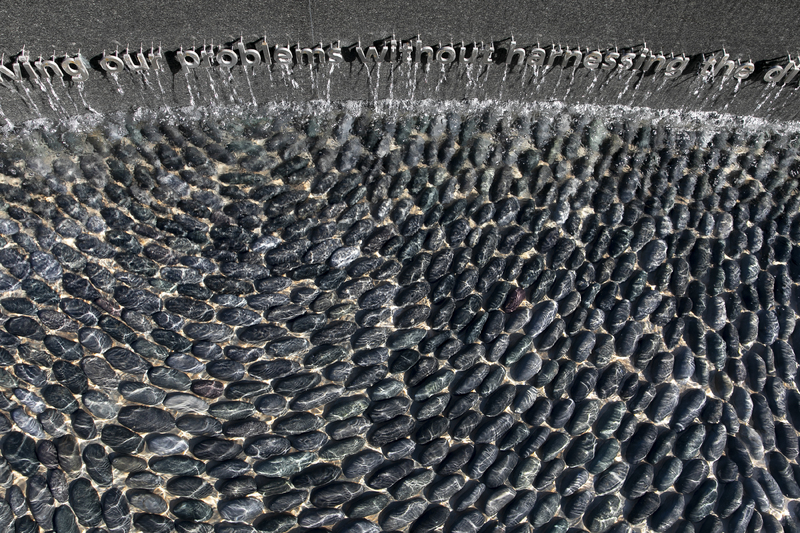
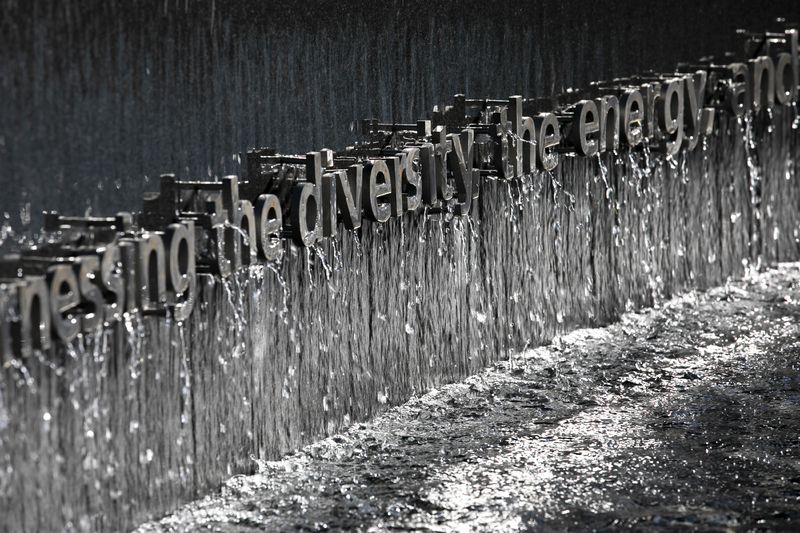
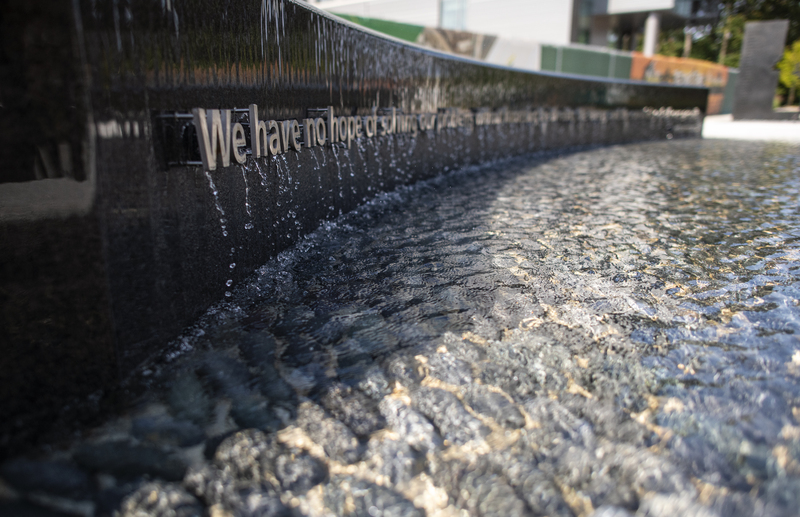
At the center of Wilkins Plaza, standing between the Penny and James panels is a large rectangular fountain which ties the entire project together and yet is itself a distinct element of the memorial. The backdrop of the fountain is a quote from Roger Wilkins, the late African American civil rights leader, Pulitzer Prize-winning journalist, and Mason Robinson Professor for whom the plaza where the memorial is located is named. It reads:
“We have no hope of solving our problems without harnessing the diversity, the energy, and the creativity of all our people.”
This quote helps us understand the whole of the Enslaved People of George Mason Memorial Project which in itself, is a step towards solving the problem of incomplete history. Without intentionally seeking out the stories of Penny, James and the other enslaved people of George Mason IV, it would have been easy for researchers to continue finding sources that tell a history of the university’s namesake as one that omits enslavement. However, by complicating his history, showcasing his multifaceted identity as a “brilliant legal scholar, ardent defender of individual freedoms for a limited few, enslaver of black women and children, and the father of nine," this project has directly answered Roger Wilkins’ call to action.
Wilkins' book Jefferson's Pillow: The Founding Fathers and the Dilemma of Black Patriotism tells the complicated histories of several founding fathers, including Mason, whose political lives were dedicated to liberty and equality, but whose personal lives and generational successes were built on the enslavement of Africans. He asks the question of how both of these things could be true and how might the legacies of men like George Mason IV be interpreted without diminishing thsoe contradictions. He openly addresses the "Dilemma of Black Patriotism" by expressing his awe of and inspiration by many of the historic achivements of these men, while also being upset by their legacy of enslavement and the silencing of that legacy within traditional history. He reacts to a popular historical film about Washington's Crossing of the Delaware in 1776, saying, "There are no blacks in it. There are no black civilians, no black soldiers, and no black slaves or body servants- just white people bravely and busily creating a country." [1]
Centering the lives of Black people owned by founding fathers such as Mason, does not erase their positive impacts on the founding of the nation. Rather, by making Black enslaved people such as James and Penny visible, their histories and legacies become more complete.
As compared to the other elements of the memorial, the fountain is more subtle in the way that it tells history of African and African descended people. Rather than being written in words on the structure, the history and significance behind the fountain is nestled within the stones laid beneath the water. The gray pebbles were set vertically in a continuous spiral pattern. Symbolically, this was intended to communicate the idea of wake, as it relates to the transatlantic slave trade, mourning, and being awake/present.
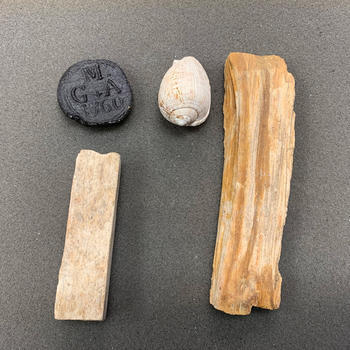
Artifacts found by David Shonyo at Gunston Hall: a bottle seal with George Mason's initials and the date 1760, a cowrie shell from the Caribbean, and pieces of petrified wood.
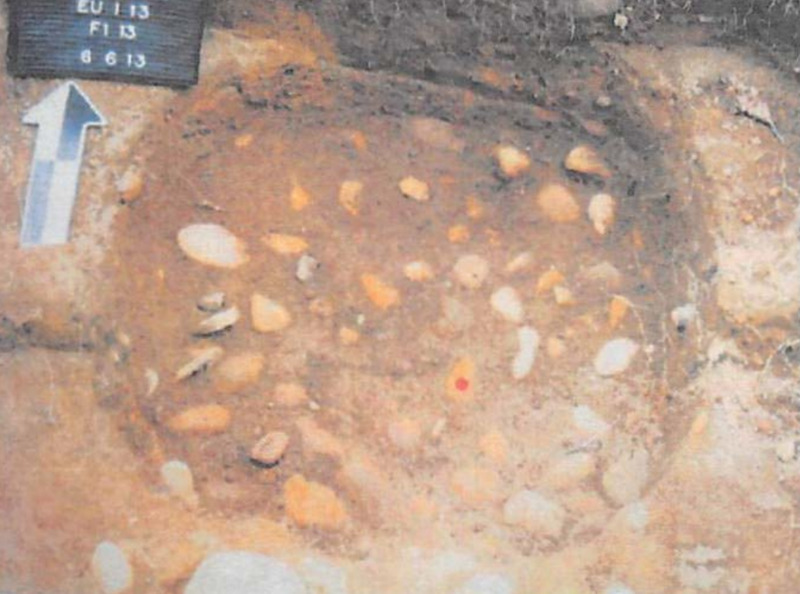
Cobble pattern at the bottom of the smaller pit excavated by David Shonyo at Gunston Hall.
This pattern’s origins, however, lie in the tradition of African people arranging this pattern in moments and locations of prayer and archaeological work done at Gunston Hall. With the help of GMU students investigating and keeping records of the land surrounding the plantation home, archaeologist David Shonyo was able to dig and uncover the former dwellings of the enslaved people owned by the Masons.[2] In excavating the former homes of these bonded people, Shonyo discovered two unusual sub-floor pits that had been dug. The larger of the two contained artifacts consistent with it being used by enslaved people such as a bottle seal with George Mason's initials and the date 1760, a cowrie shell from the Caribbean, and pieces of petrified wood. [3]
The smaller of the two pits (seen above) did not contain any artifacts, but the floor of it was constructed of cobbles arranged in a spiral pattern.[4] This pattern led Shonyo to believe that it could signify a site of spiritual importance or practice by enslaved Africans at Gunston Hall. In affirmation, Dr. Carton, primarily a historian of Africa and South Africa at GMU, and another of the core faculty members on the Enslaved People of George Mason Memorial Project spoke of the cultural significance of this pattern and its importance to the memorial. He contends that the presence of the stones in a pattern within the former homes of enslaved people at Gunston Hall signals that it was a ritual site where they went “to pray and to look at their origins across the sea.”
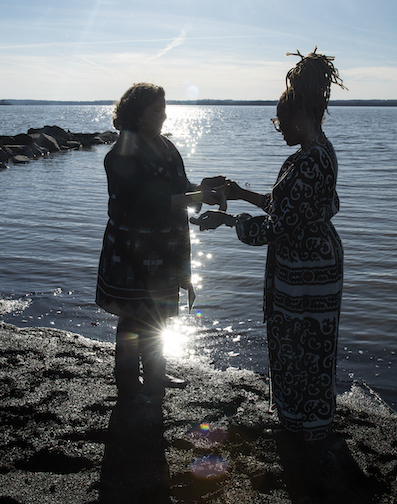
Mason faculty Gabrielle Tayac and Wendi Manuel-Scott gather water from the Potomac River to use in the fountain on Wilkins Plaza. Photo by Evan Cantwell/Creative Services
The final symbolic component of the fountain installation was the water flowing through it. The Potomac River which flowed near the Gunston Hall plantation was the site of an altar built by enslaved people there and was also a place they hunted and fished for food while also being forced to work in Mason fisheries.[5] The project sought the collaboration of Mason faculty member Dr. Gabrielle Tayac in acknowledging not only the enslaved people’s connection to the river, but also the fact that indigenous people originally inhabited the land on which the university was built. As an ode to this, they gathered water from the Potomac and poured it into the fountain.[6]
The inspiration drawn from Roger Wilkins for this memorial is connected to this indigenous inclusion as well. He spends many pages in his book, Jefferson's Pillow, discussing his lineage that includes Ghanian people brought to America, white Americans, and Cherokee indigenous people. He calls himself "a Native son" in the introduction, ellaborating much later on what that means. Claiming nativeness as a Black American man with indigenous lineage is powerful because it asserts the centrality of his ancestors in the creation of America. While he is majorly claiming his identity as an American through his connection to enslavement and the impact of enslaved work on the founding of the U.S., he also intentionally inserts indigenous people, particularly his indigenous family into the conversation. He shows us that the histories of indigenous Native Americans and Black Americans are inextricable, and to attempt to separate the two would be misrepresentative. The inclusion of the Potomac's river water represents the often invisible but vital presence of indigenous people in the story of colonialism in Virginia and the Mason family in particular.
Forevermore since the construction of it as the centerpiece of the Enslaved People of George Mason Memorial, the fountain serves as a space to sit and reflect, ponder the past, and how we can each ensure a more equitable and representative future. The fountain was equally intended to be a place for healing. In the words of George Oberle, one of the three primary faculty members on this project, "the fountain is a space in which I range from melancholy to hope. With acknowledgement, there is a hope for healing."
Sources
[1] Roger Wilkins, Jefferson’s Pillow: The Founding Fathers and the Dilemma of Black Patriotism, Boston: Beacon Press, 2001.
[2] Mariam Aburdeineh, “From Archaeology to Artistic Representations, Mason Students Help Reveal the Stories of the Enslaved at Gunston Hall," George Mason University News, February 22, 2023, https://www.gmu.edu/news/2023-02/archaeology-artistic-representations-mason-students-help-reveal-stories-enslaved.
[3] Archeaology at Gunston Hall: Mariam Aburdeineh, “From Archaeology to Artistic Representations, Mason Students Help Reveal the Stories of the Enslaved at Gunston Hall," George Mason University News, February 22, 2023. https://www.gmu.edu/news/2023-02/archaeology-artistic-representations-mason-students-help-reveal-stories-enslaved.; David Shonyo. "Photo of artifacts from dwelling sub-floor pits."
[4] Ibid.
[5] Damian Cristodero, “Enslaved People of George Mason Memorial to Be Dedicated,” George Mason University News, March 28, 2022, https://www.gmu.edu/news/2022-03/enslaved-people-george-mason-memorial-be-dedicated.
[6] Archeaology at Gunston Hall: Mariam Aburdeineh, “From Archaeology to Artistic Representations, Mason Students Help Reveal the Stories of the Enslaved at Gunston Hall," George Mason University News, February 22, 2023. https://www.gmu.edu/news/2023-02/archaeology-artistic-representations-mason-students-help-reveal-stories-enslaved.