
George Mason
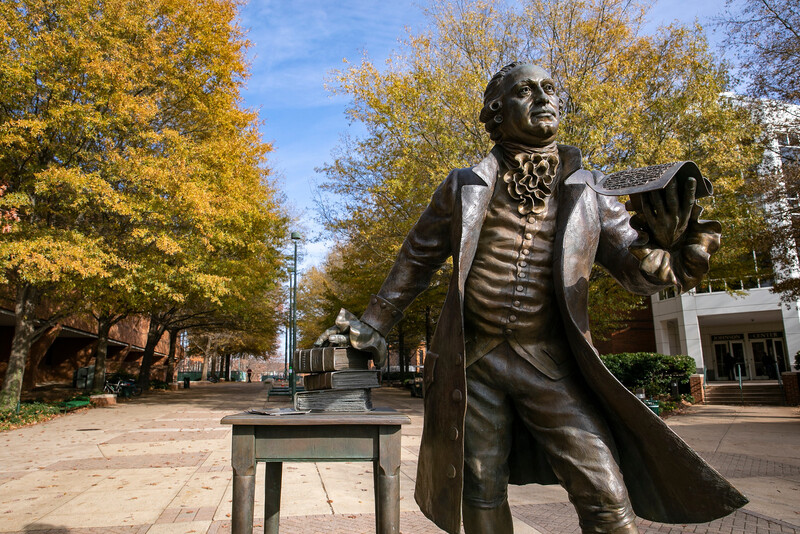
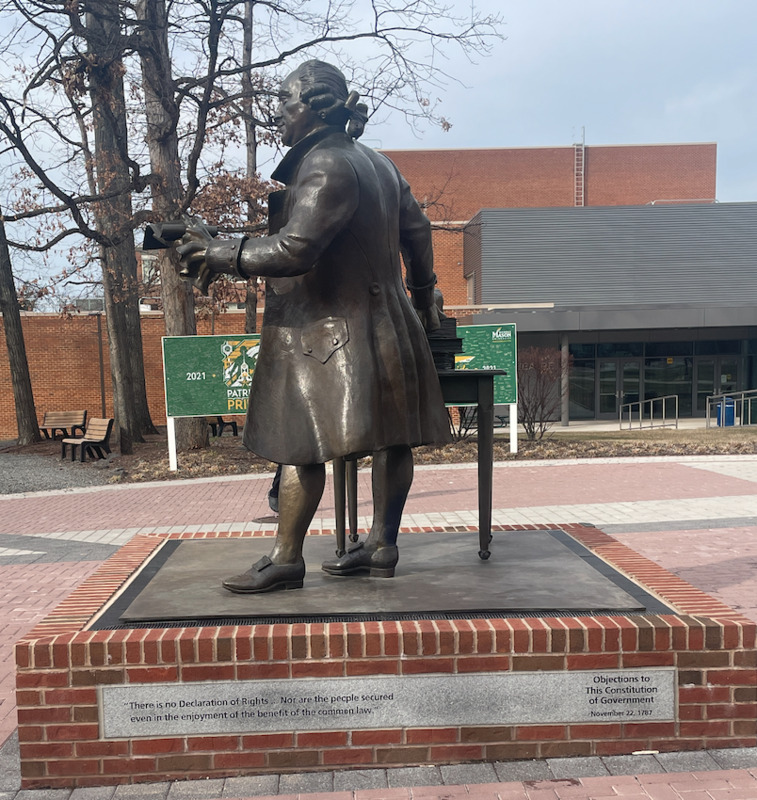
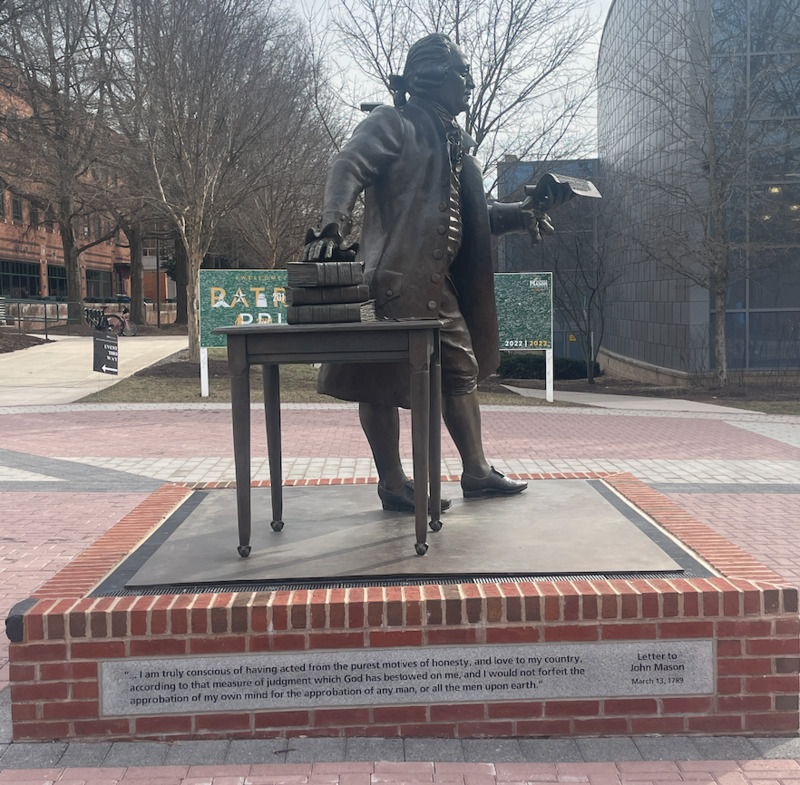
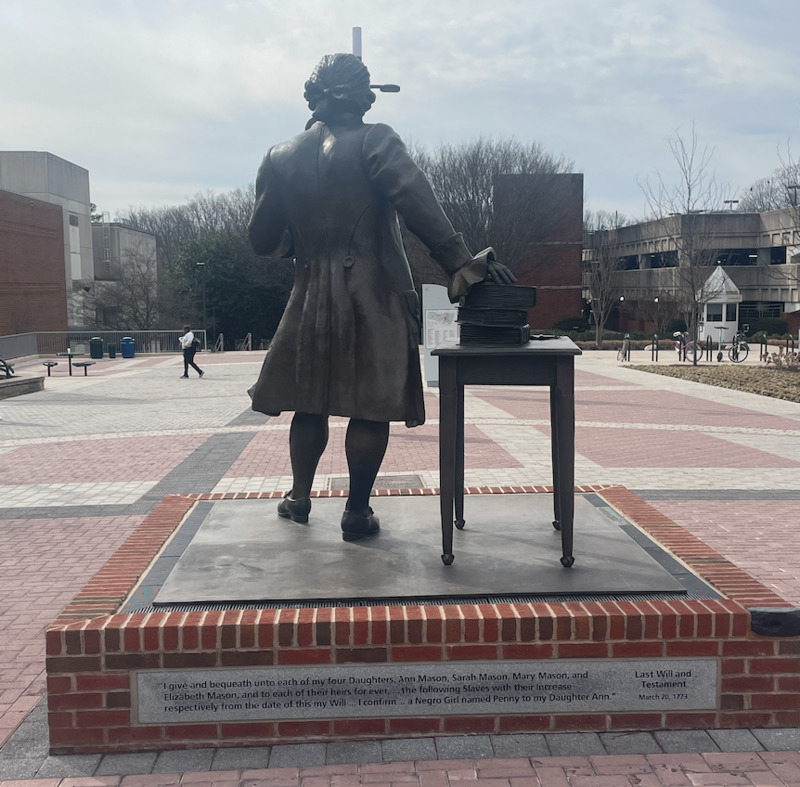
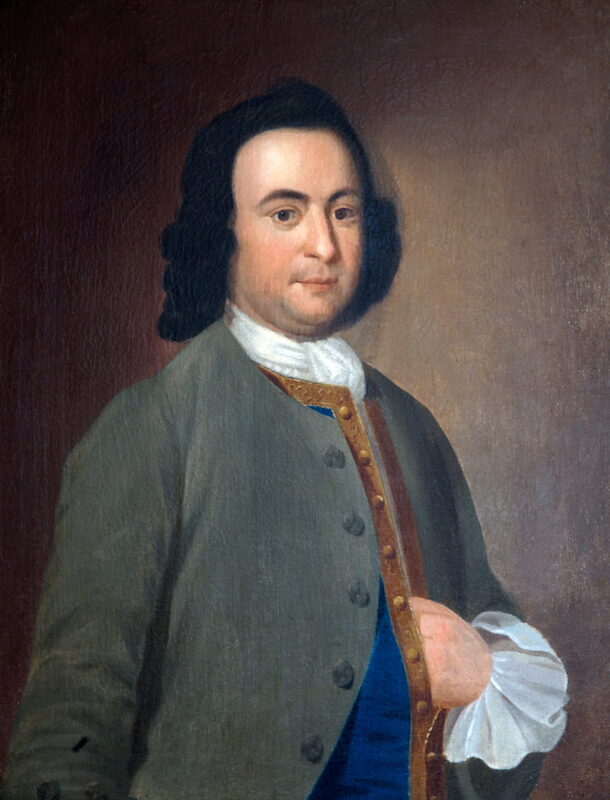
The statue of George Mason IV, namesake of the university, was installed on Wilkins Plaza on April 12, 1996. The concept of a public representation of Mason and its eventual installation were inspired by student discussion on wanting to give the campus a “soul.” Given the youthfulness of the university, students wanted to invigorate the campus community with traditions and a connection to relevant local history. The artist, Wendy Ross, created the impressive statue standing over 7 feet tall, depicting Mason in his fifties, when she claimed he was the most “influential.” The statue shows Mason with one hand resting on a stack of books on a table and the other reaching slightly forward holding the Virginia Bill of Rights. The three books in the stack are written by John Locke, Jean-Jacques Rousseau, and David Hume, all prominent Enlightenment philosophers.
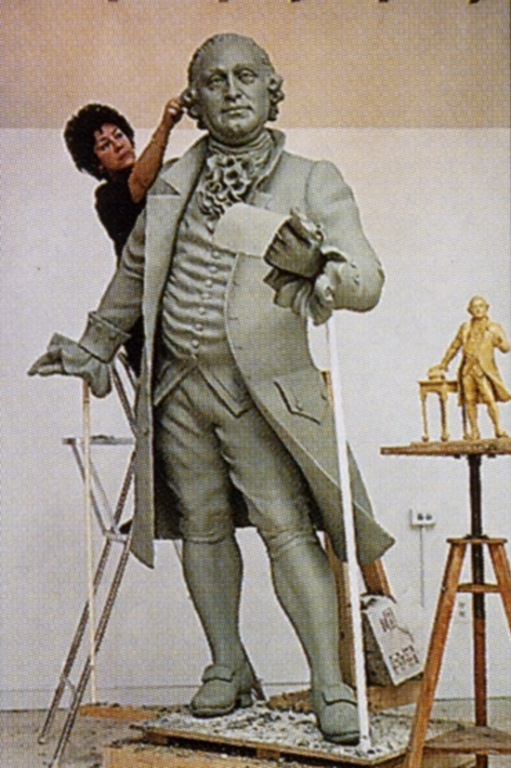
Wendy Ross sculpting the statue of George Mason IV
Another important symbolic piece of the statue that should be interrogated is the stack of books. The three books on the table remind viewers that Mason was a founding father and played an important role in the intellectual movement to declare American independence. Depicted as leaning on them, the statue of Mason explains his influences from the Enlightenment in particular.
The fact that he lived during and was engaged with the Enlightenment is significant when working to understand Mason’s life and memory. While Enlightenment thought was liberating in the context of the United States and its founding, its principles of reason and individualism should also be questioned and complicated from a social justice perspective. The Enlightenment at its core, sought to spurn deep thought and conversation on the definition of “man” or citizen and what divine or inherent rights individuals had. These philosophers were inspired to create a new style of government which centered on the individual and evening the playing field between traditional elites and the lower classes. These ideas made way for people like George Mason to propose that citizens had the right to overthrow an “inadequate” government, which he eventually did in the Virginia Bill of Rights, the document his statue on campus has him holding the Virginia Bill of Rights was arguably Mason’s most famous work because that idea of citizens being able to check their government would go on to inspire several documents including the Declaration of Independence and the United States Bill of Rights.
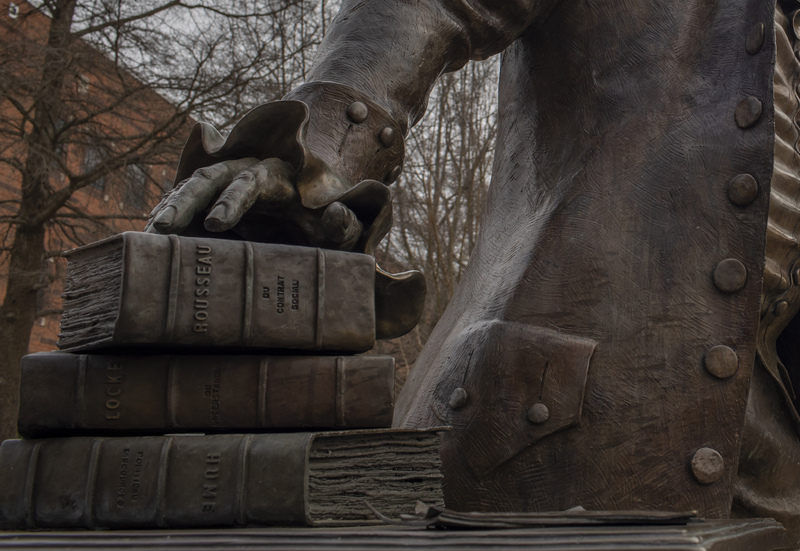
Despite this very valuable legacy, the Virginia Bill of Rights and the Enlightenment thinkers who inspired it cannot be fully represented by the texts they produced. The men creating these schools of thoughts designed in part to liberate the common man, were largely traditional elites and their definitions of “man” were extremely exclusive. Women were rarely included in it and enslaved people of every gender were defined as property. Rousseau’s Social Contract, one of the three books included in the statue, speaks to this contradiction in a particularly problematic way. His so-called Social Contract Theory argued that citizens were in a contract with their government, in which they agreed to abide by the laws in order to then receive protection and other freedoms/provisions from the government in return. That said, if the government were to not hold up their end of the contract, the citizens would then be within their rights to act. Scholars have since problematized this theory with the knowledge that enslavement was occurring in these societies simultaneously and that enslaved people were in no way included in this theoretical contractual agreement. Social Contract Theory was also used to justify enslavement in the Antebellum South for the century following the life and death of Mason and Rousseau, further proving the hypocrisy of Enlightenment philosophy.
In addition to analyzing what these theories were used for, it is important to understand what these Enlightenment philosophers, including Mason, truly stood for. To do so, their lives and actions must be considered alongside their written words. This historical investigation unfortunately only reveals a greater cognitive dissonance between manhood and race during this period. While men like Locke, Rousseau, Hume, and Mason pontificated on their own unalienable rights and fought to liberate the colonies from English oppression, they were either involved or complicit in the institution of slavery.
John Locke is most well-known for his idea of the “natural rights of man,” which he named as “life, liberty and property.” While his official stance on slavery, particularly in the Americas was foggy, historians have confirmed that he “owned stock in slave trading companies and was secretary of the Lords Proprietors of the Carolinas where slavery was constitutionally permitted.”v In the Southern economy, to which the Mason family belonged, the natural right to “property” often alluded to Black human life which was bought, sold, and even willed. Men like Locke were afforded not only the rights to life, liberty, and property, but also the rights to own and control the lives and liberties of Black enslaved folks.
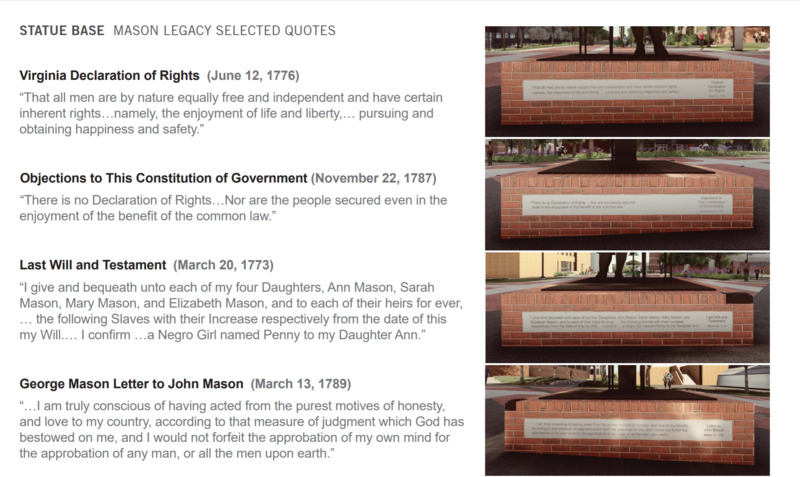
The Enslaved People of George Mason Memorial, dedicated in the spring of 2022, brings this context to the association of George Mason IV with Enlightenment philosophy and his legacy both on campus and in the Fairfax community. In addition to the two panels paying respects to Penny, James, and the other enslaved folks owned by Mason, the project added context to the statue of Mason itself in the form of quotes and a single bronze brick.

The single bronze brick installed on the corner of the statue’s base, was inspired by an actual brick that was found at the Gunston Hall plantation which had an enslaved person’s thumb print on it. A 3D scan was done of the original brick so that the bronze replica could be made to the exact specifications including the fingerprint. Sitting within the brick base of the statue but made from a completely different material, this bronze brick can be perceived as an act of disruption. Its placement in the foundation also calls to mind the fact that Mason could not have had his standing in society without the institution of slavery to stand upon.
The quotes put in place around the base of the statue reveal the contradictions George Mason IV exemplified in his political and personal life. Viewers of the statue can now conceptualize him as having been four Masons in one: The brilliant legal scholar, the ardent defender of individual rights for a limited few, the enslaver of Black men women and children, and the father of nine. To describe him as one of those alone would be to silence the other, equally important facets to his identity, and so it is important that they all remain visible, especially when representing such a large and diverse university.
To read more about the student movement to create the statue of George Mason on campus click here.