
George Mason's Will
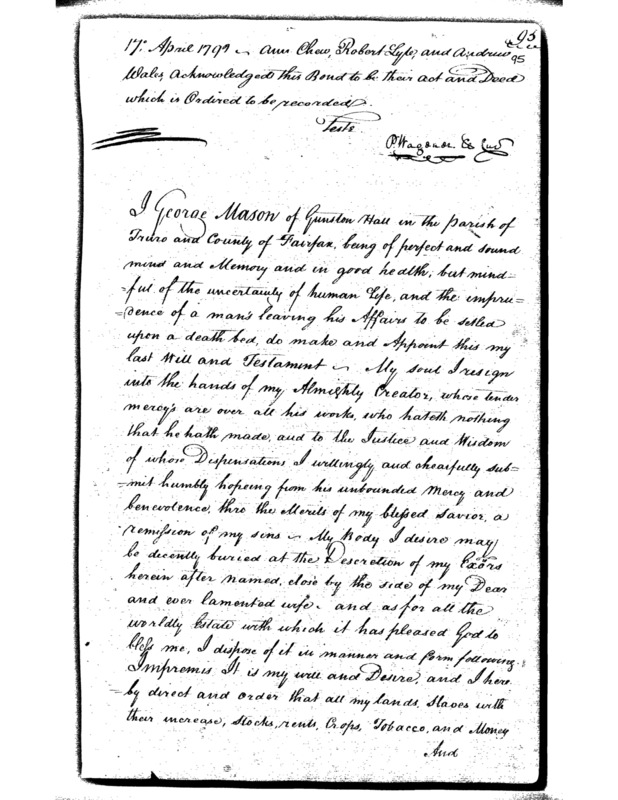
Mason’s final wishes expressed in his Last Will and Testament revealed his commitment to a financial strategy and remained unaltered for almost two decades. Today, this notable document is one of the few existing papers that disclose his priorities regarding slavery and consideration of the humanity of the people he enslaved. He actively sought to maximize estate profits by centralizing his valuable assets until time to distribute them to his heirs. Mason could have chosen to emancipate “all my . . . Slaves with their increase” in keeping with sentiments enshrined just three years later in his Virginia Declaration of Rights finalized on June 12, 1776. But something else motivated what he famously professed: “That all men are (by nature) equally free and independent, and have certain inherent rights, of which, (when they enter into a state of society,) they cannot, by any compact, deprive or divest their posterity; (namely,) the enjoyment of life and liberty, with the means of acquiring and possessing property, and pursuing and obtaining happiness and safety.” Choosing to do so would have undermined the logic of his arithmetic in calculating wealth.[1]
George Mason’s Will is the best expression of how Mason viewed the people he enslaved. There is no evidence that Mason ever viewed these people who secured his wealth and produced value daily as human beings deserving of the liberty he so highly valued. Slaves are mentioned throughout the document, sometimes by name. Other times they are lumped together and considered as a whole. Generally, slaves served as liquid assets for his children. The will’s organizational structure makes it easy to discern Mason’s intent. For each of his sons, Mason provided a paragraph that identified the real estate bequeathed. George Mason V received the largest single grant. However, he also received the responsibility for assuring the patrimony of his younger brothers. A significant part of the estate’s wealth remained invested for the common good of the brothers. A separate paragraph identified the personal property items which Mason willed to his sons, including each to share in one-fifth of his books, while also articulating “Plantation Utensils and Impliments of Husbandry” and other items of value including, livestock, furniture, and watches. This section is where George Mason enumerated the legacy of those enslaved by him to his sons “and his heirs forever.” [2]
An essential part of the will lies in George Mason’s recognition of the importance of assuring that his male heirs would have an independent and self-sustaining source of perpetual wealth. Each son received at least one pair of slaves, exclusive of the gifts from the grandparent Eilbecks; one male and one female who could assure that the “their natural increase” would maintain a consistent form of wealth. George Mason V received the most considerable inheritance of named slaves from the Mason estate, including four males and three females. William and Thomson both received one male and one female. John and Thomas Mason, both born after Grandfather Eilbeck died and thus received no extra gift of slaves from that estate, also received one pair of slaves, including a male and female. Most of the sons received more slaves in their inheritance but the specific listing of at least a male and female seems to indicate the importance of a self-sustaining supply of enslaved people for his heirs.[3]
As George Mason’s children began to start their own families, he needed to adjust his financial plans. He never altered his will, but two later documents help us understand his ideas about slaves as property. In 1789 he wrote an indenture designed to secure Ann (Nancy) Mason’s property. This document was filed in Fairfax County in 1789. Nancy’s marriage provided a worry for Mason as a patriarch. When a woman married, her personal property could become controlled and utilized by her husband, and the security which a father intended to be for his daughter could be lost. George Mason knew that Johnson had debt problems, so he provided Nancy with an indenture. Mason stated that purpose was to prevent a husband or his executors from “intermeddle with or haven any right title or interest either in Law or equity in or to either of the said negroes or onto any of the increase or Issue that shall hereafter be born of the said negroes.” Although it provides evidence of the duty that Mason, the father had to his children, it also provides evidence of his commitment to building capital and wealth despite any moral reservations about slavery which could be inferred from his public pronouncements.[4]
What is remarkable about this contract is the irony that as it confers security upon Mason’s daughter, it also demonstrated the vulnerability of life for enslaved people due to their legal status as property. Of the original five slaves enumerated in his 1773 will “Bess (the Daughter of Cloe) and her child Frank, mulatto Priss (the Daughter of Jenny) and Nell (the Daughter of Occoquan Nell)” and Penny, only three remain listed in the indenture. Notably, the contract now also included a total of twelve additional people. In the updated contract Mason itemizes the stunning number which is now seventeen people! Mason names “Lizzy, Nan, mulattoes, Bess and her eight children to wit Frank, Lizzy, Dick, Chloe, Nancy, Margret, Pris, and Delia, Penny, Arecasa and her four children to wit Nace, Kate, Willian and Sarah.” The document is striking and crucial to understanding the power of the statement, which conveyed the person and “with their Increase” which granted future wealth. This phrase often repeated in Mason’s Will and the contract with Rinaldo Johnson took no account of these people as human beings.[5]
Like some of his fellow Virginians, Mason’s decision to pass along his enslaved people to his children rather than emancipating them had lasting consequences for the enslaved people. In September 1802, one-month shy of the ten-year anniversary of George Mason’s death, Rinaldo Johnson filed a deed that focused on the disposition of Nell, and her “increase.” Nell was originally itemized in George Mason’s will to be left to Ann. The document states that upon George Mason’s death, “doubts were entertained by the Executors” of George Mason’s will whether “Negro Nell was intended to be given” to Nancy because Nell was not listed in the indenture filed by Mason when Nancy married Rinaldo Johnson in 1789. As a result, her husband had a claim to Nell and in order to “do away with all doubts and difficulties in the premises” as to who rightfully owned her it was decided “that the Negro Nell should be sold and the money arising therefrom vested in a natural born slave of the state of Maryland of as nearly the same age as Negro Nell by the said Rinaldo Johnson.” Johnson received two hundred dollars from the executors of George Mason’s estate for Nell but the contract also conveyed title of a woman named Henna and her two children, Betty 4 years old and Bob who was only 9 months old to Nancy and to her daughter. It is unclear as to who exactly purchased Nell. It is possible that she remained part of the George Mason V estate but by 1817 all 49 enslaved people whom Rinaldo Johnson held title to were sold by the order of the Orphan’s Court in Maryland.[6]
An additional consequence for nor changing his will resulted in confusion over the disposition of the property among the brothers. A deed clarifying this was filed by the four younger brothers shortly after their father died. William, Thomson, John and Thomas wanted to help clear up an “obscurity” in their father’s will. This clarification was over “the disposal of “Slaves, Stocks of horses, Cattle, Sheep and Hogs, implements of husbandry which should be resident on, and properly belonging to his plantations or Quarters at the time of his death.” The deed provides clear ownership of twenty-four people, all named, to their older brother George along with the other items mentioned which were all at the “two quarters” at “Hallowing Point on Patowmack River, and the other in the bottom of Doegs neck on the River Occoquan.” The brothers agreed that “it was the intention of our said father” that their brother was to inherit this once the younger brothers no longer needed to secure the legacies of the other brothers as well as George Mason’s income during his lifetime. This clarification reinforces the intent of Mason’s last will and testament to consign these assets to their brother, George Mason V, and “his heirs forever.”[7]
George Mason V, the eldest son of George Mason, died at the end of 1796, just four years after his father. Mason V’s will provides another testimony to the Mason family’s commitment to slavery as a means of securing the wealth and their prosperity for the next generation. In addition to the allotment of property between his eldest sons George Mason VI and William Eilbeck Mason the rest of Mason’s property was divided up with his wife Elizabeth “Betsey” Hooe. Betsey received use of his “Mansion House and Seat called Lexington” along with the proceeds from his “Plantation in Dogue Neck…together with all the Negroes Stocks of Horses” and other farm animals and implements to be used for her maintenance during her “life or widowhood.” Additionally, Mason allotted six slaves “Sarah, Phillis, Betty, Cooke, Charles, Jerry son of Occoquan Nell, and George son of Phyllis.” The inventory of his property conducted in 1797 lists eighty-three slaves by name and age. Thirty of the names listed were children 12 years old and younger. This indicates that 36 percent of the total number of people enslaved by George Mason V were children. His brother Thomas Mason died in 1800 about 8 years after his father. The inventory conducted on October 28, 1800 included 33 slaves 15 of which were 12 years or younger. This indicates that 45% of the total number of people enslaved by Thomas were children. This shows that the Mason family were able rely on the people they enslaved to reproduce their population and that this continued across generations.[8]
Prosperity came not only from those enslaved, their labor, and their natural increase, but also their valuable skills for which they could be hired out to others for specific tasks. Some of the enslaved, such as Nell the midwife who was named in George Mason’s 1773 will, were exceptionally skilled and in high demand among neighbors. Nell was a valued part of the Mason labor pool as she not only helped protect the bodies of their existing valued chattel property, but they also helped assure that the “natural increase” of the enslaved people would be tended to, thus promoting and assuring the ongoing economic security for the family and supplying the new bodies for the expanding domestic slave trade. Additionally, Nell was hired to assist other midwifes in the area. Historian Sara Collini found that “Nell was called on to assist an enslaved woman named Leah who went into labor at Martin Cockburn’s nearby Springfield estate. Nell successfully delivered Leah of her child on February 21, and Cockburn paid her 12 shillings.” In fact, Nell was called upon several times including “later that year…when Hagar, another enslaved woman at the Springfield estate, give birth to a daughter and earned 12 shillings and 4 pence.” Her reputation as an expert in the northern neck region must have been widely known since George Washington also hired her several times as late as 1798.[9]
This legacy of relying on the economic security provided by bequeathing enslaved people continued into the next generation. George Mason IV’s grandson, Richard Chichester Mason was the child of George Mason’s fourth eldest son, Thomson, and his wife Mary McCarty Chichester. Richard was an M.D. who studied women’s bodies at the University of Pennsylvania as evidenced from his 1816 dissertation titled “Essay on Menstruation.”
Despite the lucrative endowment of generational wealth in the form of land, enslaved people, livestock, mills and ferries, and other instruments his investments in the southern slave economy led them to have a heavy debt of $3,665. This debt was secured by placing their eight-hundred-acre residence and twenty-one enslaved peoples “in trust” as collateral to be forfeited if the debt went unpaid. However, these enslaved peoples were not located in Virginia but were held on a “plantation” in “Madison County, MS.” This trust, filed in 1843 noted that R.C. Mason was still entitled to remain in “peaceable possession…[of] the aforesaid slaves, and take the profits thereof to his own use” until his debt was fully paid. By 1851, Mason had paid off his debt and the trust was released. Mason had retained full ownership of these twenty-one enslaved peoples throughout this period of indebtedness while still profiting from the labor they produced.[10]
[1] George Mason, “Last Will and Testament,” 20 March 1779, The Papers of George Mason, 1725-1792, ed. Robert Allen Rutland (Chapel Hill: University of North Carolina Press, 1970); George Mason “Final Draft of the Virginia Declaration of Rights” 12 June 1776. PGM 287-9. The first draft of the Declaration of Rights written in May 1776 was broader and simply stated “That all Men are born equally free and independant, and have certain inherent natural Rights, of which they can not by any Compact, deprive or divest their Posterity; among which are the Enjoyment of Life and Liberty, with the Means of acquiring and possessing Property, and pursueing and obtaining Happiness and Safety.”
[2] George Mason, “Last Will and Testament,” 20 March 1779, The Papers of George Mason, 1725-1792, ed. Robert Allen Rutland (Chapel Hill: University of North Carolina Press, 1970); This phrase is repeated throughout the will. Sometimes it is articulated as “heirs for ever.” Ibid.
[3] George Mason, “Last Will and Testament,” 20 March 1779, The Papers of George Mason, 1725-1792, ed. Robert Allen Rutland (Chapel Hill: University of North Carolina Press, 1970). It remains unclear if this was a common practice or one which the Mason family utilized. Future research is needed on this topic. This is the first time I know of that anyone has made this analysis. I am grateful to the deep and thoughtful conversations which I had with my History 300 and History 499 classes to help me recognize this pattern.
[4] Nancy was about 34 years old and she had served as the mistress of George Mason’s household for sixteen years since his wife had died in 1773. George Mason’s 1773 Last Will and Testament directed that to his oldest three daughters Ann, Sarah, and Mary he confirmed the gift left to them of “a Negro Girl given to each of them by their Grand Father Mr. William Eilbeck Dec’d. to wit, a Negro Girl named Penny to my Daughter Ann— a Negro Girl named Priss to my Daughter Sarah and a Negro Girl named Nan to my Daughter Mary.” He then apportioned out the enslaved people he intended to serve as economic security for his daughters. The four girls, including Elizabeth who was born after her Grandfather Eilbeck had died, were promised a total of fifteen slaves in the 1773 will. Nancy’s example provides a useful window into how slavery worked to promote the economic security of families. Further it demonstrates Mason’s legacy regarding his attitude toward slavery which we can use because Nancy’s marriage provided documentation from George Mason which we lack for the other daughters. George Mason, “Indenture between Rinaldo Johnson and Ann Eilbeck and George Mason and George Mason Junior and Commonwealth Esquires,” 4 February 1789, Fairfax County Circuit Court Historical Records Division.
[5] George Mason, “Indenture between Rinaldo Johnson and Ann Eilbeck and George Mason and George Mason Junior and Commonwealth Esquires,” 4 February 1789, Fairfax County Circuit Court Historical Records Division.
[6] Several slaveholders decided to manumit enslaved people in the decades after the Revolution. See First Emancipator; Eva Sheppard Wolf, Race and Liberty in the New Nation: Emancipation in Virginia from the Revolution to Nat Turner’s Rebellion; Prince George’s County Court (Land Records), [MSA CE 65-38], JRM 9, pg. 295; ibid; “Public Sale,” Daily National Intelligencer, 16 January 1817, p1; Maryland State Archives, “Rinaldo Johnson” in Archives of Maryland Biographical Series (2013) https://msa.maryland.gov/msa/speccol/sc5400/sc5496/050700/050749/html/050749.html last accessed (GET PRINCE GEORGE'S REGISTER OF WILLS (Inventories) 1817-1820, Liber TT 3, pg. 18. Also Look at Orphans Court documentation for 1817.)
[7] Fairfax County Deed Book U-1, p467-469.
[8] George Mason, “Last Will and Testament,” 19 December 1796, Fairfax County Will Book G-1, 254-261; ibid; George Mason, Inventory, 10 January 1797, Fairfax County, Virginia, Fairfax County Will Book H-1, 38-52; Thomas Mason, Inventory, 28 October 1800, Prince William County, Virginia, Prince William Will Book I 1803-1809, 123-141.
[9] Sara Collini, “The Labors of Enslaved Midwives in Revolutionary Virginia,” in Women in the American Revolution: Gender, Politics, and the Domestic World (Charlottesville: University of Virginia Press, 2019), 19–38. 32; ibid, 27
[10] I am incredibly grateful to the work of Anthony Guidone. His exhaustive work on the Center for Mason Legacies project uncovered a rich story on Richard C. Mason which deserves to be published soon. Richard Chichester Mason and School of Medicine, “Essay on Menstruation.” (Dissertation, Philadelphia, Pennsylvania, University of Pennsylvania, 1816). Thanks to the staff in the archives for providing me a scan of this dissertation during the covid-19 pandemic. Richard C. Mason and Lucy B. Mason, Trust, August 29, 1843. Deed Book H-3, pg. 331; Richard C. Mason and Lucy B. Mason, Release, xxxx. Deed Book Q-3, 341.