
"To Each of Their Heirs Forever"
"to each of their heirs forever":
Legacies of George Mason a Family Patriarch and Plantation Slaveholder
The Virginia revolutionary George Mason IV was more than a father of the Bill of Rights and reluctant founder of American democracy. Mason, like many founders, was calculating and self-interested, and he augmented his family’s wealth and influence through racial slavery. While claiming to “detest . . . [the] trade” in human beings and its “ill Effect[s] . . . upon the Morals & Manners” of white colonists, Mason was silent about his use of chattel labor. His drive to profit from the toil of enslaved people of African descent has escaped serious academic scrutiny. This oversight is largely due to a dearth of primary sources on Mason’s legacy as a slaveholder. The few existing Mason papers are bound in an edited collection which was extracted from disparate collections. These compiled documents reveal little about how George Mason learned to be a slaveholder. They also reveal little about how important slavery was to his family. One thing is clear. According to surviving records, Mason never emancipated the “Negroe” children and adults whom he held in bondage on various plantations in the Potomac region.[1]
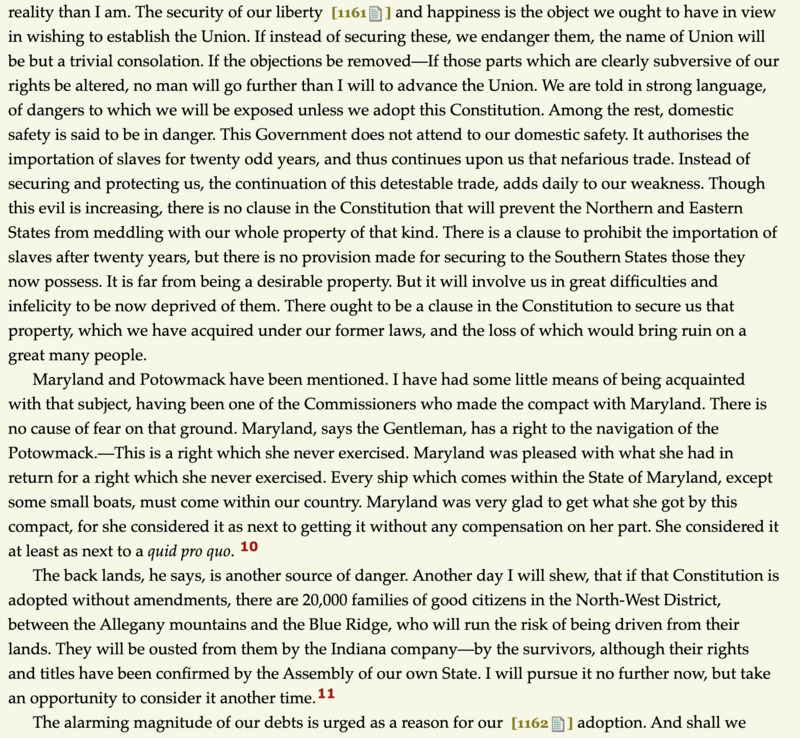
Newly uncovered evidence illuminates how Mason accumulated diverse sources of wealth. These documents raise questions about an American pioneer of individual rights: Why have scholars seen Mason as an opponent of the slave trade when he unwaveringly sought to embrace its benefits? Mason's condemnation of the buying and selling of people of African descent is often cited, but not his commitment to own Black human beings and bequeath them as inheritable property. Was his pursuit of liberty part of a patriarchal plan to secure reproducible wealth for his children in an independent United States liberated from an oppressive monarchy? What were the long-term consequences for this enslaver and the people he held in bondage during his lifetime? Engaging the scholarship of social and cultural historians, including overlooked studies Peter Wallenstein among others this article re-examines Mason’s views of plantation slavery, Chesapeake and trans-Atlantic slaving, and personal power in post-revolutionary America.[2]
The declarations of rights proclaimed by Mason in public records reveal his desire to exercise individual prerogatives over personal property and to keep a power-hungry state from controlling what he owned privately and wished to bequeath to his progeny. George Mason’s identity as a colonial patriarch reinforced his drive to enhance the security and wealth of his family members. He was not alone in embracing and perpetuating such rights. Although scholars have focused on how Mason differed from peers in the gentry class, his position and authority as a slaveholder provided the means for securing his freedom. In fact, George Mason learned to be a patriarch who enslaved people to promote his security and welfare from his family and then passed it along to his children. As a result, to understand George Mason as a slaveholder we need to look at his role as a son and a father. His family helped shape his identify and he in turn passed that along to his children. Amid the Revolutionary War, Mason wrote to his neighbor and friend and nostalgically remembered the “many agreeable hours” they “spent together” at Mount Vernon prior to the revolution. Mason prayed “May God grant us a return of those halcyon Days; when every Man may sit down at his Ease under the Shade of his own Vine, & his own fig-tree, & enjoy the Sweets of domestic Life! Or if this is too much, may He be pleased to inspire us with spirit & resolution, to bear our present & future Sufferings, becoming Men determined to transmit to our Posterity, unimpair'd, the Blessings we have received from our Ancestors!”[3]
Mason’s ability to reminisce with his friends and focus on his historical and legal knowledge came from his ability to focus on the economic interests of his family. The business-savvy George Mason IV developed property that created lasting wealth for each of his nine surviving children. Unlike many of his peers, he died with a robust surplus and no burdensome liabilities. Dated 1773, Mason’s last will and testament directed “that all my lands, Slaves with their increase, Stocks, rents, Crops, . . . and Money And Debts due to me, with the yearly interest arising thereon . . . be kept together and considered as one common stock, for the payment of my Debts and Legacies and the Maintenance and Education of my children, and the payment of their fortunes.” The last word, “fortunes,” encapsulates what his progeny received and retained well into adulthood. A fortune that Mason inherited from his family and the legacy he assured to pass down to his children.[4]
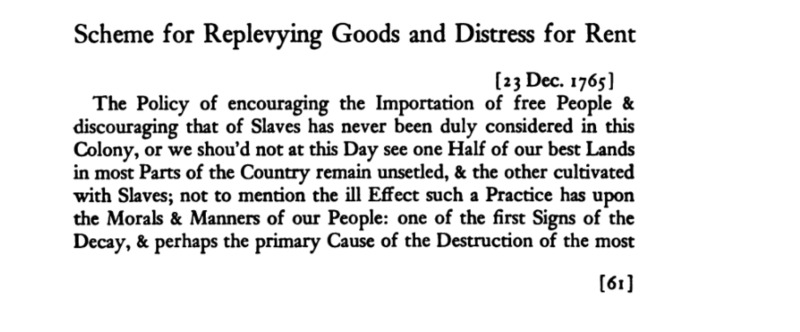
[1]George Mason, “Debates: Virginia Convention” 11 June 1788, The Documentary History of the Ratification of the Constitution Digital Edition, ed. John P. Kaminski, Gaspare J. Saladino, Richard Leffler, Charles H. Schoenleber and Margaret A. Hogan. Charlottesville: University of Virginia Press, 2009. https://rotunda.upress.virginia.edu/founders/RNCN-02-09-02-0004-0012-0001 [accessed 19 Dec 2020]. Original source: Ratification by the States, Volume IX: Virginia, No. 2, 1161; George Mason, “Scheme for Replevying Goods and Distress for Rent, 23 December 1765, The Papers of George Mason, 1725-1792, ed. Robert Allen Rutland (Chapel Hill: University of North Carolina Press, 1970). 61 Critical to see here is that Mason has an unchanging idea on the problem with slavery. It is a security problem and thus bad for business; For excellent overviews on the sources available see Peter Wallenstein, “George Mason 1725-1792,” in Research Guide to American Historical Biography (Beacham Publishing, 1991); Many of the papers were collected by Mason’s kinsman Kate Mason Rowland, The Life of George Mason, 1725-1792: Including His Speeches, Public Papers, and Correspondence, (New York: G.P. Putnam’s Sons, 1892). Rutland’s effort included many additional collections including many writings of George Mason found in collections in the LOC’s Manuscript room. George Mason, The Papers of George Mason, 1725-1792, ed. Robert Allen Rutland (Chapel Hill: University of North Carolina Press, 1970); George Mason, “Last Will and Testament,” dated 20 March 1773, filed for probate 16 October 1792, Will Book F, Fairfax Circuit Court Historic Records Center, 92; Also see PGM Vol. I, 147-161.
[2]The scholarship on George Mason is large and I will only mention the most important to this work. George Bancroft, in his multi-volume survey of United States History details Mason’s role in the creating the Virginia Declaration of Rights and his role in the Revolution and with the establishment of the Virginia Constitution in 1776. Importantly in his 1876 completely revised centenary edition Bancroft adds that in the writing of the Virginia Resolves “George Mason foretold the blight that was to avenge negro slavery.” This is the first example I have found where a historian erroneously suggests that Mason was antislavery. See George Bancroft, History of the United States of America, from the Discovery of the Continent [to 1789] vol.6, Thoroughly revised edition (Boston: Little, Brown and Company, 1876), 303. Peter Wallenstein first exposed the ongoing series of errors made by many scholars related to this topic in his important essay Peter Wallenstein, “Flawed Keepers of the Flame,” Virginia Magazine of History & Biography 102, no. 2 (April 1994): 229–60. Significant biographical works on Mason include: Jeff Broadwater, George Mason, Forgotten Founder (Chapel Hill: University of North Carolina Press, 2006); Pamela C. Copeland and Richard K. MacMaster, The Five George Masons: Patriots and Planters of Virginia and Maryland, Second edition (Fairfax, Virginia: Published with the Board of Regents of Gunston Hall by George Mason University Press, 2016); Robert Allen Rutland, George Mason, Reluctant Statesman (Baton Rouge: Louisiana State University Press, 2009); Helen Hill Miller, George Mason, Constitutionalist (Gloucester, Mass: PSmith, 1966). Several articles and edited books also are helpful in understanding Mason’s political and legal legacy including: Brent Tarter, “George Mason and the Conservation of Liberty,” Virginia Magazine of History & Biography 99, no. 3 (June 1991): 279–304; Joseph Horrell, “George Mason and the Fairfax Court,” Virginia Magazine of History & Biography 91, no. 4 (September 1983): 418–39; Josephine F. Pacheco, The Legacy of George Mason, The George Mason Lectures (Fairfax: George Mason University Press, 1983).
[3] For the relationship between Washington and Mason see Peter R. Henriques, “An Uneven Friendship: The Relationship Between George Washington and George Mason,” Virginia Magazine of History & Biography 97, no. 2 (March 1989): 185–204; George Mason to George Washington, 2 April 1776, The Papers of George Mason. Vol. 1. Ed. Robert Rutland, Chapel Hill: The University of North Carolina Press, 1970. 266-68. Sitting under one’s vine and fig-tree was a reference to independence and security of one’s home. See Tsakiridis, George, and George Washington’s Mount Vernon. “Vine and Fig Tree.” Digital Encyclopedia of George Washington. Accessed January 8, 2021. http://www.mountvernon.org/library/digitalhistory/digital-encyclopedia/article/vine-and-fig-tree/.
[4]“George Mason’s Last Will and Testament,” PGM, 147.