James


Unfortunately, the information we have been able to find on James is limited and amounts to an incomplete sketch of him as a person and what his life would have been like in the servitude of George Mason IV. However, he is specifically named in some sources where other enslaved folks owned by the Masons were not and his ancestry has been traced farther back than is possible for many.
Ann Thomson Mason, mother of George Mason IV, died in 1762 and her Last Will and Testament therefore executed the dispersal of her property. The estate inventory and instructions explicitly listed an enslaved boy called Jammy and his mother Letty who were bequeathed by Ann Mason unto her son George Mason IV and ordered that they be owned by him and his heirs forever. It is possible that this young boy Jammy was the enslaved James dubbed Mason’s manservant decades later. There are no existing records showing how James came to be owned by George and living at Gunston Hall. That said, based on these pieces of information, we might assume that James and Letty came to Gunston Hall in 1763 having become inheritance after the death of Ann Thomson Mason. [1]

Archival evidence indicates that the father of James was probably a white man. In certain historical records James was described as "Mullatto," meaning mixed race and of lighter skin tone.[2] It is possible that he was conceived in a consensual relationship involving Letty and one of the paid white workers at Ann Thomson Mason's home in Stafford, Virginia. It is equally possible that James was born after a sexual assault carried out by a white man who had access to the Stafford property. [3]
James is the only enslaved person mentioned by name in Recollections, the memoir by George Mason IV’s son John. John details that James was his father’s manservant, or livery at Gunston Hall. We do not know the age at which James became Mason's livery but we could reasonably assume that they traveled together to Richmond and Williamsburg, Virginia, and perhaps as far as Philadelphia, Pennsylvania where official discussions of American constitutional matters took place. [4] Just four years after George Mason IV acquired James, he drafted the Virginia Declaration of Rights, the radical document which touted individual liberties and was the precursor for what would become the Bill of Rights in the Constitution of the United States.
In the 1780s, Mason was heavily involved in conversations surrounding the future of slavery and the transatlantic slavetrade in the new republic. He attended the 1787 Constitutional Convention in Philadelphia, with James in tow no doubt, where he was animated in expressing his concerns about the proposed Constitution. It is here that his opposition to the importation of slaves began. Several quotes from this debate illustrate his points well, but are often cited as evidence that Mason was anti-slavery. However, the important distinction that needs to be made here is that being anti-slave trade did not make him anti-slavery. Mason was concerned about the shipping monopoly held in the north and how that would affect the southern economy if there was no Bill of Rights in place to protect the rights of planters like himself to own enslaved people. Peter Wallenstein in "Flawed Keepers of the Flame" summarizes the work of historians on this topic and provides more detail in his analysis of Mason that is essential in the debate over his morality and personal vs. political contradictions. [5]
The business journeys Mason took him on exposed James to different settings far from Gunston Hall. If James did indeed visit Philadelphia as a manservant, he could have witnessed life in and around a well-established free black community. Back on the plantation James would have been exposed to prominent figures in the 1770s agitating for revolution and independence, as well as the language of the Enlightenment they used. He answered the front door when distinguished guests like George and Martha Washington visited the plantation. Before these occasions and probably following the morning routine, John Mason notes in his Recollections that James was also tasked with dressing his father's wig. James' proximity to his owner doubtlessly afforded him better social status in a hierarchy of bondspeople working in the house and the field. [6]

This portrait of the Washington family features an enslaved man on the right named William Lee. William is wearing a livery uniform similar to what James would have worn.
James wore a livery uniform, which George Mason IV bought. This outfit was different from the cheap and rough clothes supplied in bulk to enslaved people of Gunston Hall.[7] In William Carlin's original "Account Book," which is held in archival collections of the Library of the National Museum of American History, there is a written entry showing that Mason paid Carlin, a tailor, money for making a livery suit for "his man James.[8] The same financial record shows that Carlin was also employed to manufacture clothes for the Mason children.


There is no record of James' death or of him ever being sold. In addition, the name James does not appear in George Mason IV's Will. There is, however, a James listed in the inventory of George Mason V taken in 1797. That James was listed as 22 years old and so likely was not this James if we believe him to be Jammy form Ann Thomson Mason's will. It is possible that this 1797 James was the son of George Mason IV's James. Neverthess, the many possible legacies of James are left unknown. The enslaved man who waited on the needs of the man who wrote the precursor to the Declaration of Independence for many years has been hidden and lost in time.
James’ memorial panel strives to reflect on and represent many things. First, how vital his service was to the livelihood of George Mason IV, what the experience of enslaved adults was on the Mason plantation, and what James' life would have been like at the right hand of a founding father. In Dr. Manuel-Scott's words to describe the memorial, “compelled to serve George Mason, James offers a quill for writing declarations, his fist symbolizing resilience and a reckoning.” Having been exposed to the defenders of freedom and the words they used to fuel their revolution against an oppressive government, James might have pondered what that did and did not mean for himself held in racial bondage.
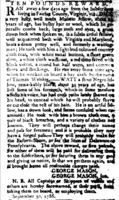
We have no evidence to suggest that James ever ran away or was punished for any form of resistance. However, his panel serves as representation for all adult enslaved people [link to potential page about all enslaved people at gunston hall] on the plantation and depicts him with an strong fist held behind his back, which speaks to the resistance of others. Two men in particular, Dick and Clem, both ran away from the Masons. Under the bondage of George Mason V, Dick and Clem lived at Lexington Plantation and Dick is documented to have run away twice. The first time, in 1784, he and Clem ran together and while Clem's fate is unknown, Dick was eventually caught. [9] We know this because in 1786, the Mason's put out a new series of runaway ads to look for him. In this second flight for freedom Dick may have been successful because there is no further record of his enslavement on either Lexington or Gunston Plantations.[10]
The quote visible on one side of James' panel is from Roger Wilkins, famous Black historian and activist, namesake of the plaza where the Enslaved People of George Mason Memorial stands. The quote comes from his book Jefferson's Pillow in which he analyzes the complicated legacies of America's founding fathers. He writes about the people these men enslaved, saying, "They did not just endure; They lived and created and passed down strength and power and hope and love."[11]
With this quote, Wilkins asserts that Black lives were significant in the founding of the United States of America, not just because of their physical labor, but because of the humanity embodied and the legacies they created. Within the violent oppression of enslavement, especially at the hands of men who pontificated on equality and libery, people like James raised families. They often stablished kinship outside of biology, facilitated Black joy, and practiced powerful and varying forms of resistance. This quote situates James and the other adult enslaved people owned by George Mason IV in a class of Black folks who are the essence of what it means to be American, and were not defined by their enslavement.
This article is an adaptation of an earlier exhibit created by Ayman Fatima.
[1] Ann Thomson Mason, “The Will of Ann (Thomson) Mason, 1762,” The Enslaved Children of George Mason, accessed September 18, 2023, https://ecgm.omeka.net/items/show/29.
[2] Terry K. Dunn, Among His Slaves: George Mason’s Struggle with Slavery (Alexandria, VA: Commonwealth Books of Virginia, 2016), 97.
[3] This inference was inspired by the creative scholarly narrative of Erica Armstrong Dunbar, Never Caught: The Washington’s Relentless Pursuit of Their Runaway Slave Ona Judge (New York: Simon & Schuster, 2017).
[4] Terry K. Dunn, The Recollections of John Mason: George Mason’s Son Remembers His Father and Life at Gunston Hall (Mason Neck, VA: Gunston Hall, 2012), 22.; Inference regarding travel was inspired by the creative scholarly narrative of Erica Armstrong Dunbar, Never Caught: The Washington’s Relentless Pursuit of Their Runaway Slave Ona Judge (New York: Simon & Schuster, 2017).
[5]Peter Wallenstein, “Flawed Keepers of the Flame: The Interpreters of George Mason,” The Virginia Magazine of History and Biography 102, no. 2 (1994): 229–60, http://www.jstor.org/stable/4249431.
[6] “Domestic Servants” folder, Gunston Hall Plantation Library and Archives.
[7] Robert Rutland, The Papers of George Mason, 1725-1792 Vol .III (Chapel Hill: University of North Carolina Press, 2011), 1124-1125.
[8] Account Book of William carlin, 1772, 72, National Museum of American History Library.
[10]George Mason’s Gunston Hall. “Enslaved People at Gunston Hall.” Accessed October 1, 2023. https://gunstonhall.org/learn/people-of-gunston-hall/enslaved-people/
[11] Roger W. Wilkins, Jefferson’s Pillow the Founding Fathers and the Dilemma of Black Patriotism, Boston: Beacon Press, 2001, Pg 123.