
John Mercer, The Freeholder
The evidence listed in legal records cataloging Mason IV’s wealth, from farms to chattels, confirm how he became and remained an affluent member of the Virginia gentry. As the patriarch he served his community on the county court, as a vestryman in the Truro Parish but this political ideal of service depended on Mason IV's ability to be an independent freeholder. The freeholder was beholden to no man or woman and deployed the labor bound to him in ways that produced lucrative commodities and commercial value. The capital he generated gave him and his family the financial security to weather the boom-and-bust times of colonial agricultural markets. He learned such strategies and how to be a conservative accumulator of wealth at feet of his mentors – his uncle, John Mercer and his mother, Ann Thomson Mason.
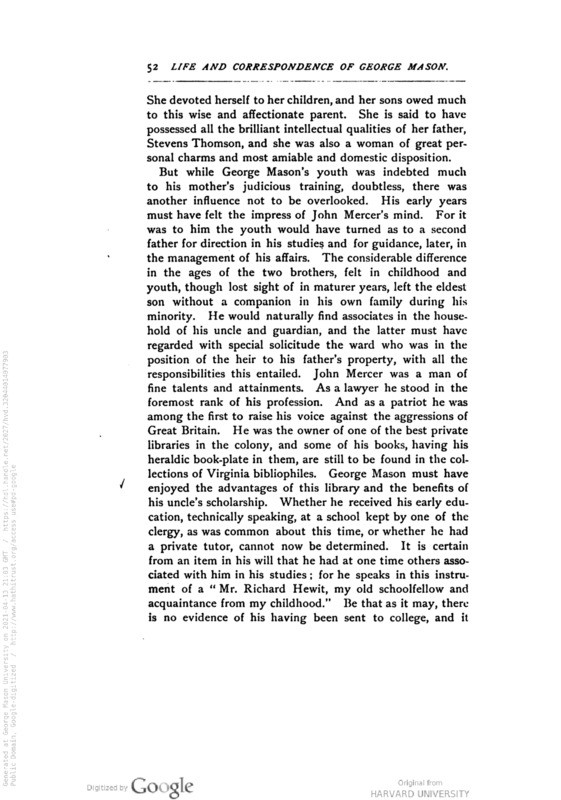
John Mercer was more successful at being a lawyer than as a planter and businessman, so it is likely that George Mason learned important lessons about how not to manage one’s plantation from his uncle. Mercer’s marriage to Catherine Mason, daughter of Col. George Mason II and half-sister to George Mason III in 1725 offered an opportunity for the immigrant from Ireland to access credit networks needed for entrée into the gentry class. In 1728 he purchased lots in the failed town of Marlborough. He intended to use significant parts of the land to establish the seat for his new plantations. Mercer also began to acquire significant lands in the west and the slaves needed to profit. By 1753 he had accumulated about sixty thousand acres and 112 slaves, mostly from the Bight of Biafra in Africa. His expenditures for building this commercial enterprise were eighty-two hundred pounds sterling. Despite the significant investment of capital, Mercer’s speculation in humanity was a series of failures. Of the people he purchased and enslaved between 1731 and 1750, 51% died, at least one from suicide, several ran away, and Mercer had a high turnover among his overseers. Ultimately Mercer survived only by becoming extremely frugal by replacing imported goods with homemade goods and by transferring much of his land and fifty of his slaves to his sons under the condition that they pay half of his considerable debts.[1
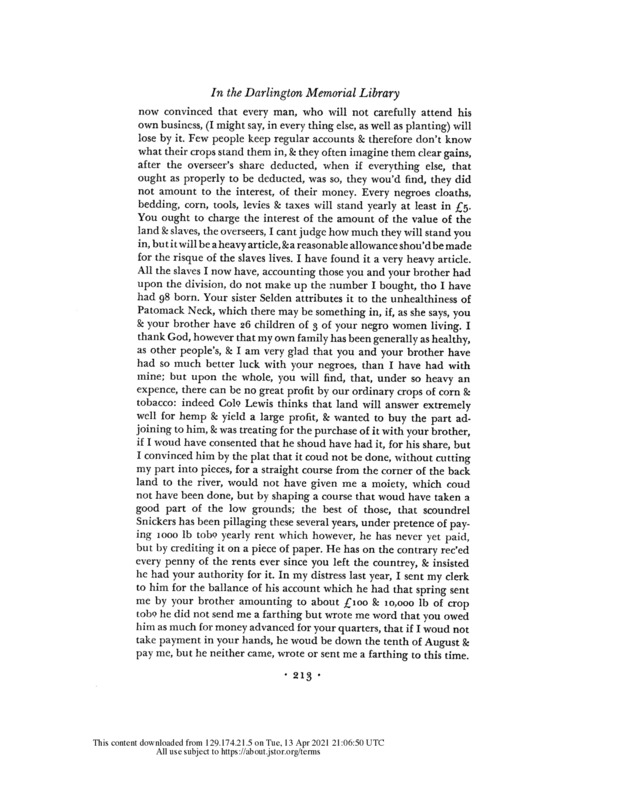
Mason observed the legacy of this indebtedness of John Mercer left to his two sons, George Mason’s cousins, George and James. Mason likely would have paid particular attention to the challenges experienced with those he enslaved—specifically his difficulty with managing people as property and the riskiness of importing new slaves on credit. John Mercer wrote to his son George Mercer in 1767 of his concern about his son’s focus on building his own plantation and the plan to purchase 50 more slaves. “I have lost many thousand pounds by it, but as my practice so wholly engrossed me, I never cou'd attend to consider the matter thoroughly…I am now convinced that every man, who will not carefully attend his own business, …will lose by it.” Mercer’s letters to his sons were filled with detailed stories of his failed enterprises and of being cheated by people. In one case, Mercer provided a detailed listing of his modest earnings and while emphasizing his thrifty nature in expenses and fees in the years after quitting his law practice. He exasperatedly exclaimed, “What then remained to support me &a family consisting of about 26 white people & 122 negroes? Nothing but my crops.” Mercer added that his scheme for a brewery, which he had recently hired 50 additional slaves, was a failure since the “proceeding from the brewery, was swallowed up in taxes (tho the people in England say we pay none, but I can fatally prove that my estate from which I did not receive sixpence has, since the commencement of the war paid near a thousand pounds in taxes only).”[2]
By 1773 both of Mercer’s sons, George and James were knee-deep in debt due to their father’s actions and their purchasing of slaves on credit. It became evident when James Mercer took an advertisement in the Maryland Gazette on 8 July 1773 which offered several plots of land for sale and indicating that George Mason had the power to settle terms with anyone who wanted to purchase these lands that things had become really difficult for Mason’s kinsman. One of their debts was to George Washington, who took over the debt of £21,000 which amounted to over £1,000 of unpaid interest from an outstanding credit originally due to Martha Parke Custis. George Mason IV wrote to Washington in late December 1773 that “The embarrass’d Situation of my Friend Mr Jas Mercer’s Affairs gives Me much more Concern than Surprize. I always feared that his Aversion to selling the Lands & Slaves, in Expectation of paying the Debts with the Crops & Profits of the Estate, whilst a heavy Interest was still accumulating, wou’d be attended with bad Consequences.” Ultimately the lands Mason was asked to sell were taken over by Washington and auctioned off to pay the Mercer’s debts.[3]
[1] Most Mason scholars believe that Mason must have learned much from John Mercer’s legal expertise and his vast library. Kate Mason Rowland, The Life of George Mason, 1725-1792: Including His Speeches, Public Papers, and Correspondence, vol. 1 (New York: G.P. Putnam’s Sons, 1892). 52; Jeff Broadwater, George Mason, Forgotten Founder (Chapel Hill: University of North Carolina Press, 2006). 3. As this essay shows I differ from this interpretation. Lorena Seebach Walsh, Motives of Honor, Pleasure, and Profit: Plantation Management in the Colonial Chesapeake, 1607-1763, Published for the Omohundro Institute of Early American History and Culture, Williamsburg, Virginia (Chapel Hill, North Carolina: Published for the Omohundro Institute of Early American History and Culture, Williamsburg, Virginia, by the University of North Carolina Press, 2010), 514-518; He collected one of the largest libraries in colonial Virginia. Mercer compiled two collections of laws in both Maryland and in Virginia. He was aggressive in the courtroom and on the bench making many enemies which result in several suspensions from being able to practice due to disreputable behavior. Despite this and the limits set on fees which attorneys could charge he made a good living as a lawyer and his legal business was worth £1,000 sterling per year by the 1740s. Mercer aggressively sought clients and did a high volume of business but some of the elite gentry, such as Landon Carter, looked disapprovingly at lawyers believing that attorneys were little more than clerks whose value was only in knowing whom to copy for specific transactions. See A Compleat Collection of the Laws of Maryland (1727); An Exact Abridgement of the Laws of Virginia (1737); Jeff Broadwater, George Mason, Forgotten Founder (Chapel Hill: University of North Carolina Press, 2006). 3; Lemay, J. A. Leo. "Mercer, John (1705-1768), lawyer and writer." American National Biography. 1 Feb. 2000; Accessed 31 Aug. 2019; Lorena Seebach Walsh, Motives of Honor, Pleasure, and Profit: Plantation Management in the Colonial Chesapeake, 1607-1763, Published for the Omohundro Institute of Early American History and Culture, Williamsburg, Virginia (Chapel Hill, North Carolina: Published for the Omohundro Institute of Early American History and Culture, Williamsburg, Virginia, by the University of North Carolina Press, 2010), 517; A. G. Roeber, Faithful Magistrates and Republican Lawyers: Creators of Virginia Legal Culture, 1680-1810, Studies in Legal History (Chapel Hill: University of North Carolina Press, 1981). 77; Alan McKinley Smith, “Virginia Lawyers, 1680-1776: The Birth of an American Profession” (Ph.D., The Johns Hopkins University, 1967); Landon Carter, The Diary of Colonel Landon Carter of Sabine Hall, 1752-1778., (Charlottesville: Published for the Virginia Historical Society, University Press of Virginia, 1965), 93.
[2] Letter from John Mercer to George Mercer 22 Dec. 1767–28 Feb. 1768, in Lois Mulkearn, George Mercer Papers Relating to the Ohio Company of Virginia (Pittsburgh, Pennsylvania:University of Pittsburgh Press, 1954), 213; Letter from John Mercer to George Mercer 22 Dec. 1767– Jan 28 1768, in Lois Mulkearn, George Mercer Papers Relating to the Ohio Company of Virginia (Pittsburgh, Pennsylvania: University of Pittsburgh Press, 1954), 198; Letter from John Mercer to George Mercer 22 Dec. 1767– Jan 28 1768, in Lois Mulkearn, George Mercer Papers Relating to the Ohio Company of Virginia (Pittsburgh, Pennsylvania: University of Pittsburgh Press, 1954), 198 but see 189 for the mention of hiring 40 slaves. His brewery idea cost him over £8,000 in debts.
[3] “James Mercer, Fredericksburg Virginia, June 28, 1773,” Maryland Gazette 8 July 1773, 3; At Martha Parke Custis’s death, GW took over the two Mercer bonds as part of Mrs. Washington’s share of her daughter’s estate. See note 1. George Washington to James Mercer 19 July 1773 Papers of George Washington Digital Edition, (Charlottesville: University of Virginia Press, Rotunda, 2008). http://rotunda.upress.virginia.edu/founders/GEWN-02-09-02-0209 [accessed 01 Sep 2019]; George Mason to George Washington, 21 December 1773 Papers of George Mason v.1, 185; The pattern of Virginia patriarchs holding debt is a well-researched topic. Works such as Woody Holton, Forced Founders: Indians, Debtors, Slaves, and the Making of the American Revolution in Virginia (Chapel Hill: Published for the Omohundro Institute of Early American History and Culture, Williamsburg, Virginia, by the University of North Carolina Press, 1999); T. H. Breen, Tobacco Culture: The Mentality of the Great Tidewater Planters on the Eve of Revolution (Princeton: University Press, 2001) have helped me understand this important topic.