
Penny


The panel silhouette of Penny, an enslaved girl who lived in 18th-century Virginia, stands in the center of George Mason University's Wilkins Plaza. Balancing a tea tray, she braces herself in a narrow staircase. Her outstretched hand reveals potential difficulty ahead and a feeling of resistance to her condition. Penny was forced to serve the household of George Mason IV, the man for whom the university is named. His legacy is known while her life is being rediscovered in the Enslaved People of George Mason Memorial by a team of faculty and student researchers who have led the effort to create this work of public history on the main Fairfax campus.
Memory of Penny was almost erased. She only appears in the historical record in 1765, as part of the William Eilbeck Inventory. Official legal inventories record itemized ownership after a person's death to make sure that their property is dispersed equitably according to their last intentions, and Penny was one very important piece of Eilbeck’s property.

Shown to the left, the inventory lists Penny as a “Negro Girl... not a part of his Estate having been given several years ago to his Granddaughter Ann (Nancy) Mason and ever since in her possession.” William’s granddaughter, Ann Eilbeck Mason, was the daughter of Ann Eilbeck and George Mason IV, meaning William was George Mason IV’s father-in-law. While it is not clear when exactly this gifting occurred, since it was before Eilbeck’s death, it marks the official transfer of ownership over Penny to the Mason family. This inventory is also particularly significant because of its legal classification of Penny as a “girl.” This terminology was reserved for female enslaved people who had not yet reached puberty and were unable to give birth. Further complicating that observation, we know that Ann Eilbeck Mason was herself only about 10 years old in 1765 when the inventory was done, meaning that she and Penny were likely similar in age when they entered into the owner/enslaved relationship. These girls had and would continue to grow up together in an elite Virginia plantation culture that defined their experiences of girlhood and womanhood as completely separate, yet also inextricably reliant on one another. The extreme power dynamic of ownership and racial exploitation bestowed upon these girls stratified a social standing for Ann that would not have been possible without the distinct and oppressed experience of Penny. Similarly, without the assertion of ownership that Ann began as a child in the Mason lineage, we will never know what Penny’s life could have been in freedom. The idea of peer ownership, especially as girls in a patriarchal culture, is just barely revealed in this document and the others that follow, but it is perhaps one of the most important filters through which Penny’s life can be interpreted.
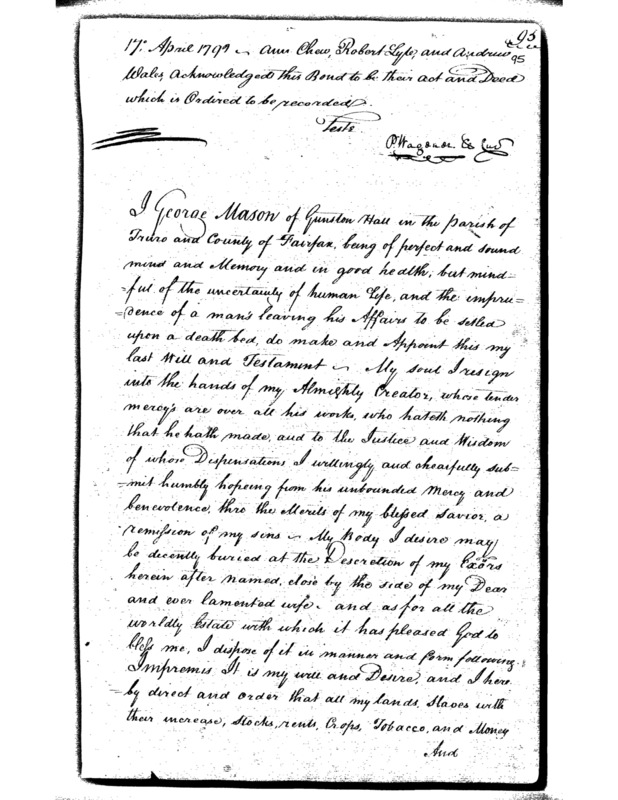
Penny’s ownership continued to be a legal matter of contention for Ann Mason and her family’s inheritance practices. The next time Penny’s enslavement is legally asserted by the Mason family is in the will of George Mason IV. Before Ann Eilbeck Mason was old enough to marry, she continued to live in the home of her father (George Mason IV) and because of that, any property, including Penny, was technically his until she was no longer a part of the Mason household. In 1773, shortly after the death of his first wife, George Mason IV wrote his will (see right) and in it, he proclaimed again that Penny was technically the property of his daughter Ann, though he included her as part of his estate for the time being. The will would not be filed until his death in 1792, but Ann Eilbeck Mason married in 1789, taking with her Penny and the promise of other inherited enslaved people from her father.

When Ann Eilbeck Mason married a man named Rinaldo Johnson, Penny’s name is again brought before the court; This time, in the form of an indenture. The indenture document was designed to ensure that 34-year-old Ann’s property (namely Penny and other enslaved people) remained designated to her and under the control of the Mason lineage only. The document, signed by Johnson, Ann Mason, George Mason, and George Mason Jr. outlined that Johnson and his creditors, despite being married into the family, were not to “intermeddle with or have any right or interest in Law or equity in or to either of any of the said negroes or into any of the increase” born after the marriage.ii This document legally preserved Ann’s entitlement to Penny’s life and labor as well as that of any children Penny could have in the future. More importantly, Ann’s husband Rinaldo Johnson, would never be able to dispose of Ann’s living endowment unless approved by the Mason patriarchs.

In 1804, Ann wrote her will, an important part of which was the delineation of what property would be given to her daughter Ann Eilbeck Mason Johnson. It appears that Penny was to be included in young Ann’s portion. Interestingly, the will lists Penny last on the list of 31 enslaved people as “Penny or Penelope.” Was this the same Penny? Did she go by the name Penelope? Was this perhaps the original Penny’s daughter? We do not know. The will was filed on March 12, 1816, when Penny would have been in her 50s or 60s. However, the subsequent inventory records taken in 1816 do not show an enslaved person named Penny amongst the 45 people listed. We have found no subsequent reference to Penny.
Because so little is known about Penny as a person, especially outside of her condition of enslavement to the Mason family, it was difficult to bring her to life in a personal and impactful way while creating the Enslaved People of George Mason Memorial.
Quoting Dr. Manuel-Scott, one of the faculty members on the Enslaved People of George Mason Memorial Project, this public depiction of Penny, "animates the experiences of a girl disappeared from the public record. She stretches out her hand and navigates a narrow staircase, reminding us of her vulnerability, of her strength, and her resistance as if to say no more."
To read more about the design choices that were made and how primary sources were used to showcase Penny in her humanity, check out our Building the Memorial exhibit.