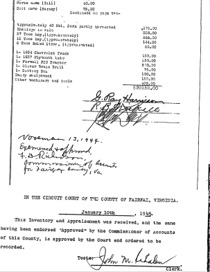
Document that appraises the land and assets of the deceased George Coates. This Document demonstrates that was able to maintain a successful farm which he then passed on to his son Leslie.
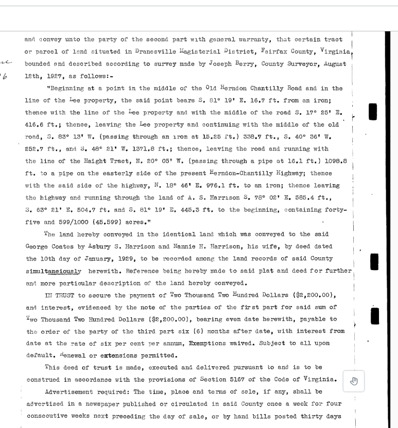
Deed which says that land once owned by Asbury and Nannie Henderson was conveyed to George Coates. This document showcases that Leslie Coates's father was a successful enough to become a landonwer within the community of Fairfax.
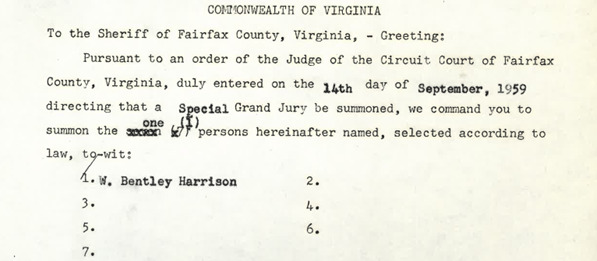
After Leslie R. Coates protested the separate eating arrangements in the Fairfax County Cafeteria Courthouse, he would be discharged and replaced with W. Bently Harrison. Primay Source shows how the Court choose to handle the discharging of Mr. Coates.
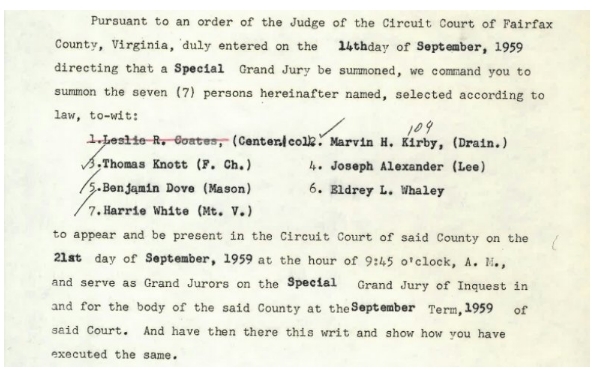
Leslie R. Coates name crossed of jury list after he refused to eat separately from his jurors in the Courthouse cafeteria. Black jurors could be excused from jury duty during this period if experienced unequal conditions.
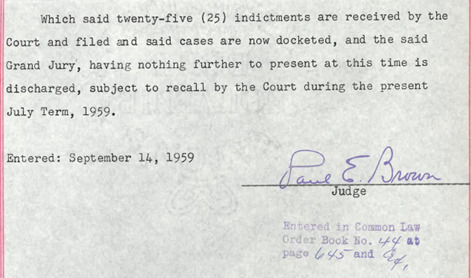
Order by the judge for the temporary discharge of the jurors for lunch. Primary source created on the same day that Lesile R. Coates would encounter segregation in the Fairfax Courthouse Cafeteria.
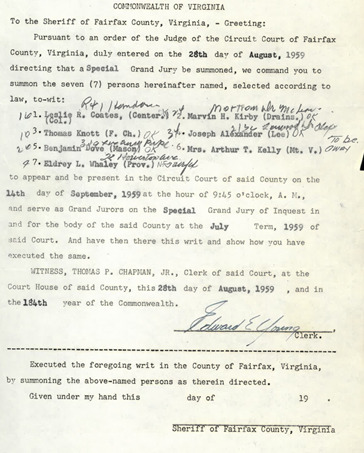
Grand Jury summons where Leslie R. Coates was called upon to serve along with six other men. Document showcases that the clerk of the court considered Mr. Coates fit to serve.
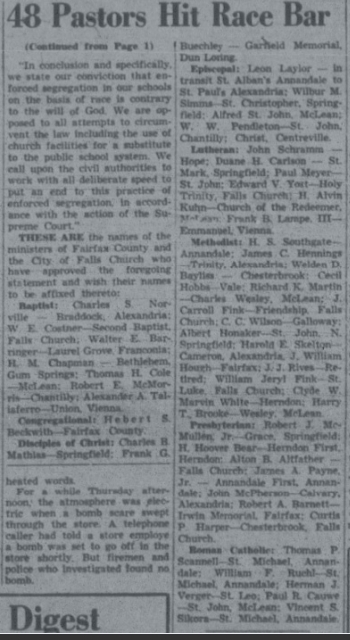
Article documenting a statement with the names of minsters from a variety of different Chirstian denominations in Fairfax County and the City of Fairfax, urging action to be taken by civil authorities against the practice of segregation in schools. One of the names featured is Reverand Robert E. McMorris who headed Chantilly Baptist Church. Leslie R. Coates attended this church during this period and would experience segregation at the Fairfax Country courthouse cafeteria one year later
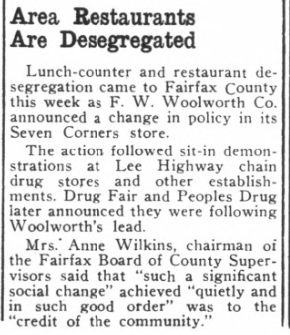
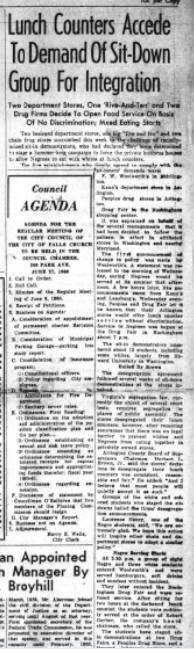
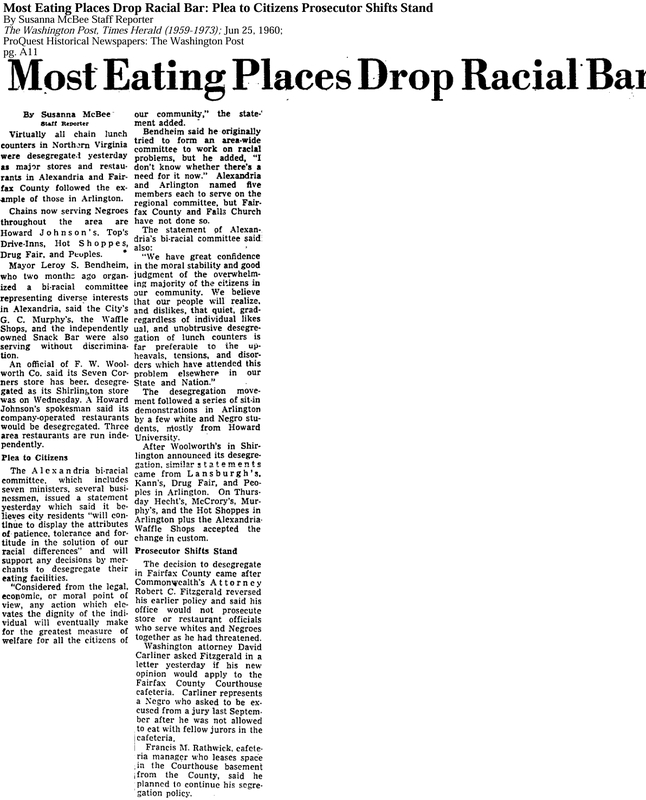
Short article documents how restaurants in Fairfax County, Virginia began to integrate because of a change in policy from F.W. Woolsworth. This policy change was due to a series of sit-in demonstrations that occurred at drug stores and other establishments in Lee highway. Article demonstrates that segregation policy in Northern Virginia had changed because of active opposition.
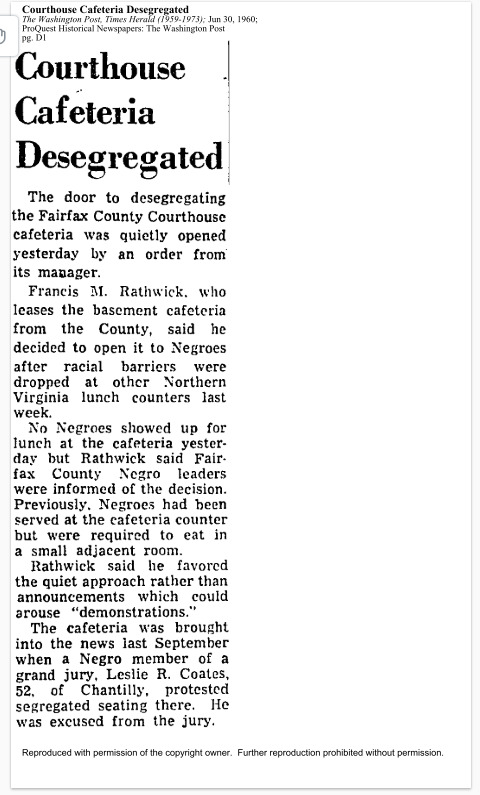
Article announcing that the Fairfax County courthouse cafeteria fully integrated as of June 29, 1960. The effort to integrate the Fairfax County cafeteria came after a complaint by Leslie Coates who refused separately from everyone else because of his race and because of series of sit-ins that occurred across Northern Virginia lunch counters.
Article documents when establishments that lunch eating areas across Northern Virginia made a commitment to fully integrate. These commitments to integration came after series of sit ins that occurred in those establishments. Article demonstrates that opposition to lunch counter segregation only continued to increase in northern Virginia after the Leslie Coates incident
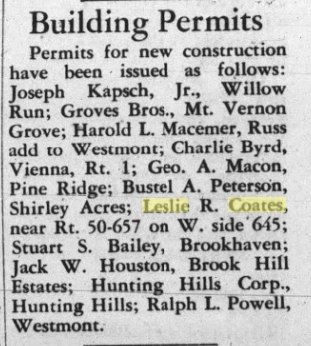
Article documenting the approval of new building permits for Fairfax, Virginia that occurred in the month of June 1960. Article demonstrates that Leslie Coates continued to be a relevant part of the Fairfax community after encountering segregation in the Fairfax courthouse.
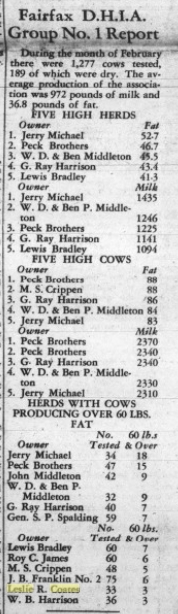
Short article that documents the amount of cow fat produced by dairy farmers in Fairfax, Virginia in the month of February 1960. Article shows that Leslie R Coates had 3 cows that were producing over 60 pounds of fat. Important in show that Leslie R. Coates was still active member of community after encountering segregation in the Fairfax courthouse cafeteria.
Newspaper article commenting on the desegregation of virtually all lunch eating areas in Northern Virginia following a series of sit ins that occurred in Arlington. Article directly connects the segregation incident involving Leslie Coates at the Fairfax courthouse with the larger civil rights movement.
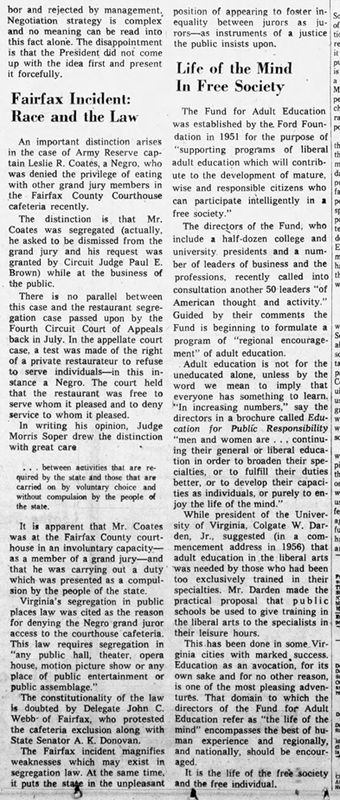
Article analyzes the constitutionality of the law that prevent Leslie Coates from eating in the cafeteria of his fellow jurors. Example of a local media press covering the debate over segregation in eating faculties especially in regard to an incident where the person segregated against was there because of involnaitry duty to the state.
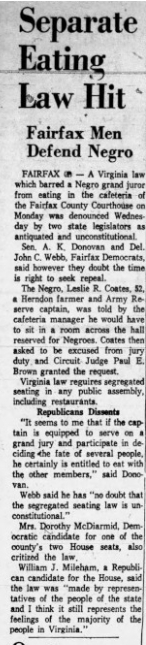
Article showcases reaction to the Leslie Coates cafeteria segregation incident among Virginian politicians. Article is also important because it demonstrates that legality of segregated eating was beginning to be doubted in Virginia.
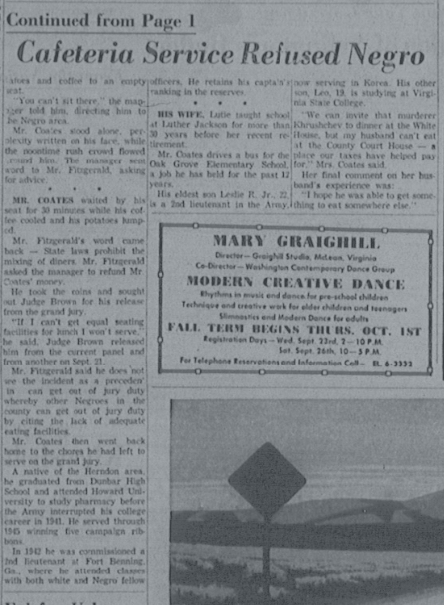
Article written one day after Lelsie Coates encountered seating segregation in Fairfax courthouse and describes the basic timeline of events. Gives an initial reaction to the segregation incident from the perspectives of Leslie, his wife Lutie, and this involved in the cafeteria courthouse.
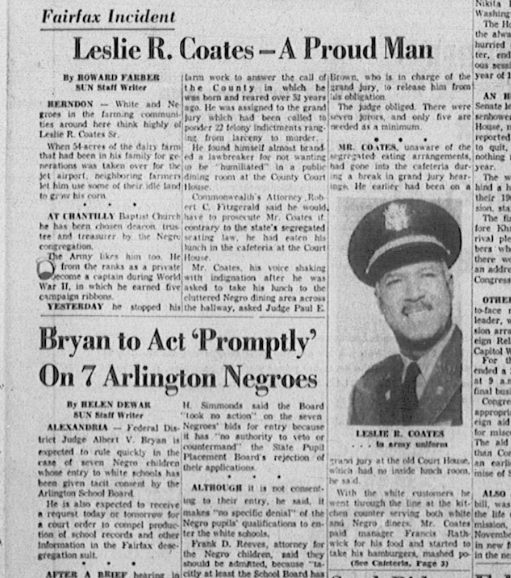
First part of a Newspaper article describing the life and achievements of Leslie R. Coates. Helps to establish that Leslie R. Coates was hardworking individual that was liked by the community and thus had capability to act as juror.
First part of a Newspaper article describing the life and achievements of Leslie R. Coates. Helps to establish that was Leslie R. Coates was hardworking individual that was liked by the community and thus had capability to act as juror.
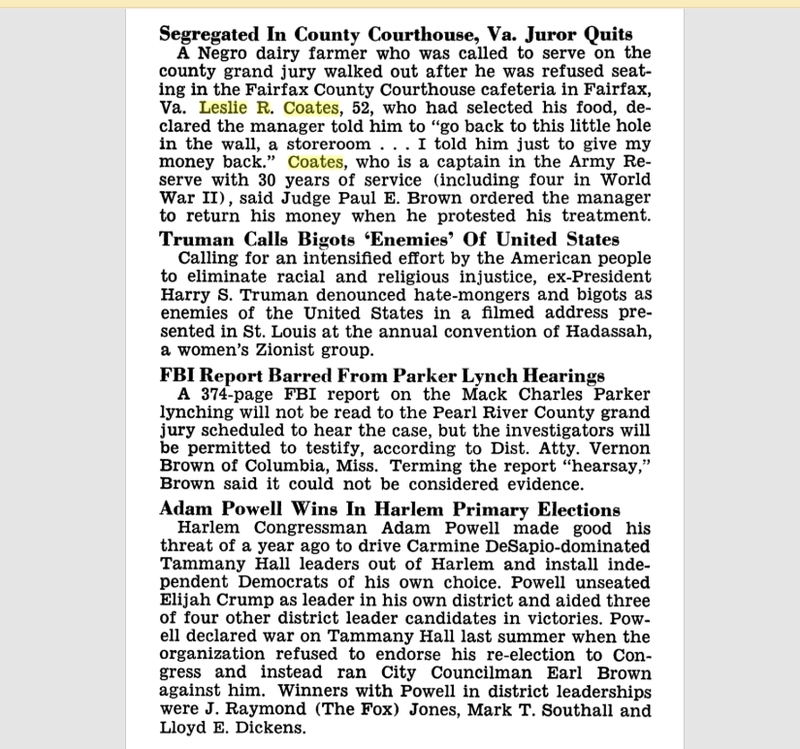
Short magazine experts described the Leslie Coates incident less than one month after it occurred and includes interview statements by Coates himself. Article expert helps to showcase that the Leslie Coates incident was seen as an example of ongoing discrimination occurring at eating facilities.
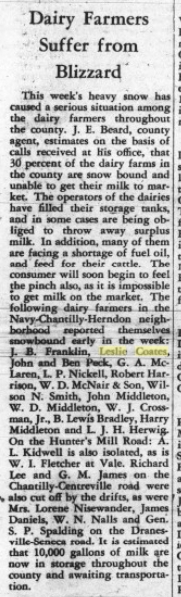
Article written on February 21, 1958, that details the effects of a blizzard that occurred earlier in the week on local dairy farmers in Fairfax County. The article is written to inform the Fairfax reader about the inability to obtain milk because of the snow that covered the local dairy farmers of Fairfax County. Article establishes that Leslie R. Coates was a prominent dairy farmer in the Fairfax and could be used to attest to the hardworking of Mr. Coates.
This Found in the Archives highlights the courageous story of Leslie R. Coates, who brought about the desegregation of the Fairfax Courthouse cafeteria.