
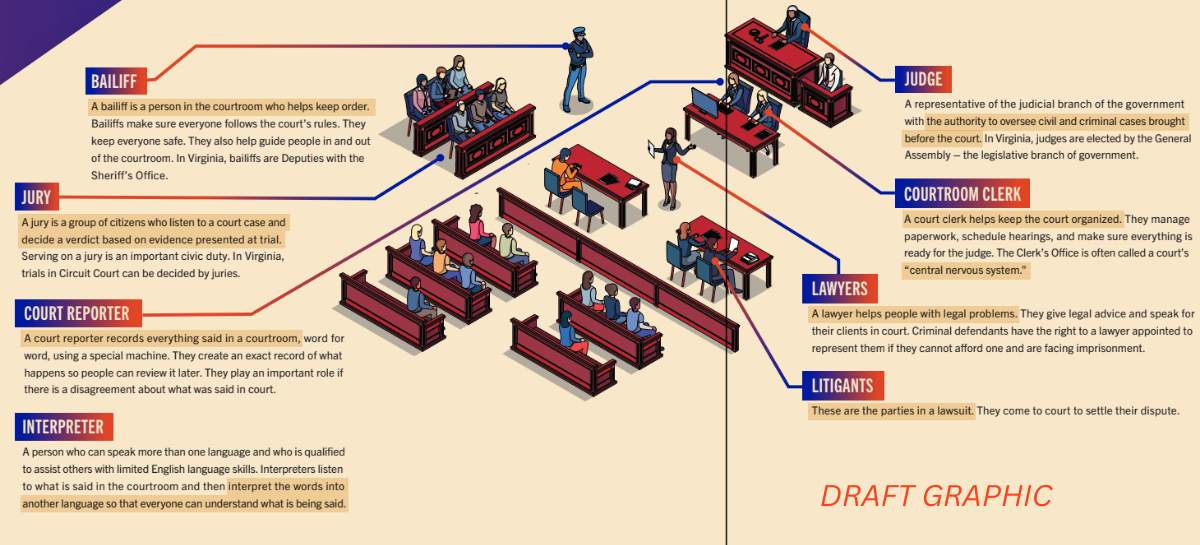
Draft Graphic showing different court roles
- Title
- Draft Graphic showing different court roles
- Description
-
Judge
A representative of the judicial branch of the government with the authority to oversee civil and criminal cases brought before the court. In Virginia, judges are appointed by the General Assembly – the legislative branch of government. The people of Virginia vote to elect Members to the General Assembly.
Bailiff
A bailiff is a person in the courtroom who helps keep order. Bailiffs make sure everyone follows the rules. They keep everyone safe and help the judge and lawyers with anything they need during the trial. They also help guide people in and out of the courtroom. In Virginia, bailiffs are Deputies with the Sheriff’s Office.
Clerk
A court clerk helps keep the court organized. They manage paperwork, schedule hearings, and make sure everything is ready for the judge. The Clerk’s Office is often called a court’s “central nervous system.”
Lawyers
A lawyer helps people with legal problems. They explain the rules (laws), give advice, and speak for their clients in court. In Virginia, each city or county elects a Commonwealth’s Attorney responsible for prosecuting people charged with crimes on behalf of the state. Criminal defendants have a right to have a lawyer appointed to represent them, even if they cannot afford one.
Interpreter
A person who can speak more than one language and who is qualified to assist others with limited English language skills. Interpreters listen to what is said in the courtroom and then translate the words into another language so that everyone can understand what is being said.
Court Reporter
A court reporter records everything said in a courtroom, word for word, using a special machine. They create an exact record of what happens so people can review it later. They play an important role if there is a disagreement about what was said in court.
Jury
A jury is a group of people who listen to a court case and decide what really happened. In criminal cases, the jury works together to decide if someone is guilty, or innocent based on the evidence and the law. In civil cases, the jury decides whether someone must pay money to another person. Serving on a jury is an important civic duty. - Date
- 2025
Part of DRAFT JLC graphic