Background: Jury Selection & Scottsboro Cases
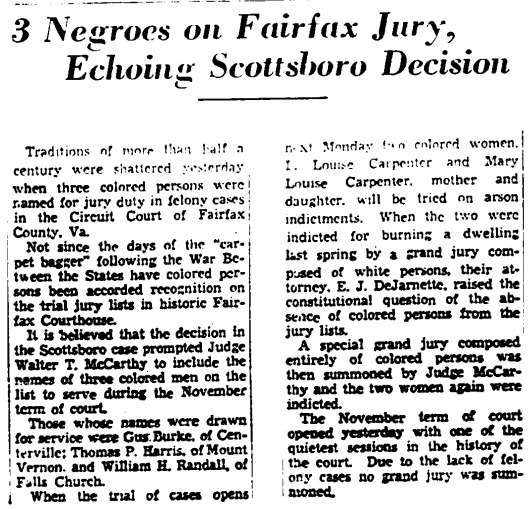
The United States legal system is complicated and often difficult to navigate. The Carpenter cases highlight the slow pace at which change can be implemented through this system. In essence, the journey for the Fairfax Court to grant the Carpenters an all-Black grand jury began 50 years prior, in 1880. The April 1935 Supreme Court decisions in Norris v. Alabama and Patterson v. Alabama secured access for Black people to serve of juries.
On March 25, 1931, two young white girls accused nine Black boys of rape on a freight train headed west towards Memphis, Tennessee. Law enforcement arrested the nine boys in Alabama after a “ragged crew of hoboes” accused “bunch of Negroes” of throwing them from the train after they got in a fight.[1] According to historian Dan Carter, at this time “[i]n Jackson County – as over all the South – a substantial numbers of persons agreed that … a Negro rapist hanged and burned by a mob “got off awful light.””[2] The situation was bleak for the nine boys. The community judged the nine boys as guilty from the beginning. All nine boys were wrongly convicted and served jail time. Eventually their convictions were either overturned or they were pardoned, but the April 1935 Supreme Court decision regarding the exclusion of Black people from serving on juries opened the door to challenges of discrimination throughout the United States.
In Strauder v. West Virginia (1880), the United States Supreme Court “held that the deliberate exclusion of Negroes from the jury lists was a violation of the equal protection clause of the Fourteenth Amendment.”[3] Then in Neal v. Delaware (1881), they effectively made it impossible to enforce their previous ruling.[4]
In Norris v. Alabama (1933), the Supreme Court granted a retrial to Clarence Norris, one of the nine Scottsboro Boys. His attorney had “[t]hree main points,” but the Supreme Court only acknowledged the inadequate counsel argument as applicable. According to supporters of the Scottsboro boys, the court “ignored” the other two points, “the lack of a fair trial … and the systematic exclusion of Negroes from Alabama juries because they contained “deep social significance.”[5]
In 1935, the cases were appealed to the Supreme Court again. The court ruled that the attorney needed to prove the systematic exclusion of Black jurors for them to overturn Clarence Norris and Haywood Patterson’s death sentence. He successfully proved the exclusion along with the fact that the Alabama court had forged the names of eight Black jurors on the jury list. The Supreme Court sent both cases back to Alabama State Courts on the grounds that they deprived Norris and Patterson of their Fourteenth Amendment rights.[6]