
Criminal Court Cases: The Final Decision
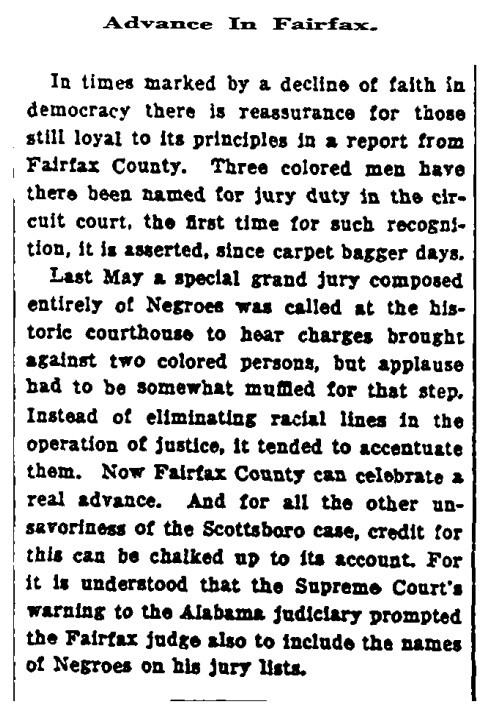
The trials for Louise and Mary Lucy took place during the November 1935 Court Term. On November 18, 1935, the court issued a writ of venire facias for twenty-two men to be summoned to appear as jurors. Three of those on the list were Black men. Those three Black men served alongside nine White men as jurors for both trials.[1]
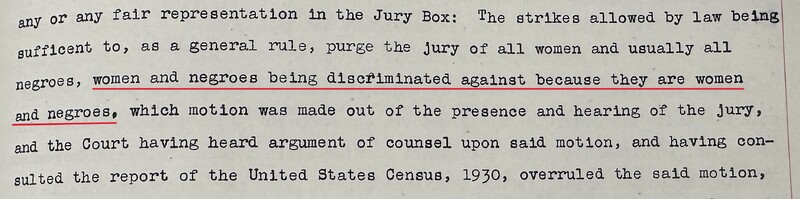
The trial proceeded with these jurors, but not before DeJarnette again demonstrated the deprivation of their Fourteenth Amendment rights. In his motion to “quash the venire facias … on the ground that the jury was improperly selected and selected from an improper jury list,” he argued that Louise was “denied the right to be tried by members of her own race because she [was] a Negro, and deprived of the equal protection of the laws, and [to be judged] by members of her own sex, [since] women [are] now … qualified voters under the law of Virginia, and otherwise entitled to act as jurors.”[2] DeJarnette used this same argument on Mary Lucy’s behalf, but in Louise’s case he added that “being a woman in distress with a large family of small children, other women similarly situated could better appreciate [Louise’s] condition other than men.”[3]
DeJarnette provided convincing statistics to claim the injustice committed against his clients. He cited “that there [were] only 12 colored people or negroes, and no women on the jury list of 300 from which the jury [was] drawn.”[4] The “four per cent (4%)” of Black people on the jury list did not reflect “the negro population of Fairfax County,” which “is at least one-fifth (1/5) of the entire population of said county, and 1/8 of the population of the district in which the defendant[s] reside and [where] the crime[s are] charged to have been committed.”[5] He continued to highlight that “1/5 of the population are women,” so “negroes and women have been systematically excluded from having their names in any or any fair representation in the Jury Box.”[6] The attorney concluded that these actions violated “Sec. 5988” of the Code of Virginia, which states that “the jury list is required to be taken from each district … in accordance with the percentage of the population.”[7]
The Verdict:
The court overruled DeJarnette’s motion and the trial proceeded with not guilty pleas from both women. In the end, the jury found them not guilty on all criminal charges.[8] Although the court overruled the second motion to quash the venire facias, the women successfully challenged the systemic exclusion of both people of color and women in Fairfax County’s judicial system.
Present Day Jury Selection:
Today it is illegal to exclude jurors based on race. In Fairfax, potential jurors are randomly selected from voter registration lists, who then complete a questionnaire. This way of picking potential jurors is more representative of our community. For each case, the judge and both sides can ask potential jurors questions to make sure that they can be fair and impartial if selected to hear that case.
[1] Commonwealth vs. L. Louise Carpenter, November 18, 1935, 171-172, 174-176, 178-179; Commonwealth vs. Mary Lucy Carpenter, November 25, 1935, 176-178.
[2] Commonwealth vs. L. Louise Carpenter, November 25, 1935, 175.
[3] Commonwealth vs. L. Louise Carpenter, November 25, 1935, 175; Commonwealth vs. Mary Lucy Carpenter, November 25, 1935, 176-178.
[4] Commonwealth vs. L. Louise Carpenter, November 25, 1935, 175.
[5] Commonwealth vs. L. Louise Carpenter, November 25, 1935, 175.
[6] Commonwealth vs. L. Louise Carpenter, November 25, 1935, 175.
[7] Commonwealth vs. L. Louise Carpenter, November 18, 1935, 171-172, 174-176, 178-179; Commonwealth vs. Mary Lucy Carpenter, November 25, 1935, 176-178.
[8] Commonwealth vs. L. Louise Carpenter, November 18, 1935, 171-172, 174-176, 178-179; Commonwealth vs. Mary Lucy Carpenter, November 25, 1935, 176-178.