
Little Hunting Park Court Cases
The Court Cases:
Mr. Sullivan and Dr. Freeman both attempted to solve the issue by talking with the pool’s board members and neighbors. When their efforts failed, they filed cases against Little Hunting Park at the Fairfax Courthouse. Dr. Freeman sought damages for having to pay pool membership fees elsewhere and personal hardship endured by him and his family.[1]
Mr. Sullivan argued that he was wrongfully deprived of membership, which diminished the value of his property. Like Dr. Freeman, he also argued that it caused damage to him and his family’s well-being. They stated it was an unlawful racial restriction and violated the equal protection clauses of the Fourteenth Amendment.[2]
In court, lawyers argued whether the Fourteenth Amendment applied. They also debated whether Little Hunting Park was a private club. This was important because if it was private then the club could restrict who could join.[3] Little Hunting Park argued it was a private club and therefore could be selective in the membership process. However, evidence showed White members of surrounding communities were able to become members and that even Black guests were turned away from the pool.[4]
Both Mr. Sullivan and Dr. Freeman lost their cases at the Fairfax Courthouse.
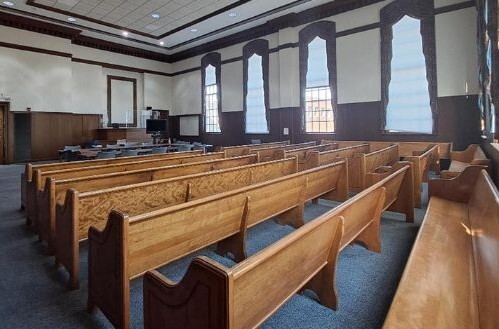
Fairfax Courtroom built in the 1950s.
Fairfax Courtroom built in the 1950s that could have heard the Sullivan and Freeman cases.
The Final Decision:
Both Mr. Sullivan and Dr. Freeman appealed their cases. Mr. Sullivan’s case was eventually by heard in the U. S. Supreme Court in 1969, 4 years after the membership was initially denied. By this time, the Freeman family had left the area.[5] The Supreme Court ruled that it was illegal to deny Dr. Freeman a pool membership based on his race and to cancel Mr. Sullivan’s membership for standing up against the club’s discriminatory practices.[6]
Allison W. Brown, Jr.
Allison W. Brown Jr. was the lawyer that successfully argued Mr. Sullivan’s case. Originally from Illinois, he graduated from Antioch College in Ohio and the University of Michigan law school. Brown lived in Alexandria, Virginia at the time he argued this case. The Sullivan case was not the only civil rights case he was involved in. He successfully argued that the Poll Tax required for voting in Virginia was unconstitutional. He also advocated open occupancy in housing the desegregation of public and private schools, as well as movie theaters in Northern Virginia.[7]
National Impact:
This case was an important step in fighting racial discrimination in neighborhoods and parks. It made it clear that everyone has the right to be treated equally under the law. This case and the Fair Housing Act of 1968 led to the desegregation of recreational clubs in communities across the United States.
Questions Answered
- How did the Fourteenth Amendment apply to this case?
- The Supreme Court said that it is against the law to treat people unfairly because of their race, especially when it comes to owning or using property. They also said it is wrong to punish someone for standing up against discrimination.
- How did Dr. Freeman and Mr. Sullivan use the court system to resolve conflict?
- When their appeals to their neighbors and Little Hunting Park board failed, they filed a suit. Then when Dr. Freeman and Mr. Sullivan lost their cases at the Fairfax Circuit Court they appealed their cases. Sullivan's cases made it to the Supreme Court. Review Virginia's court system in the judiciary exhibit.
[1] Freeman Jr., Lucky Diplomat, 118-119; Sullivan, No. 22751, 17-18, 27-28, 96.
[2] Sullivan, 396 U.S. 229.
[3] Freeman Jr., Lucky Diplomat, viii.
[4] Freeman Jr., Lucky Diplomat, 119-120.
[5] Sullivan v. Little Hunting Park, Inc., 396 U.S. 229, 1969. Sullivan v. Little Hunting Park, Inc. | Oyez
[6] Sullivan, 396 U.S. 229.
[7] Bart Barnes, “Lawyer, Civil Rights activist: Allison W. Brown Jr. Dies,” The Washington Post. April 13, 1984.
Legal Terms on This Page:
-
Amendment XIV - Passed by Congress June 13, 1866. Ratified July 9, 1868. Note: Article I, section 2, of the Constitution was modified by section 2 of the 14th amendment.
- Section 1. All persons born or naturalized in the United States, and subject to the jurisdiction thereof, are citizens of the United States and of the State wherein they reside. No State shall make or enforce any law which shall abridge the privileges or immunities of citizens of the United States; nor shall any State deprive any person of life, liberty, or property, without due process of law; nor deny to any person within its jurisdiction the equal protection of the laws.
- Section 2. Representatives shall be apportioned among the several States according to their respective numbers, counting the whole number of persons in each State, excluding Indians not taxed. But when the right to vote at any election for the choice of electors for President and Vice-President of the United States, Representatives in Congress, the Executive and Judicial officers of a State, or the members of the Legislature thereof, is denied to any of the male inhabitants of such State, being twenty-one years of age,* and citizens of the United States, or in any way abridged, except for participation in rebellion, or other crime, the basis of representation therein shall be reduced in the proportion which the number of such male citizens shall bear to the whole number of male citizens twenty-one years of age in such State. *Changed by section 1 of the 26th amendment.
- Section 3. No person shall be a Senator or Representative in Congress, or elector of President and Vice-President, or hold any office, civil or military, under the United States, or under any State, who, having previously taken an oath, as a member of Congress, or as an officer of the United States, or as a member of any State legislature, or as an executive or judicial officer of any State, to support the Constitution of the United States, shall have engaged in insurrection or rebellion against the same, or given aid or comfort to the enemies thereof. But Congress may by a vote of two-thirds of each House, remove such disability.
- Section 4. The validity of the public debt of the United States, authorized by law, including debts incurred for payment of pensions and bounties for services in suppressing insurrection or rebellion, shall not be questioned. But neither the United States nor any State shall assume or pay any debt or obligation incurred in aid of insurrection or rebellion against the United States, or any claim for the loss or emancipation of any slave; but all such debts, obligations and claims shall be held illegal and void. Section 5. The Congress shall have power to enforce, by appropriate legislation, the provisions of this article.
- Fair Housing Act 1968 - Act passed in 1968 that prohibits discrimination in housing. Money lending institutions, insurance companies, and those providing housing cannot discriminate and make housing unavailable to people based on race, religion, sex, national origin, familial status or disability.