
"Spread the Butter a Little Thinner"
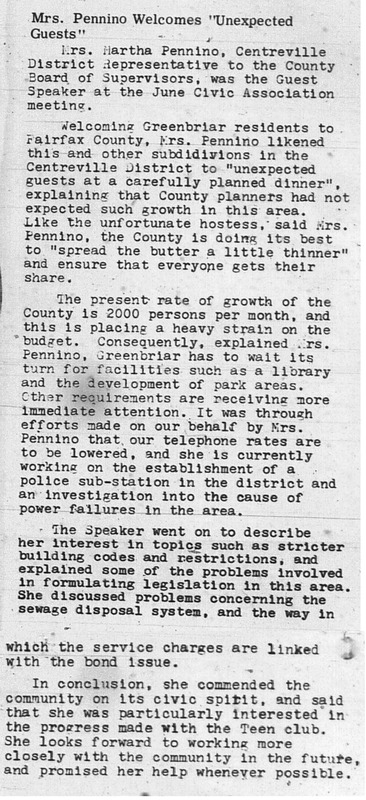
In 1969, supervisor Martha Pennino, who used to represent LLV, was invited to speak to her new constituents at a meeting of the Greenbriar Community Association. She described the challenge of governing the County’s new residents, describing new Fairfax suburbanites as “unexpected guests at a carefully planned dinner” as she argued that the County planners did not expect the massive growth which Fairfax experienced[21]. She continued:
“Like the unfortunate hostess, the County is doing its best to spread the butter a little thinner and ensure that everyone gets their share.”
Admittedly, Fairfax County officials were in a difficult position, as the state’s Dillon Rule meant that local governments had to get approval from the Virginia state legislature to get most things done. And the state often had different priorities than local governments, especially in regard to the rapid growth of the County. Simply, county officials wanted to slow the growth, while state officials, pressured by developers, argued that limiting growth infringed on the property rights of its citizens. Local officials had to deal with the aftermath of this growth, without having the financial grounding to assist all residents of the county.
But it does seem that some were citizens were listened to more than others. The Greenbriar Community Association, for example, wrote that with access to supervisors like Pennino, they could be “an influencing force on local government bodies” who control “zoning, building ordinances, gun control, low-income housing, school budgets, and noise control.”[23] The primarily white middle class residents of Greenbriar were being trained by their neighbors on the most effective ways of lobbying the County. And using their neighborhood publication[24], they encouraged their neighbors to do the same:
“Because of our ISOLATION and RATE OF GROWTH, we have needs which are unsatisfied at this time, and problems which are uniquely related to our embryonic community. Because we are LARGE we are big enough to do something about it---NOW!”
Ignored by local governments, neighborhoods like LLV relied on motivated residents and private organizations, like the anti-poverty organization Fairfax Community Action Program, to help their situation. Especially since LLV couldn’t access existing programs for the poor due to their isolation.[25] The FCAP filled in where local governments lapsed, providing childcare and job training, helping communities apply for federal grants, and training the next generation of community leaders. In a 1968 article for The Washington Post[26], journalist James Yenckel wrote:
"Ignored for years, Fairfax County's dozen or so poverty-level communities are beginning to demand the same public services their more affluent neighbors take for granted."
He added that “some county officials believe that the anti-poverty programs might be better coordinated under county control,” that the organization was “too militant in its demands for the poor.”[27] It seems, the county wanted to control an organization which was doing the work they should have done.
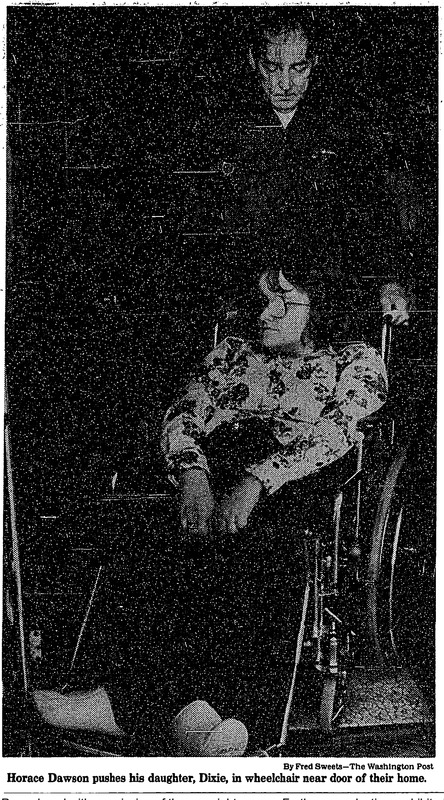
Without sewers and running water, the LLV neighborhood was unable to access other kinds of services. Many grants and community funding sources stipulated that buildings must be updated to county building codes, which was impossible in LLV, due to the lack of sewers. Furthermore, sewers were just one of a host of issues the neighborhood faced. The LLV neighborhood still had old dirt roads, and was not on any bus routes, making residents isolated from the rest of the county, and unable to easily get to the grocery story or doctor's office without a car. Marguerite Mott took this task on herself by driving a transport van for the community, but the county needed to address the isolation of its residents, especially those with disabilities, like Dixie Dawson (pictured on the left).
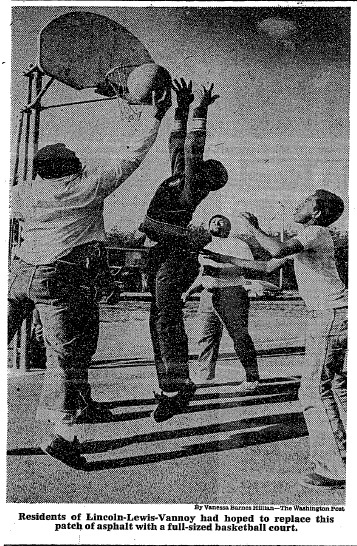
Boys playing basketball on a small court in LLV
Seeing a community need, in 1969, the Motts established the Braddock Community Center in a small, one-room cabin. In 1980, they secured a $375K federal HUD grant which would fund the Center’s expansion, yet, FFX County’s health department refused to issue them a building permit due to the neighborhood’s lack of plumbing. While waiting for the sewer system to be built, according to The Post, the grant suffered the effects of inflation, which “nibbled away at what the money can buy.”[28] Then, in 1981, the LLV residents were “out-lobbied” for funding to build a full-sized basketball court by a “mostly white neighborhood on the other side of the county.”[29]
The lack of attention affected the moral of this community. Seventeen year old LLV resident Greg Robinson was quoted[30] in The Washington Post:
“Hope for the future? Yeah we’re doing a lot of hoping man. That’s about all we’re doing….we ain’t gettin’ no gym.”
So, the teens resorted to hitchhiking three miles to GMU’s campus to play basketball.
___
[21-22]Mrs. Pennino Welcomes ‘Unexpected Guests,’” Greenbriar Flyer, July 1969, Fairfax Public Library: Virginia Room.
[23-24]The listed issues have a long history of being racially coded. See “Local Government Representative to Speak at June 9 Meeting,” Greenbriar Flyer, June 1969, 1–2, Fairfax Public Library: Virginia Room.
[25-27]James Yenckel, “Fairfax Poor Areas Seek Services: Hearing Slated Organizing the Poor Seek Federal Grant,” Washington Post, June 3, 1968, ProQuest Historical Newspapers: The Washington Post.
[28]Bob Levey, “Tattered Blueprints, Shattered Hopes,” Washington Post, April 24, 1980.
[29]Bob Levey, “The Big City Look Comes to the Suburbs,” Washington Post, January 8, 1981, Proquest Historical Newspapers.
[30]Levey, “Tattered Blueprints, Shattered Hopes.”