
Creating Futures
Many Black residents grew expert in choosing, purchasing, and developing land. The Joint Stock Club of Gum Springs, created in the 1890s by Henry Randall and four other Black men, exemplifies a persistent spirit of entrepreneurship unleashed by emancipation. The Stock Club fostered Black landownership by pooling its members’ funds to buy land, which it then sold at cost to newcomers and others in the community. Black women joined in purchasing and “participat[ing] in the process of dispersing land ownership.” Several innovative strategies were used by Black women who sought to leave a legacy of land ownership. Their actions also demonstrate their commitment to building and sustaining Black communities.
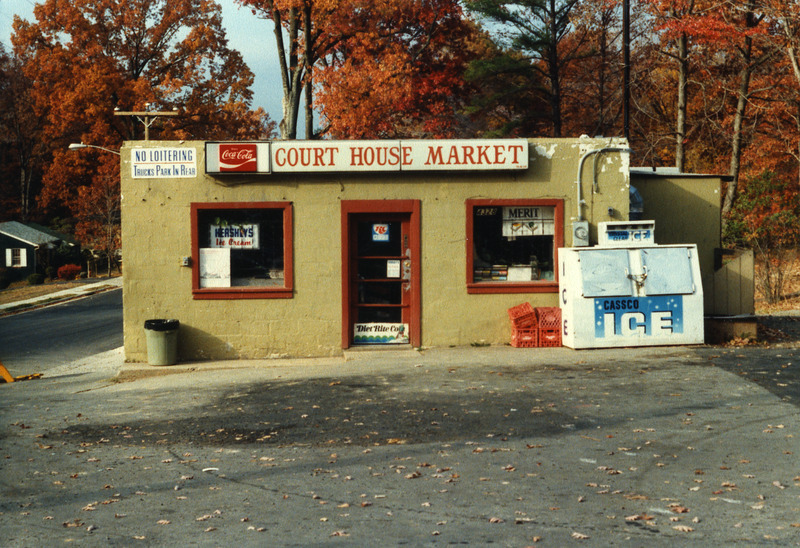
Warren and Evelyn Moriarty's store on Chain Bridge Road.
In the Mount Vernon District, at least four women bought land from the Stock Club, including Emma Ford, who in 1897 procured a half-acre, and Susane Belfield, who purchased one acre in February 1898 for thirty dollars. In the School Street neighborhood on the outskirts of Fairfax City, adjacent to what is now the George Mason campus, another Black woman enabled generations of wealth-building. Luvenia (Gibson) Morarity, whose father was born in the nearby Black community of Ilda and who was active in the Mt. Calvary Baptist Church, purchased land from her Irish-born father-in-law in 1903, which she passed on to her children. Luvenia’s daughter, Mabel Gibson, and her husband, Stephen Payne, acquired even more land adjacent to her mother’s home. Her son, Warren, and his wife, Evelyn, further extended Luvenia’s family compound in 1930 and, by 1948, had purchased even more and opened a store. Luvenia’s granddaughter, Dorothy Payne, and her husband were able to build a home on the family compound despite social impediments. Luvenia Morarity’s story exemplifies how the Black investment in land offered multi-generational stability and sovereignty.
Black pioneers of the 1890s, like James Lee, would surely have been devastated to see the predicaments, almost one hundred years later, of the once strong Black communities they founded. Throughout the twentieth century, Black property owners were met with a barrage of racially discriminatory policies. Federal, state, and local government officials, land developers, lending institutions, and affluent residents constructed an exclusionary housing system designed to finance and protect White suburban growth. The origins of suburban Fairfax reveal partitioning of land and infrastructure investments that created and supported White islands of advantage.
The exhibit, A History of the Pines, describes the 1965 erasure of The Pines community that wiped out dozens of long-established Black families near Merrifield. Founded by a Black veteran of not just the U.S. Army but, before that, U.S. slavery, The Pines’ rise and fall starkly shows how county entities—in this case, Fairfax County Public Schools –weaponized the process of eminent domain against vulnerable populations. The process seems even more exploitative when considering that it was the very fact of segregation, disenfranchisement, and structural neglect that made African American property attractive for seizure. Decades of public disinvestment and market bias reduced property values, while its owners’ lower incomes and political marginalization diminished their capacity to fight government takings in court (as White communities often did).
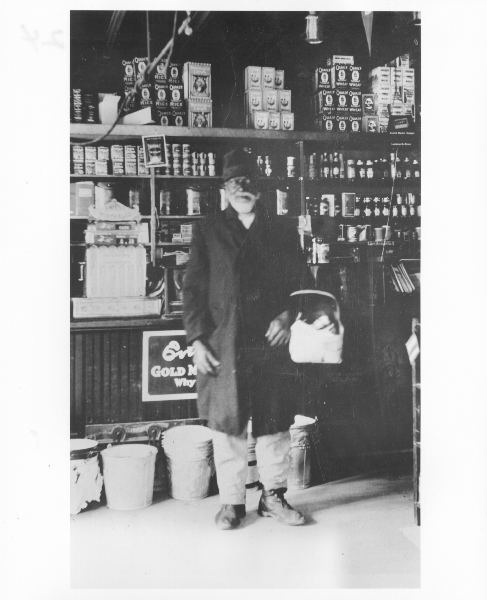
Elderly James Lee in the Henderson grocery store. Courtesy of Mary Riley Styles Public Library, Falls Church History Collection, Falls Church, VA.