
An Incompatible Racial Element
Building the American Dream
Federal subsidies shaped the birth of suburban Fairfax. Three types of federal investments produced the now nostalgic single-family-home-with-white-picket-fence ideal. Direct financial incentives, such as those provided by the FHA and VA, explicitly targeted suburban development. Structural initiatives such as expressway construction, tax breaks for homeowners, and tax incentives for real estate developers indirectly facilitated suburban growth. And, lastly, Supreme Court rulings on deed restrictions and civil rights legislation influenced the racial composition of suburbs and helped assure geographic homogeneity. Together, these mechanisms constituted a unified federal housing policy that was reproduced in the private sector by lending agencies, realtors, homeowner associations, and residents of exclusionary subdivisions to construct a segregated American Dream—an ideological enterprise designed to condition consumer behavior.
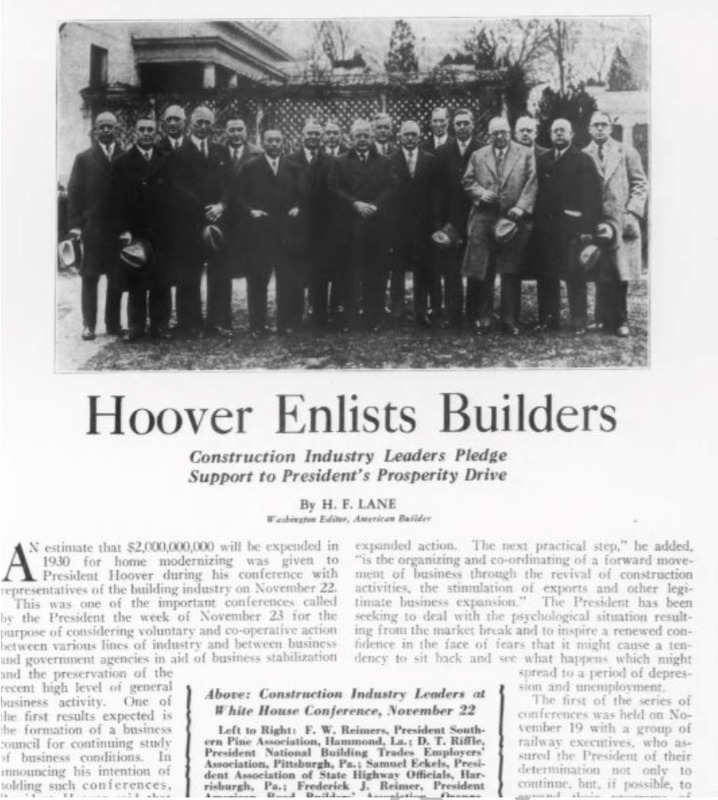
Herbert Hoover, as U.S. secretary of commerce, discouraged multifamily residential construction and fostered racially exclusionary zoning as part of a national movement advocating for “wholesome” American homes.
This ideological project originated with Herbert Hoover, on his appointment as Secretary of Commerce in 1921. To address the problem of residential crowding in American towns and cities, Hoover convened an Advisory Committee on Zoning. These advisors held up land-use restrictions as a solution for cities burdened by over-crowded aging multifamily housing stock. Such policies did nothing to address the problems’ underlying causes, however, namely housing scarcity and poverty. Requiring larger lot sizes while impeding the construction of denser options like apartments had the dual impact of constraining investment in affordable housing while moving single-family home ownership further out of reach for most working-class families.
Behind this seeming illogic was an unambiguous government desire to promote a certain, “right,” kind of American homeownership, in the analysis of writer Manisha Claire. It was no coincidence that 1922 saw the founding of a private organization that, though little known today, shaped the ensuing century of American homeownership through its influence on national lending standards.
The incorporated Better Homes in America (BHA), with Hoover as its titular head, was started by a journalist, Marie Meloney, who edited the then prominent women’s publication, The Delineator. In support of its “ideological vision of the basic home for the typical American middle-class family,” the BHA gathered “a wealth of analytical work” that the government would later conveniently adopt as the basis for lending criteria set by the newly formed Federal Housing Administration—criteria that led to the notorious federally sanctioned “redlining” of Black, immigrant and working-class neighborhoods, a policy whose effects still resonate. For more about the Better Homes in America movement see the exhibit: The Better Homes in America Movement.
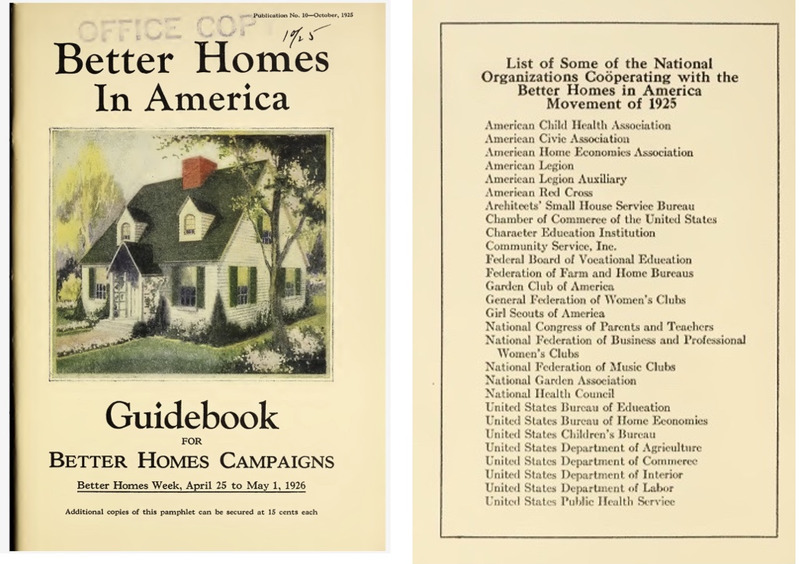
Fairfax County hosted two BHA demonstration houses in the 1920s, introducing local officials, civic and parent-teacher groups, garden and landscape club members and the general public to an innately race-based vision of the "perfect" American home.