
The Redoubt and Early War Skirmish
In June of 1861, Confederate units from the 5th Alabama Infantry Regiment, commanded by Colonel Robert E. Rodes, constructed Farr’s Redoubt.22 The troops encamped there also constructed a supporting trench line to cover the flank of the redoubt. In the initial stage of the war, the fort served as a valuable defense point in a chain of defenses monitoring Union advances from Alexandria, along with other earthworks constructed in the vicinity of Farr’s Crossroads.23 Unfortunately, the remains of these other earthen fortifications are no longer visible. Farr’s Redoubt is located atop a hill overlooking the crucial Braddock and Ox Roads. Braddock Road connected Alexandria to Centreville, while Ox Road linked Fairfax Courthouse to Fairfax Station.24 During the war, these roads were heavily contested, serving as important avenues for invading armies and for the transport of supplies.
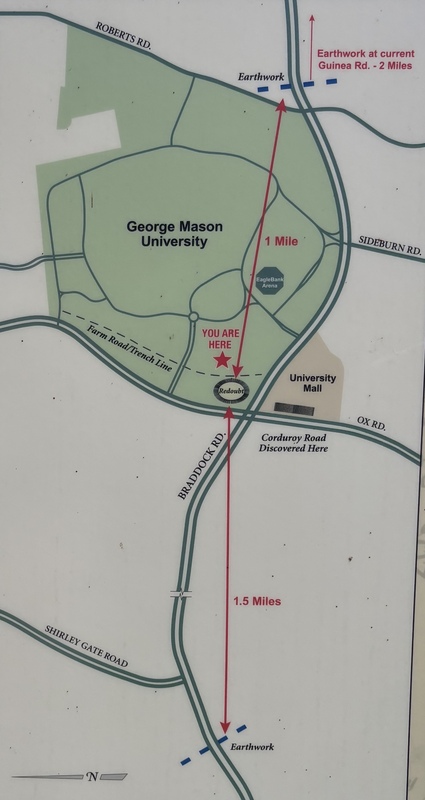
Map from Interpretive Sign at Farr's Redoubt
Map of Farr's Redoubt, trenchline, and neighboring fortifications.
Four days prior to the First Battle of Bull Run on July 17th 1861, multiple Union divisions were sent to converge on Fairfax Courthouse as part of General Irvin McDowell’s advance on Richmond.25 Union infantry from Colonel Miles’ 5th Division, consisting of units from the 16th and 18th New York infantry, marched towards Fairfax Courthouse taking Braddock Road.26 Within roughly 3 miles of Fairfax, troops from the 16th and 18th New York infantry came across the first encampment of the Confederate 5th Alabama regiment. 27 There they engaged in a brief skirmish. Outnumbered, the 5th Alabama regiment made a fighting retreat, abandoning their posts at Farr's Redoubt as members of the New York infantry continued to progress closer to the courthouse.28 By 1:30 PM, Miles’ Division reached Farr’s Crossroads while Confederate forces retreated west towards Centreville and Bull Run.29 Ultimately, the skirmish around Farr’s Crossroads delayed the Union advance long enough for Confederate General Richard S. Ewell to successfully maneuver his troops to defensive positions at Bull Run.30 Just days later, the first major land battle of the Civil War took place.
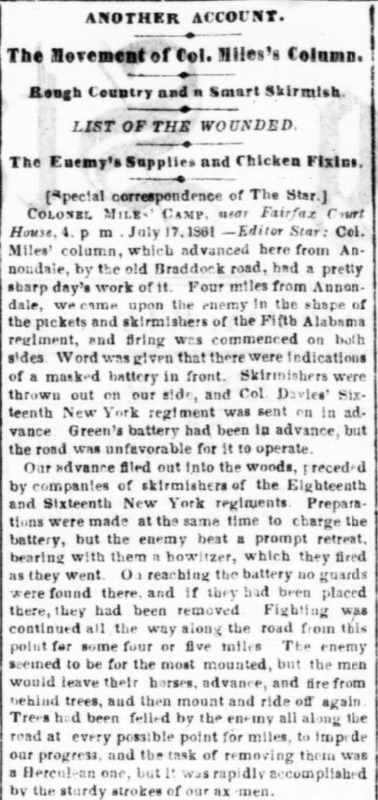
Evening Star Account of Skirmish (1861)
Article from The Evening Star detailing skirmish near Farr's Crossroads on July 17, 1861.
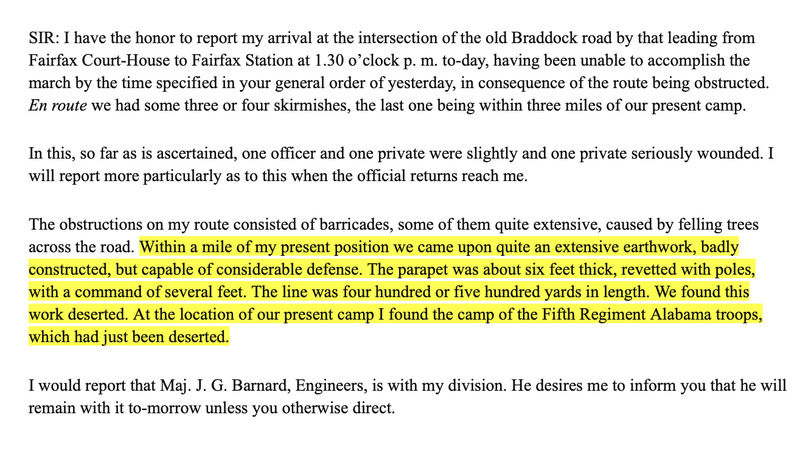
Colonel Dixon S. Miles Report (1861)
In a report from Union Colonel Dixon S. Miles, he describes an extensive earthwork fortification within a mile from his position at the former 5th Alabama encampment. It is possible that the earthen fortification that he mentions is Farr’s Redoubt. However, it could also be one of the other fortifications built nearby.
While available records suggest that the engagement on July 17, 1861 was likely the only skirmish in Fairfax to take place directly near Farr's Crossroads, Fairfax saw plenty of military activity for the remainder of the Civil War. For the latter half of the war, various Union units used Farr's Redoubt as an outpost guarding enemy advances to Washington and to monitor enemy movement towards Fairfax Courthouse or Fairfax Station. It is quite possible that Union troops stationed at the redoubt frequently scanned the surrounding area for Confederate guerrilla units such as Mosby’s Rangers, who frequently conducted raids around both Fairfax Courthouse and Fairfax Station.
22. Christopher Sperling, Significance Statement – Site 44FX0185 (Fairfax, VA: Fairfax County Park Authority, 2018), PDF.
23. George Mason University, Farr’s Fort Interim Preservation and Interpretation Plan (Revised) (Fairfax, VA: George Mason University, 2020), PDF.
24. George Mason University, Farr’s Fort Interim Preservation and Interpretation Plan (Revised) (Fairfax, VA: George Mason University, 2020), PDF.
25. "Skirmish at Farr’s Crossroads," Spirit of ’61: An Encyclopedia of Early Civil War Virginia, March 17, 2025, https://spirit61.info/battles/potomac-front/skirmish-at-farrs-crossroads/.
26. "The Movement of Col. Miles's Column," The Evening Star (Washington, DC), July 18, 1861, https://www.loc.gov/resource/sn83045462/1861-07-18/ed-1/?sp=2&st=image&r=-0.123,-0.031,1.141,0.579,0.
27. U.S. War Department, "Report of Col. Dixon S. Miles, Second U.S. Infantry, July 17, 1861," in The War of the Rebellion: A Compilation of the Official Records of the Union and Confederate Armies, ser. 1, vol. 2 (Washington, DC: Government Printing Office, 1880), 422–23, Internet Archive, https://archive.org/details/warofrebellion02secrrich/page/422/mode/2up.
28. "Skirmish at Farr’s Crossroads," Spirit of ’61: An Encyclopedia of Early Civil War Virginia, March 17, 2025, https://spirit61.info/battles/potomac-front/skirmish-at-farrs-crossroads/.
29. U.S. War Department, "Report of Col. Dixon S. Miles, Second U.S. Infantry, July 17, 1861," in The War of the Rebellion: A Compilation of the Official Records of the Union and Confederate Armies, ser. 1, vol. 2 (Washington, DC: Government Printing Office, 1880), 422–23, Internet Archive, https://archive.org/details/warofrebellion02secrrich/page/422/mode/2up.
30. "Skirmish at Farr’s Crossroads," Spirit of ’61: An Encyclopedia of Early Civil War Virginia, March 17, 2025, https://spirit61.info/battles/potomac-front/skirmish-at-farrs-crossroads/.
Lucas Gimm